Lusopress
Italy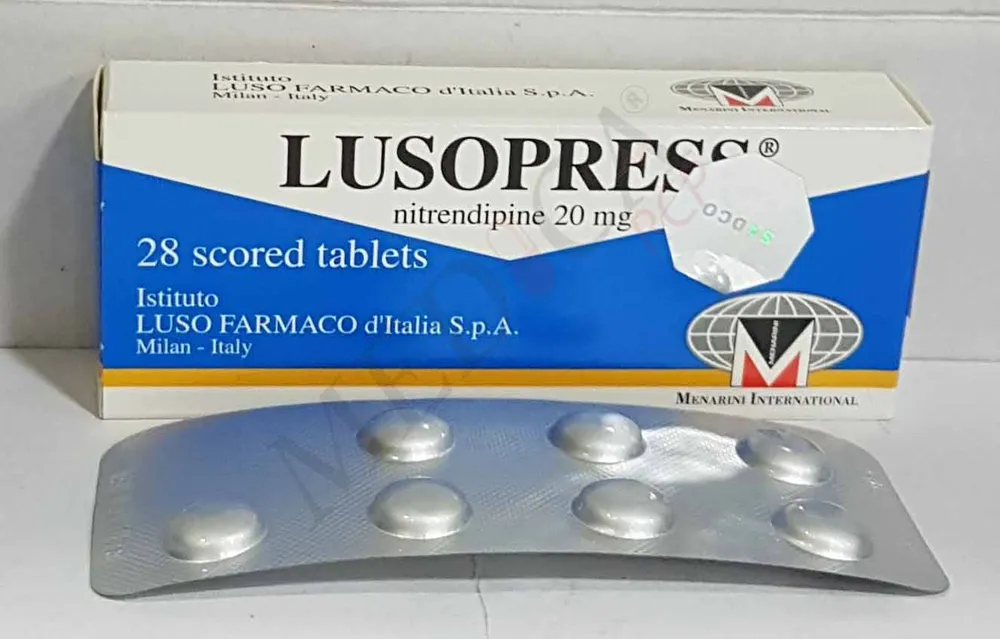
LUSOPRESS ®
Nitrendipine
C08CA08
COMPOSITION
Each tablet contains:
Active substance: nitrendipine 20 mg.
Excipients: maize starch, microcrystalline cellulose, polyvinylpyrrolidone, sodium lauryl sulfate, magnesium stearate.
PHARMACEUTICAL FORM AND PRESENTATION
28 divisible tablets for oral use in a lithographed cardboard box.
THERAPEUTIC PHARMACOLOGICAL CATEGORY
Selective calcium antagonist with predominant vascular effect.
NAME AND ADDRESS OF THE MARKETING AUTHORISATION HOLDER AND MANUFACTURER
LUSOFARMACO
Istituto Luso Farmaco d'Italia S.p.A.
Milanofiori – Strada 6 – Edificio L – Rozzano (MI)
Manufactured and controlled by:
Berlin Chemie - Glenicker Weg, 125 - Berlin (Germany)
THERAPEUTIC INDICATIONS
Arterial hypertension.
CONTRAINDICATIONS
Lusopress is contraindicated:
- in patients with known hypersensitivity to nitrendipine or to any of the excipients (see sections “Special precautions for use” and “Composition”)
- in patients with unstable angina pectoris and within the first 4 weeks after acute myocardial infarction
- during pregnancy and lactation (see section “Special warnings”).
Based on experience with the structurally similar calcium antagonist nifedipine, rifampicin is expected to accelerate the metabolism of nitrendipine due to enzyme induction, and effective plasma levels of nitrendipine may not be achieved. Therefore, concomitant use of rifampicin is contraindicated (see section “Interactions with other medicinal products and other types of interactions”).
SPECIAL PRECAUTIONS FOR USE
The drug should be used with caution and under medical supervision in patients with hepatic or renal impairment and glaucoma.
Occasionally, an increase in alkaline phosphatase has been observed. Therefore, periodic monitoring of liver function is advisable, with treatment interruption if necessary.
In case of hypersensitivity reactions such as skin rash and generalized pruritus, discontinuation of the drug is recommended.
Uncompensated heart failure
Patients with uncompensated heart failure should be treated with caution.
Hepatic disorders
In patients with severe hepatic dysfunction, the effects of nitrendipine may be enhanced and prolonged. In such cases, patients should be closely monitored with frequent blood pressure checks during therapy (see section “Dosage and method and timing of administration”).
Angina pectoris
As with other vasoactive substances, angina pectoris may very rarely occur with immediate-release nitrendipine (data from spontaneous reports), particularly at the beginning of treatment. Clinical study data confirm that the onset of angina attacks is not common (see section “Undesirable effects”).
Cytochrome CYP 3A4 system
Nitrendipine is metabolized via the cytochrome CYP 3A4 system. Therefore, drugs known to inhibit or induce this enzymatic system may alter the first-pass effect or clearance of nitrendipine (see section “Interactions with other medicinal products and other types of interactions”).
Drugs that are inhibitors of the CYP 3A4 system and may lead to increased plasma concentrations of nitrendipine include:
macrolide antibiotics (e.g., erythromycin),
anti-HIV protease inhibitors (e.g., ritonavir),
azole antifungals (e.g., ketoconazole),
the antidepressants nefazodone and fluoxetine,
quinupristin/dalfopristin,
valproic acid,
cimetidine and ranitidine.
When these drugs are co-administered, blood pressure should be monitored and, if necessary, a reduction in the dose of nitrendipine should be considered (see section “Interactions with other medicinal products and other types of interactions”).
Drug reactions, which may vary in intensity from individual to individual, could impair the ability to drive or operate machinery. This is particularly relevant at the beginning of treatment, during dose adjustments, and when combined with alcohol.
INTERACTIONS WITH OTHER MEDICINAL PRODUCTS AND OTHER TYPES OF INTERACTIONS
Drugs affecting nitrendipine
Nitrendipine is metabolized via the CYP 3A4 system, present in both the intestinal mucosa and the liver. Therefore, drugs known to inhibit or induce this enzymatic system may alter the first-pass effect or clearance of nitrendipine.
The extent and duration of interaction should be considered when nitrendipine is administered concomitantly with the following drugs:
Rifampicin
Based on experience with nifedipine, a structurally similar calcium antagonist, rifampicin is expected to accelerate the metabolism of nitrendipine through an enzyme induction mechanism. Therefore, the efficacy of nitrendipine may be reduced when administered concomitantly with rifampicin. The use of nitrendipine in combination with rifampicin is therefore contraindicated (see section “Contraindications”).
When co-administering the following CYP 3A4 inhibitors, blood pressure should be monitored and, if necessary, a reduction in the dose of nitrendipine should be considered (see section “Dosage”).
Macrolide antibiotics (e.g., erythromycin)
No formal interaction studies have been conducted between nitrendipine and macrolide antibiotics. Drugs in this class are known to inhibit the CYP 3A4-mediated metabolism of other drugs. Therefore, a potential increase in plasma concentrations of nitrendipine cannot be excluded when co-administered with these macrolide antibiotics (see section “Special precautions for use”).
Azithromycin, although structurally related to macrolide antibiotics, does not inhibit CYP 3A4.
Anti-HIV protease inhibitors (e.g., ritonavir)
No formal studies have been conducted to evaluate the potential interaction between nitrendipine and certain anti-HIV protease inhibitors. Drugs in this class have been reported to be potent inhibitors of the CYP 3A4 system. Therefore, a potential increase in plasma concentrations of nitrendipine cannot be excluded when co-administered with these protease inhibitors (see section “Special precautions for use”).
Azole antifungals (e.g., ketoconazole)
No formal study has been conducted to evaluate the potential pharmacological interaction between nitrendipine and certain azole antifungals. Drugs in this class are known to inhibit the CYP 3A4 system, and various interactions have been reported with other dihydropyridine calcium antagonists. Therefore, when administered orally in combination with nitrendipine, a substantial increase in systemic bioavailability of nitrendipine due to reduced first-pass metabolism cannot be excluded (see section “Special precautions for use”).
Nefazodone
No formal studies have been conducted to evaluate the potential interaction between nitrendipine and nefazodone. This antidepressant has been reported to be a potent inhibitor of the CYP 3A4 system. Therefore, a potential increase in plasma concentrations of nitrendipine cannot be excluded when co-administered with nefazodone (see section “Special precautions for use”).
Fluoxetine
Based on experience with nimodipine, a structurally similar dihydropyridine calcium antagonist, concomitant administration with the antidepressant fluoxetine resulted in an approximately 50% increase in plasma concentrations of nimodipine.
Exposure to fluoxetine was significantly reduced, while no effects were observed on the active metabolite norfluoxetine. Therefore, following concomitant administration of fluoxetine, a clinically relevant potential increase in plasma concentrations of nitrendipine cannot be excluded (see section “Special precautions for use”).
Quinupristin/Dalfopristin
Based on experience with nifedipine, a structurally similar calcium antagonist, co-administration of quinupristin/dalfopristin may lead to increased plasma concentrations of nitrendipine (see section “Special precautions for use”).
Valproic acid
No formal studies have been conducted to evaluate the potential interaction between nitrendipine and valproic acid. Since valproic acid has been shown to increase plasma concentrations of nimodipine, a structurally similar calcium channel blocker, due to enzyme inhibition, an increase in plasma concentrations of nitrendipine and thus an increase in efficacy cannot be excluded (see section “Special precautions for use”).
Cimetidine, Ranitidine
Cimetidine and, to a lesser extent, ranitidine may lead to increased plasma levels of nitrendipine, thereby enhancing its effect (see section “Special precautions for use”).
Additional studies
Enzyme-inducing antiepileptic drugs such as phenytoin, phenobarbital, carbamazepine
No formal study has been conducted to evaluate the potential pharmacological interaction between nitrendipine and these anticonvulsants. However, phenytoin, phenobarbital, and carbamazepine are known to be potential inducers of the CYP 3A4 system. Concomitant administration of these anticonvulsants may lead to a clinically relevant reduction in the bioavailability of nitrendipine, and consequently a decrease in its efficacy can be expected. If the dose of nitrendipine is increased during co-administration with phenytoin, phenobarbital, or carbamazepine, a reduction in the dose of nitrendipine should be considered when anticonvulsant treatment is discontinued.
Effects of nitrendipine on other drugs
Antihypertensive drugs
Nitrendipine may enhance the hypotensive effect of other antihypertensive drugs administered concomitantly, such as:
diuretics,
beta-blockers,
ACE inhibitors,
angiotensin 1 receptor antagonists (AT1),
other calcium antagonists,
alpha-adrenergic blocking agents,
PDE5 inhibitors,
alpha-methyldopa.
Digoxin
When nitrendipine and digoxin are administered concurrently, an increase in plasma levels of digoxin should be anticipated. Therefore, patients should be monitored for possible signs of digoxin overdose, and plasma digoxin levels should be measured if necessary, with possible dose reduction of the glycoside.
Neuromuscular blocking agents
The duration and intensity of action of neuromuscular relaxants, such as pancuronium, may be increased during therapy with nitrendipine.
Drug-food interactions
Grapefruit juice
Grapefruit juice inhibits the CYP 3A4 system. Administration of dihydropyridine calcium antagonists concomitantly with grapefruit juice therefore leads to increased plasma concentrations due to decreased first-pass metabolism or reduced clearance.
Consequently, the hypotensive effect may be enhanced. Based on experience with nisoldipine, a structurally similar calcium antagonist, this effect may last for at least 3 days after the last intake of grapefruit juice.
Therefore, consumption of grapefruit/grapefruit juice should be avoided during treatment with nitrendipine.
SPECIAL WARNINGS
Tablets removed from the blister must be protected from light.
The medicine is not contraindicated for patients with celiac disease.
Pregnancy
Data on the use of nitrendipine in pregnant women are limited or lacking.
Animal studies have shown reproductive toxicity. Animal studies using clearly maternally toxic doses of nitrendipine have revealed evidence of malformations.
Nitrendipine is contraindicated during pregnancy (see section “Contraindications”).
Lactation
Nitrendipine is excreted in human milk.
The effect of nitrendipine on neonates/infants is unknown.
Nitrendipine is contraindicated during breastfeeding (see section “Contraindications”).
Fertility
In individual cases of in vitro fertilization, calcium antagonists have been associated with reversible biochemical changes in the spermatozoa apical segment, which may lead to altered sperm function.
For male patients who repeatedly fail conception through in vitro fertilization and where no other explanation can be found, calcium antagonists should be considered as possible causes.
If a pregnancy is planned and negative effects on fertility are anticipated, an alternative treatment may be considered.
DOSAGE, METHOD AND TIMING OF ADMINISTRATION
Treatment with nitrendipine should be individualized according to patient needs and the severity of hypertensive disease, and always under medical supervision.
Unless otherwise prescribed by a physician, the recommended dosage in adults is:
1 tablet once daily in the morning or ½ tablet twice daily, in the morning and evening (totaling 20 mg of nitrendipine per day).
If higher doses are required, the daily dose may be gradually increased up to 1 tablet twice daily, in the morning and evening (totaling 40 mg of nitrendipine per day).
If dose reduction is necessary, ½ tablet (10 mg of nitrendipine) should be administered in the morning.
In patients with chronic liver disease or renal insufficiency, metabolism and excretion of the drug are delayed, respectively; therefore, individual dose adjustment is essential, depending on the severity of the concomitant conditions. In the above-mentioned cases, treatment should be initiated with ¼ tablet (5 mg) in the morning.
Additional information for special populations
The safety and efficacy of nitrendipine have not been established in children under 18 years of age.
In patients with severe hepatic dysfunction, treatment should be initiated with the lowest available dose tablet (10 mg of nitrendipine = ½ tablet), and the patient should be closely monitored during therapy.
OVERDOSE
Symptoms
In cases of acute overdose/intoxication, increased manifestations of flushing, headache, drop in blood pressure (accompanied by circulatory collapse), and altered heart rate (tachycardia or bradycardia) should be expected.
Treatment of overdose in humans
The initial therapeutic measure to consider is gastric lavage followed by administration of activated charcoal. Vital functions must be monitored. In case of severe hypotension, dopamine or noradrenaline is recommended. Possible side effects of catecholamines (particularly cardiac rhythm disturbances) should be carefully considered.
If bradycardia occurs, as in overdose or intoxication with other calcium antagonists, administration of atropine or orciprenaline is indicated.
Based on experience with intoxication from other calcium antagonists, repeated administration of 10 ml volumes of calcium gluconate or 10% calcium chloride, followed by slow infusion (taking care to avoid hypercalcemia), usually leads to rapid symptom improvement.
Occasionally, catecholamines have proven effective in such cases only at high doses. Subsequent treatment should be based on the most prominent symptoms.
UNDESIRABLE EFFECTS
Summary of safety profile
Safety data from clinical studies, post-marketing surveillance, or any other source are analyzed and reported in the ADR section of nitrendipine. The frequencies of adverse events are calculated from clinical study analyses or estimated from post-marketing surveillance.
The most common ADRs (common frequency: ≥1/100, <1/10) are headache, palpitations, vasodilation, edema, flatulence, malaise, and anxiety reactions. Based on overall experience, none of these ADRs is considered severe. Except for "malaise" and "anxiety reactions," the ADRs can be attributed to the mechanism of action of nitrendipine.
The most serious ADRs are hypotension, angina pectoris (chest pain), and allergic reaction including angioedema (all of uncommon frequency: ≥1/1,000, <1/100). These ADRs, based on their course, may require immediate medical intervention.
The ADRs listed as "common" were observed at a frequency below 3%, except for edema (6.2%), headache (4.7%), and vasodilation (3.0%).
The frequency of adverse drug reactions (ADRs) is based on placebo-controlled clinical studies with nitrendipine, categorized according to CIOMS III frequency categories (experimental clinical study database: nitrendipine n = 824; placebo n = 563).
"Gingival hyperplasia" has been reported based on spontaneous case reports. Consequently, a frequency of <1/400 has been estimated using the 3/X rule.
The frequency of ADRs reported with nitrendipine is summarized in the table below.
Within each frequency group, adverse effects are listed in descending order of severity. Frequencies are defined as follows:
Very common (≥1/10),
Common (≥1/100, <1/10),
Uncommon (≥1/1,000, <1/100),
Rare (≥1/10,000, <1/1,000),
Very rare (<1/10,000)
Table 01:
| System Organ Class (MedDRA) | Common | Uncommon |
| Immune System Disorders | Allergic reactions, including skin reactions and allergic edema/angioedema | |
| Psychiatric Disorders | Anxiety reactions | Sleep disorders |
| Nervous System Disorders | Headache | Dizziness Migraine Vertigo Somnolence Hypoaesthesia |
| Eye Disorders | Visual disturbances | |
| Ear and Labyrinth Disorders | Tinnitus | |
| Cardiac Disorders | Palpitations | Angina pectoris Chest pain Tachycardia |
| Vascular Disorders | Edema Vasodilatation | Hypotension |
| Respiratory, Thoracic and Mediastinal Disorders | Dyspnea Epistaxis | |
| Gastrointestinal Disorders | Flatulence | Abdominal and gastrointestinal pain Diarrhea Nausea Vomiting Dry mouth Dyspepsia Constipation Gastroenteritis Gingival hyperplasia |
| Hepatobiliary Disorders | Transient increase in liver enzymes | |
| Systemic Disorders | Myalgia | |
| Musculoskeletal and Connective Tissue Disorders | ||
| Renal and Urinary Disorders | Polyuria | |
| General Disorders and Administration Site Conditions | Malaise | Non-specific pain |
Keep the medicine out of the reach of children.
For the expiry date, refer to the one printed on the packaging.
Caution: do not use the medicine after the expiry date stated on the packaging.