Laxido
Italy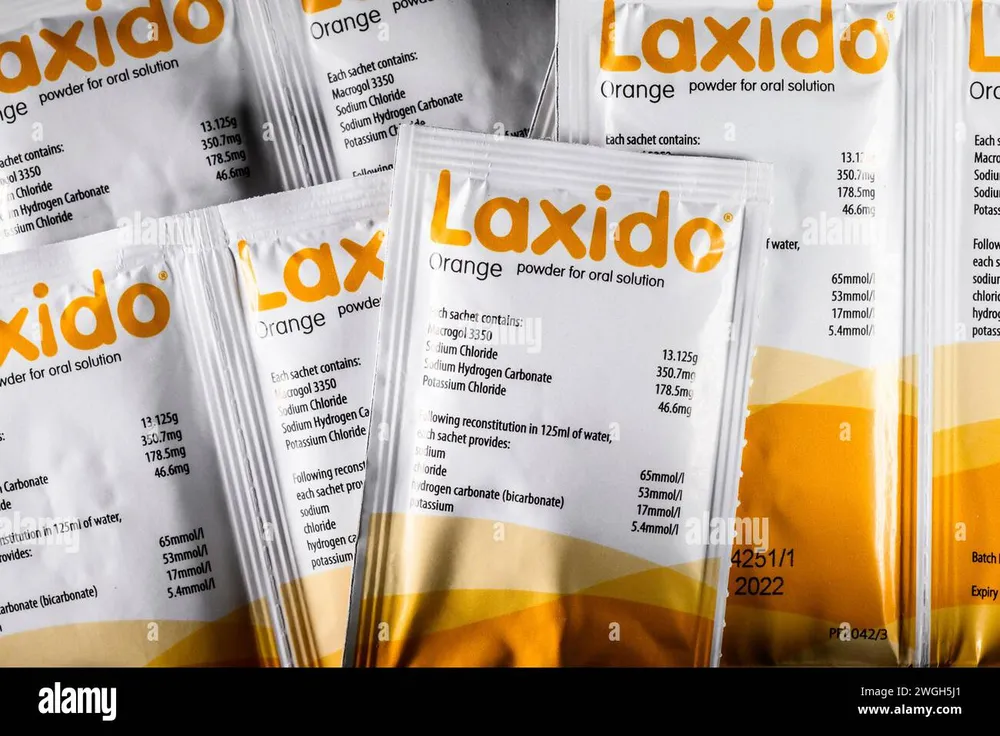
Table of Contents
Package leaflet: Information for the patient
Laxido
Powder for oral solution
Generic medicine
Please read this leaflet carefully before taking this medicine because it contains important information for you.
- Keep this leaflet. You may need to read it again.
- If you have any questions, ask your doctor, pharmacist, or nurse.
- This medicine has been prescribed for you only. Do not give it to others, even if they have the same symptoms as you, because it could be harmful.
- If you experience any side effects, including those not listed in this leaflet, talk to your doctor, pharmacist, or nurse. See section 4.
Contents of this leaflet:
- What Laxido is and what it is used for
- What you need to know before taking Laxido
- How to take Laxido
- Possible side effects
- How to store Laxido
- Contents of the pack and other information
1. What Laxido is and what it is used for
Laxido contains macrogol 3350 and the electrolytes sodium chloride, sodium hydrogen carbonate, and potassium chloride.
Macrogol 3350 is a laxative used in the treatment of constipation, especially if you have been constipated for a long time. It is also used to treat the accumulation of hard stools in the intestine, which may result from long-term constipation (this condition is known as fecal impaction). Macrogol 3350 softens the stools and facilitates their passage, providing relief from constipation. The electrolytes help maintain normal levels of sodium, potassium, and water in the body during treatment for constipation.
2. What you need to know before taking Laxido
Do not take Laxido:
- if you are allergic (hypersensitive) to macrogol 3350, sodium chloride, sodium bicarbonate, potassium chloride, or to any of the other ingredients of this medicine (listed in section 6)
- if you have intestinal wall perforation
- if you have intestinal obstruction
- if you have intestinal paralysis (for example, the intestine may stop functioning due to surgery or a severe intestinal infection)
- if you suffer from ulcerative colitis, Crohn’s disease, or toxic megacolon
If any of these conditions apply to you, consult your doctor, pharmacist, or nurse for further advice.
Warnings and precautions
Before taking Laxido for the treatment of fecal impaction, speak to your doctor, pharmacist, or nurse, because it is necessary to confirm that you actually have this condition before starting this medicine.
While taking Laxido, you must continue to drink plenty of fluids. The liquid content of Laxido should not replace your regular fluid intake.
Other medicines and Laxido
Some medicines, e.g. antiepileptic drugs, may not work as effectively if taken at the same time as Laxido. Inform your doctor or pharmacist if you are taking, have recently taken, or might take any other medicines. You should not take any other oral medicines one hour before or one hour after taking Laxido.
Laxido with food and drinks
Food and drinks do not affect the action of Laxido.
Pregnancy and breastfeeding
Laxido may be taken during pregnancy and breastfeeding. If you are pregnant, think you might be pregnant, planning to become pregnant, or are breastfeeding, ask your doctor or pharmacist for advice before taking this medicine.
Driving and using machines
Laxido does not affect your ability to drive or operate machinery.
Laxido contains potassium and sodium
Laxido contains 0.68 mmol (26 mg) of potassium per sachet. This should be taken into account if you take more than one sachet per day and you have reduced kidney function, or if you are on a potassium-controlled diet.
This medicine contains 187 mg of sodium (the main component of table salt) per sachet. This is equivalent to about 9% of the maximum daily sodium intake recommended in an adult diet.
Talk to your doctor or pharmacist if you need to take three or more sachets per day for a prolonged period, especially if you have been advised to follow a low-salt (sodium) diet.
3. How to take Laxido
Take this medicine exactly as described in this leaflet or as directed by your doctor, pharmacist, or nurse. If you have any doubts, consult your doctor, pharmacist, or nurse. Laxido is taken orally.
Laxido is a laxative used for the treatment of constipation and faecal impaction in adults, children (from 12 years of age), and the elderly.
Constipation
The usual dose for constipation is one sachet taken one to three times a day.
Faecal impaction
The usual dose for faecal impaction is eight sachets per day. All eight sachets must be taken within a six-hour period. If you have heart problems, do not take more than two sachets (in 250 ml of water) in one hour.
How to prepare
Laxido should be prepared by dissolving the contents of one sachet in a glass of water (125 ml). Stir well until all the powder is dissolved. If you are being treated for faecal impaction, you may dissolve the contents of all eight sachets together in a large container (in one litre of water).
Duration of treatment
Constipation
The treatment period for constipation usually does not last longer than 2 weeks.
The duration of treatment may exceed two weeks if you suffer from resistant constipation, or from a disease causing constipation (such as Parkinson's disease or multiple sclerosis), or if you are regularly taking other medicines that may cause constipation. In these cases, your doctor may reduce the dose to one sachet once or twice daily.
Faecal impaction
Normally, the treatment cycle for faecal impaction does not exceed 3 days.
If you take more Laxido than you should
Severe abdominal pain and bloating, vomiting, or diarrhoea may occur, possibly leading to dehydration. In such cases, stop taking Laxido and drink plenty of fluids. If you are concerned, contact your doctor or pharmacist.
If you forget to take Laxido
If you forget to take a dose, take it as soon as you remember and then continue as before. Do not take a double dose to make up for the missed dose.
If you stop taking Laxido
To get the maximum benefit from Laxido, always complete the full course of treatment recommended by your doctor or pharmacist. This will ensure resolution of constipation; otherwise, your symptoms may persist.
If your symptoms worsen or do not improve after 14 days in the case of chronic constipation, or after 3 days in the case of faecal impaction, you must contact your doctor.
If you have any questions about using this medicine, ask your doctor, pharmacist, or nurse.
4. Possible side effects
Like all medicines, this medicine can cause side effects, although not everybody gets them.
If you experience any of the following side effects, stop taking Laxido and contact your doctor immediately:
- signs of a serious allergic reaction, such as difficulty breathing, swelling of the face, lips, tongue or throat
- signs of an allergic reaction, such as rash, skin redness, hives, itching or shortness of breath
- signs of changes in fluid or electrolyte levels in the body, such as swelling (mainly in the ankles), feeling tired, dehydration or increased thirst with headache. These symptoms could indicate that the levels of potassium in your blood are lower or higher than normal.
The following side effects are also possible:
- abdominal pain
- bloating
- flatulence
- indigestion
- anal pain
- mild diarrhoea
- nausea
- vomiting
- abdominal distension
- stomach rumbling.
Reporting of side effects
If you experience any side effect, including those not listed in this leaflet, please inform your doctor, pharmacist or nurse. You can also report side effects directly via the national reporting system at the following website:
www.agenziafarmaco.gov.it/content/come-segnalare-una-sospetta-reazione-avversa.
By reporting side effects, you can help provide more information on the safety of this medicine.
5. How to store Laxido
Keep this medicine out of the sight and reach of children.
Do not use this medicine after the expiry date stated on the carton and sachet.
The expiry date refers to the last day of that month.
Store unopened sachets at a temperature not exceeding 25°C.
Do not use this medicine if you notice any damage to the sachets.
The reconstituted Laxido solution may be covered and stored in the refrigerator (2°C - 8°C) and must be used within six hours. After six hours, any unused solution must be discarded.
Do not dispose of medicines via wastewater or household waste. Ask your pharmacist how to dispose of medicines no longer in use. This will help protect the environment.
6. Package contents and other information
What Laxido contains
The active substances are macrogol 3350 (13.125 g), sodium chloride (350.7 mg), sodium hydrogen carbonate
(178.5 mg) and potassium chloride (46.6 mg). The other components are acesulfame potassium (E950) and
orange flavour (containing maltodextrin and propylene glycol (E1520)).
Description of the appearance of Laxido and package contents
Laxido is a white powder contained in sachets. It has an orange flavour and aroma.
Each sachet contains 13.8 g of powder and is packaged in boxes containing 2, 8, 10, 20, 30, 50 and
100 sachets. Not all pack sizes may be marketed.
Marketing Authorization Holder
Seller
Istituto Biochimico Italiano G. Lorenzini S.p.A.
Via Fossignano, 2, 04011 Aprilia (LT) - Italy
Responsible manufacturer for batch release
Almac Pharma Services Limited
Almac House
20 Seagoe Industrial Estate
Craigavon
BT63 5QD
United Kingdom
This medicinal product is authorized in the European Economic Area Member States under the
following names:
Denmark, Belgium, Germany, Spain, Ireland, Iceland, Luxembourg and United Kingdom - Laxido
Orange
Finland - Laxido Appelsiini
Portugal - Laxido Laranja
Sweden - Laxido Apelsin
Italy - Laxido
Laxido is a trade mark