Influvac S TETRA
Italy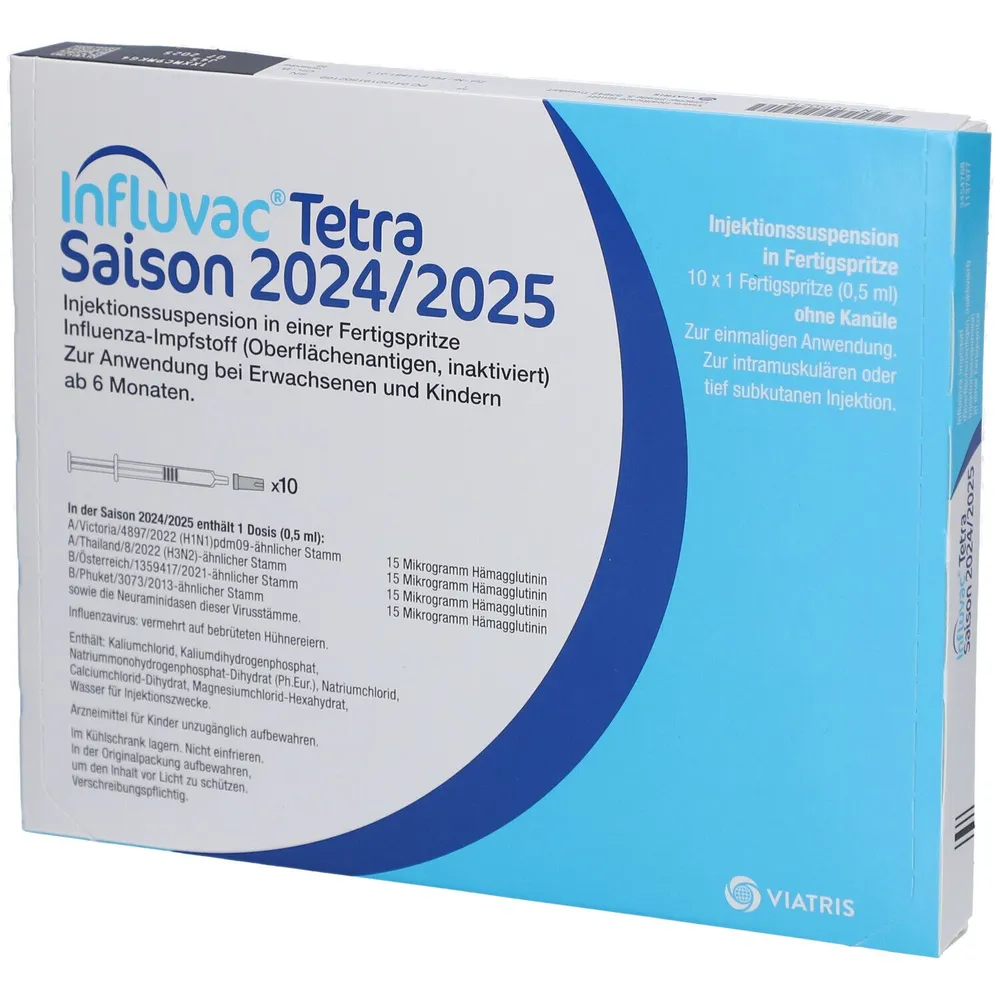
Table of Contents
Patient Information Leaflet: Information for the User
Influvac S Tetra, injectable suspension in pre-filled syringes
Influenza vaccine (surface antigen, inactivated)
Season 2025/2026
Please read this leaflet carefully before you or your child are vaccinated, as it contains important information for you or your child.
- Keep this leaflet. You may need to read it again.
- If you have any questions, ask your doctor, pharmacist, or nurse.
- This vaccine has been prescribed only for you or your child. Do not give it to others.
- If you or your child experience any adverse reactions, including those not listed in this leaflet, contact your doctor, pharmacist, or nurse. See section 4.
Contents of this leaflet:
1 What Influvac S Tetra is and what it is used for
2 What you need to know before using Influvac S Tetra
3 How to use Influvac S Tetra
4 Possible side effects
5 How to store Influvac S Tetra
6 Contents of the pack and other information
1. What Influvac S Tetra is and what it is used for
Influvac S Tetra is a vaccine. This vaccine helps protect you or your child against influenza, particularly individuals who are at higher risk of associated complications. Influvac S Tetra is indicated for adults and children from 6 months of age. The use of Influvac S Tetra should be based on official recommendations.
When Influvac S Tetra is administered, the immune system (the body's natural defence system) produces its own defences (antibodies) against the disease. None of the components of the vaccine can cause influenza.
Influenza is an illness that can spread rapidly and is caused by different strains of virus which may change each year. For this reason, you or your child may need to be vaccinated every year. The highest risk of contracting influenza occurs during the colder months, from October to March. If you or your child have not been vaccinated in the autumn, you can still be vaccinated up to springtime, as you remain at risk of contracting influenza until then. Your doctor will advise you on the best time for vaccination.
Influvac S Tetra will protect you or your child against the four virus strains contained in the vaccine starting from 2–3 weeks after vaccination.
The incubation period of influenza is a few days; therefore, if you or your child were exposed to influenza immediately before or immediately after vaccination, you or your child may still develop the disease.
The vaccine will not protect you or your child against the common cold, although some symptoms may be similar to those of influenza.
1/7
2. What you should know before you or your child use Influvac S Tetra
To ensure that Influvac S Tetra is suitable for you or your child, it is important that you inform your doctor,
pharmacist, or nurse if you or your child are in any of the following conditions. If anything is unclear, please
ask your doctor, pharmacist, or nurse for clarification.
Do not use Influvac S Tetra
- if you or your child are allergic (hypersensitive):
- to the active substances, or
- to any of the other ingredients of Influvac S Tetra (listed in section 6), or
- to any component that may be present in trace amounts such as eggs (ovalbumin or chicken proteins), formaldehyde, cetyltrimethylammonium bromide, polysorbate 80, or gentamicin (an antibiotic used to treat bacterial infections)
- if you or your child have a disease with high fever or an acute infection, vaccination should be postponed until recovery.
Warnings and precautions
Before vaccination, inform your doctor if you or your child:
- have a weakened immune response (immunodeficiency or taking medicines that affect the immune system)
- have bleeding disorders or bruise easily
Your doctor will assess whether you or your child should receive the vaccine. Fainting, feeling faint, or other stress-related reactions may occur during or even after any needle injection. Therefore, inform your doctor or nurse if you or your child have experienced such reactions following a previous injection. If, for any reason, you or your child need to have a blood test a few days after the influenza vaccination, inform your doctor, as false positive blood test results have been observed in some patients shortly after vaccination. Like all vaccines, Influvac S Tetra may not fully protect all individuals who are vaccinated. Other medicines and Influvac S Tetra
- Inform your doctor, pharmacist, or nurse if you or your child are taking or have recently taken, or might take any other vaccines or medicines, including those not requiring a prescription.
- Influvac S Tetra can be administered at the same time as other vaccines in different limbs. In such cases, it should be noted that side effects may be stronger.
- The immune response may be reduced during immunosuppressive treatment, such as with corticosteroids, cytotoxic drugs, or radiotherapy. Pregnancy and breastfeeding If you are pregnant or breastfeeding, think you may be pregnant, or are planning to have a baby, consult your doctor before using this medicine.
Influenza vaccines can be used at any stage of pregnancy. More safety data are available for the second and third trimesters than for the first trimester; however, worldwide use of influenza vaccines has not indicated that the vaccine causes harmful effects on pregnancy or the child.
Influvac S Tetra can be used during breastfeeding.
Your doctor, pharmacist, or nurse will evaluate whether you should receive Influvac S Tetra. Ask your
doctor, pharmacist, or nurse for advice before taking any medicine.
2/7
Driving and using machines
Influvac S Tetra does not affect or has a negligible effect on the ability to drive vehicles and use machinery.
Influvac S Tetra contains sodium and potassium
This medicine contains less than 1 mmol (23 mg) of sodium per dose, i.e. essentially 'sodium-free'.
This medicine contains potassium, less than 1 mmol (39 mg) per dose, i.e. essentially 'potassium-free'.
3. How to use Influvac S Tetra
Dosage
Adults should be given a dose of 0.5 ml.
Use in children and adolescents
Children from 6 months to 17 years of age should be given a dose of 0.5 ml.
A second dose should be administered to children under 9 years of age who have not previously been vaccinated against influenza, with an interval of at least 4 weeks between doses.
For infants and children in early infancy under 6 months of age, the safety and efficacy of Influvac S Tetra have not yet been established.
Route(s) and/or method of administration
Your doctor or nurse will administer the recommended dose of the vaccine by injection into the muscle or deep subcutaneous tissue.
If you have any doubts about the use of this product, consult your doctor, pharmacist, or nurse.
4. Possible side effects
Like all medicines, Influvac S Tetra can cause side effects, although not everyone will experience them.
Contact your doctor immediately if you or your child experience any of the following side effects – you or your child may require urgent medical treatment.
Severe allergic reactions (frequency not known, occurred occasionally during general use of the trivalent influenza vaccine Influvac S)
- which may lead to a medical emergency with low blood pressure, rapid and shallow breathing, fast heartbeat and weak pulse, cold and clammy skin, dizziness, possibly leading to collapse (shock)
- swelling, particularly in the head and neck, including face, lips, tongue, throat, or any other part of the body, which may cause difficulty in swallowing or breathing (angioedema).
The following side effects were observed in a clinical study with Influvac S Tetra:
Adults and elderly
Very common: may affect more than 1 in 10 people:
- headache
- fatigue
- local reaction: pain at injection site
Common: may affect up to 1 in 10 people:
- sweating
- muscle pain (myalgia), joint pain (arthralgia)
- general malaise, chills
- local reactions: redness, swelling, bruising (ecchymosis), hardening of the skin at the injection site.
Uncommon: may affect up to 1 in 100 people:
- fever
Children (from 6 months to 17 years of age)
Side effects that may occur in children aged 6 to 35 months:
Very common: may affect more than 1 in 10 people:
- drowsiness
- sweating
- loss of appetite
- diarrhoea, vomiting
- irritability/agitation
- fever
- local reactions: pain, redness
Common: may affect up to 1 in 10 people:
- local reactions: swelling, hardening, bruising (ecchymosis)
Side effects that may occur in children aged 3 to 5 years:
Very common: may affect more than 1 in 10 people:
- drowsiness
- loss of appetite
- irritability/agitation
- local reactions: pain at injection site, redness, swelling, hardening of the skin at the injection site
Common: may affect up to 1 in 10 people:
- sweating
- diarrhoea, vomiting
- fever
- local reactions: bruising (ecchymosis)
Side effects that may occur in children aged 6 to 17 years:
Very common: may affect more than 1 in 10 people:
- headache
- nausea, abdominal pain, diarrhoea, vomiting
- muscle pain (myalgia)
- fatigue, general malaise
- local reactions: pain at injection site, redness, swelling, hardening of the skin at the injection site
Common: may affect up to 1 in 10 people:
- sweating
- joint pain (arthralgia)
- fever
- chills
- local reactions: bruising (ecchymosis)
All age groups
For all age groups, most of the above reactions usually occurred within the first 3 days after vaccination and resolved spontaneously within 1–3 days of onset. The intensity of these reactions was generally mild.
In addition to the side effects listed above, the following side effects have occurred occasionally during general use of the trivalent influenza vaccine Influvac S:
Frequency not known:
- skin reactions that may spread over the entire body, such as itching (urticaria) or skin rash (rash)
- inflammation of blood vessels which may cause skin redness (vasculitis), and in very rare cases temporary kidney problems
- nerve pain (neuralgia), abnormalities in the perception of touch, pain, heat, and cold (paraesthesia), seizures associated with fever, neurological disorders which may cause neck stiffness, confusion, numbness, pain and weakness in limbs, loss of balance, loss of reflexes, paralysis of part or all of the body (encephalomyelitis, neuritis, Guillain-Barré syndrome)
- temporary reduction in the number of a type of blood particle called platelets; low platelet count may cause bruising or excessive bleeding (transient thrombocytopenia); temporary swelling of the glands in the neck, armpit, or groin (transient lymphadenopathy)
Reporting of side effects
If you or your child experience any side effect, including those not listed in this leaflet, talk to your doctor, pharmacist, or nurse. You can also report side effects directly via the website https://www.aifa.gov.it/content/segnalazioni-reazioni-avverse. By reporting side effects, you can help provide more information on the safety of this medicine.
5. How to store Influvac S Tetra
Keep this medicine out of the sight and reach of children.
Do not use Influvac S Tetra after the expiry date stated on the carton after EXP. The expiry date refers to the last day of that month.
Store Influvac S Tetra in a refrigerator (2 °C – 8 °C). Do not freeze.
Keep in the original packaging to protect the medicine from light.
Do not dispose of medicines via wastewater or household waste. Ask your pharmacist how to dispose of medicines you no longer use. This will help protect the environment.
6. Package contents and other information
What Influvac S Tetra contains
The active substances are:
Surface antigens (haemagglutinin and neuraminidase) (inactivated) from the following influenza virus strains*:
- A/Victoria/4897/2022 (H1N1)pdm09-equivalent strain (A/Victoria/4897/2022, IVR-238) 15 micrograms HA **
- A/Croatia/10136RV/2023 (H3N2)-equivalent strain (A/Croatia/10136RV/2023, X-425A) 15 micrograms HA **
- B/Austria/1359417/2021-equivalent strain (B/Austria/1359417/2021, BVR-26) 15 micrograms HA **
- B/Phuket/3073/2013-equivalent strain (B/Phuket/3073/2013, wild type) 15 micrograms HA ** per 0.5 ml dose
* propagated in fertilized hens' eggs from flocks of healthy chickens
5/7
** haemagglutinin
This vaccine complies with the recommendations of the World Health Organization (WHO) (northern hemisphere) and the European Union recommendations for the 2025/2026 season.
The other components are: potassium chloride, potassium dihydrogen phosphate, disodium phosphate dihydrate, sodium chloride, calcium chloride dihydrate, magnesium chloride hexahydrate and water for injections.
Description of the appearance of Influvac S Tetra and contents of the pack
Influvac S Tetra is an injectable suspension supplied in pre-filled glass syringes (with / without needle) containing 0.5 ml of a clear, colourless injectable liquid. Each syringe is for single use only.
Pack sizes of 1 or 10 syringes.
Not all pack sizes may be marketed.
Marketing Authorisation Holder
Viatris Healthcare Limited
Damastown Industrial Park,
Mulhuddart,
Dublin 15,
DUBLIN,
Ireland
Manufacturer
Abbott Biologicals B.V.
Veerweg 12
NL - 8121 AA Olst
The Netherlands
This medicinal product is authorised in the Member States of the European Economic Area and in the United Kingdom
(Northern Ireland) with the following names:
| Austria | Influvac Tetra Injection Suspension in a Pre-filled Syringe |
| Belgium | Influvac Tetra, suspension for injection in a pre-filled syringe |
| Bulgaria | Infuvac Tetra Injectable Suspension in a Pre-filled Syringe |
| Croatia | Influvac Tetra Suspension for Injection in a Pre-filled Syringe, Influenza Vaccine (Surface Antigens), Inactivated |
| Czech Republic | Influvac Tetra, Injection Suspension in a Pre-filled Syringe |
| Cyprus, Greece | Influvac Sub-unit Tetra |
| Denmark, Iceland | Influvac Tetra |
| Estonia, Finland, Germany, Norway, Poland, Portugal, Slovakia | Influvac Tetra |
| France, Luxembourg | Influvac Tetra, Suspension for Injection in a Pre-filled Syringe |
| Hungary | Influvac Tetra Suspension for Injection in a Pre-filled Syringe |
| Ireland | Influvac Tetra, Suspension for Injection in Pre-filled Syringe |
| Italy | Influvac S Tetra Injectable Suspension in Pre-filled Syringes |
| Latvia | Influvac Tetra Suspension for Injection in a Pre-filled Syringe |
| Lithuania | Influvac Tetra Injectable Suspension in a Pre-filled Syringe |
6/7
| Malta, United Kingdom (Northern Ireland) | Influvac sub-unit Tetra, suspension for injection in pre-filled syringe |
| Netherlands | Influvac Tetra, suspension for injection in pre-filled syringe 0.5 ml |
| Romania | Influvac Tetra injectable suspension in pre-filled syringe |
| Slovenia | Influvac Tetra suspension for injection in pre-filled syringe |
| Spain | Influvac Tetra injectable suspension in pre-filled syringe |
| Sweden | Influvac Tetra injection liquid, suspension in pre-filled syringe |
The following information is intended for healthcare professionals only:
As with all injectable vaccines, appropriate medical treatment and supervision must always be readily available in case of an anaphylactic reaction following vaccine administration.
Allow the vaccine to reach room temperature before use. Shake well before use.
Visually inspect before administration.
Do not use the vaccine if foreign particulate matter is present in the suspension.
Do not mix other medicinal products in the same syringe.
The vaccine must not be injected directly into a blood vessel.
Preferred sites for intramuscular injection are the anterolateral thigh (or deltoid if muscle mass is adequate) in children from 6 to 35 months of age, or the deltoid muscle in children from 36 months of age and in adults.
Traceability
In order to enhance traceability of biological medicinal products, the name and batch number of the administered product should be clearly recorded.
See also section 3: How to use Influvac S Tetra
7/7