Inderal
Italy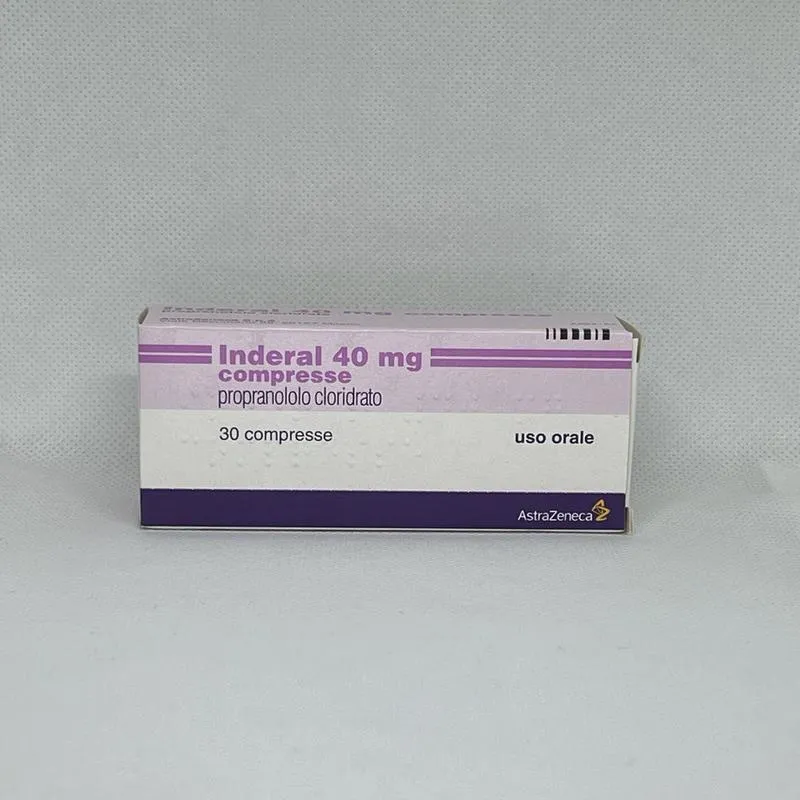
Table of Contents
Package leaflet: Information for the patient
INDERAL 40 mg tablets
propranolol hydrochloride
Read this leaflet carefully before taking this medicine because it contains
important information for you.
- Keep this leaflet. You may need to read it again.
- If you have any questions, ask your doctor or pharmacist.
- This medicine has been prescribed for you only. Do not give it to others, even if their symptoms are the same as yours, as it could be harmful.
- If you experience any side effects, including those not listed in this leaflet, inform your doctor or pharmacist. See section 4.
Contents of this leaflet:
- What Inderal is and what it is used for
- What you need to know before taking Inderal
- How to take Inderal
- Possible side effects
- How to store Inderal
- Contents of the pack and other information
1. What Inderal is and what it is used for
Inderal contains propranolol hydrochloride.
Inderal belongs to a class of medicines called beta-blockers.
-
Inderal is indicated in adults:
-
for the control of high blood pressure.
-
for the treatment of chest pain caused by reduced blood flow to the heart (angina pectoris).
-
to prevent further heart attacks (myocardial infarction).
-
to prevent severe and frequent headaches (migraine).
-
for the treatment of tremors.
-
to control anxiety and anxiety-induced rapid heartbeat (tachycardia).
-
to treat, in combination with other medicines, an excess of thyroid hormones in the blood (thyrotoxicosis) and symptoms related to this condition.
-
for the treatment of an inherited disease characterized by thickening of the heart walls (hypertrophic obstructive cardiomyopathy).
-
for the treatment of a tumor near the kidney (pheochromocytoma), in combination with a medicine for treating high blood pressure caused by the tumor.
-
Inderal is indicated in adults, children, and adolescents:
-
for controlling irregular heartbeat (cardiac arrhythmia).
Talk to your doctor if you do not feel better or if you feel worse.
2. What you should know before taking Inderal
Do not take Inderal
- if you are allergic to propranolol hydrochloride or to any of the other ingredients of this medicine (listed in section 6);
- if you have suffered from a lung disease that makes breathing difficult (bronchial asthma or bronchospasm, chronic obstructive pulmonary disease);
- if you have a slow heartbeat (bradycardia);
- if you have a heart condition causing reduced blood circulation so that tissues no longer receive sufficient oxygen (cardiogenic shock);
- if you have low blood pressure (hypotension);
- if you have increased acidity in the blood (metabolic acidosis);
- if you are undergoing prolonged fasting;
- if you have severe circulation problems in arms and legs;
- if you have a kidney disease (renal failure);
- if you have problems with the electrical conduction or rhythm of the heart (second- or third-degree atrioventricular block; sino-auricular node disease);
- if you have an untreated tumour near the kidney (pheochromocytoma) not treated with a blood pressure-lowering medicine (with an alpha blocker);
- if your heart is unable to pump enough blood to meet the body's actual needs (heart failure);
- if you suffer from severe chest pain at rest caused by reduced blood flow to the heart (Prinzmetal's angina);
- if you are taking verapamil or diltiazem, medicines used to treat high blood pressure (see section "Other medicines and Inderal");
- if you have low blood sugar levels (hypoglycaemia), for example after prolonged fasting or if you have difficulty metabolizing sugars;
- if you are pregnant or breastfeeding;
- if your child suffers from a condition other than cardiac arrhythmia (see section 1. What Inderal is and what it is used for).
Warnings and precautions
Talk to your doctor or pharmacist before taking Inderal.
Before starting treatment, inform your doctor:
- if you have ever had an allergic reaction (e.g. from an insect sting);
- if you have kidney, liver or thyroid problems (a gland in the neck);
- if you have diabetes;
- if you have circulatory or heart diseases;
- if you have problems with the electrical conduction or rhythm of the heart (first-degree atrioventricular block);
- if you have difficulty breathing or ankle swelling;
- if you have suffered from bronchial inflammation (bronchitis);
- if you have severe heart problems (heart failure); in this case you will be treated with appropriate therapy;
- if you have experienced slow or irregular heartbeats, very low blood pressure, or severe circulatory problems;
- if you have mild circulation problems in arms and legs, as treatment with Inderal may worsen these conditions.
During treatment with Inderal, your heart rate may decrease. This effect is
normal, but if it becomes a cause for concern, you should consult your doctor.
Inderal may occasionally cause a drop in blood sugar levels (hypoglycaemia),
even in non-diabetic patients such as newborns, children, elderly individuals, patients with chronic
liver disease (chronic hepatic insufficiency), or patients who have taken an excessive dose of the medicine.
For athletes
Using this medicine without a therapeutic need constitutes doping and may lead to a positive result in anti-doping tests.
Children and adolescents
Inderal is indicated in children and adolescents for the treatment of cardiac arrhythmia (see section
- What Inderal is and what it is used for).
Other medicines and Inderal
Inform your doctor or pharmacist if you are taking, have recently taken, or might take
any other medicines.
In particular, inform your doctor or pharmacist if you are taking any of the following medicines:
- lidocaine and other anaesthetics (medicines that may be administered if you are undergoing surgery; inform the anaesthesiologist about this treatment)
- clonidine (a medicine used to treat high blood pressure or prevent migraine). Do not stop treatment with clonidine or Inderal without first consulting your doctor
- disopyramide, quinidine or propafenone (medicines used to treat irregular heartbeats)
- chlorpromazine or thioridazine (medicines used to treat certain psychiatric conditions)
- analgesics such as indometacin or ibuprofen (medicines used to treat pain and inflammation)
- ergot derivatives or rizatriptan (medicines used to treat migraine)
- clonidine, nifedipine, nisoldipine, nicardipine, isradipine, lacidipine, hydralazine (medicines used to treat hypertension or angina)
- digoxin (a medicine used to treat heart failure)
- cimetidine (a medicine used to treat gastric problems)
- theophylline (a medicine used to treat asthma)
- rifampicin (a medicine used to treat tuberculosis)
- anticoagulants (medicines used to thin the blood)
- nasal decongestants or other medicines (containing, for example, pseudoephedrine) used to treat cold symptoms
- insulin or other antidiabetic treatments. In diabetic patients, Inderal may occasionally alter the response to these medicines. Inderal may also occasionally alter the normal response to low blood sugar levels (hypoglycaemia), which usually causes an increased heart rate. These symptoms may be reduced by Inderal. Rarely, hypoglycaemia may become severe enough to cause uncontrolled body movements (convulsions) or coma.
Inderal and alcohol
You should avoid drinking alcoholic beverages during treatment with Inderal.
Pregnancy and breastfeeding
Use of this product is contraindicated during pregnancy and breastfeeding (see section 2. Do not take Inderal).
Driving and using machines
It is unlikely that taking Inderal will affect your ability to drive or operate machinery. However, in some patients treated with Inderal, dizziness and fatigue may occasionally occur; if you experience these symptoms, it is advisable not to perform such activities.
Inderal contains lactose
If your doctor has diagnosed you with an intolerance to certain sugars, contact him before taking this medicine.
3. How to take Inderal
Take this medicine exactly as directed by your doctor or pharmacist. If you have any doubts, consult your doctor or pharmacist.
You must follow your doctor's instructions regarding the dose, method, and frequency of taking the tablets. The recommended daily dose should be divided throughout the day.
The tablets should be taken with a little water, preferably always at the same time each day.
Adults
High blood pressure
The recommended starting dose is 40 mg twice daily, and your doctor may increase it at weekly intervals depending on your response to treatment. Usual doses generally range between 160 and 320 mg/day. To achieve further blood pressure reduction, your doctor may also prescribe diuretics or other antihypertensive medicines (medicines used to treat high blood pressure).
Chest pain, anxiety, severe and frequent headaches, tremors
The recommended starting dose is 40 mg two or three times daily, and your doctor may increase it by the same amount at weekly intervals depending on your response to treatment. An adequate response in anxiety, headache, and tremors is usually achieved with a daily dose range of 80 to 160 mg/day.
Generally, for chest pain, a daily dose exceeding 240 mg should not be exceeded.
Irregular heartbeat, increased heart rate due to anxiety, inherited condition characterized by thickening of the heart walls and excess thyroid hormones in the blood
The recommended dose is 10–40 mg three or four times daily.
Prevention of further heart attacks
Treatment should begin between the 5th and 21st day after a heart attack (myocardial infarction). The recommended starting dose is 1 tablet of 40 mg four times daily for 2 or 3 days. The daily dose may then be administered as two daily doses of 80 mg.
Tumour near the kidney
Before surgery: the recommended dose is 60 mg/day for 3 days.
In inoperable malignant cases: the recommended dose is 30 mg/day.
(To be used exclusively in combination with a medicine for treating high blood pressure.)
Patients with liver or kidney disease
Particular care should be taken when selecting the initial dose at the start of treatment.
Elderly
In elderly patients, the optimal dose should be individually determined based on clinical response.
Paediatric population
Arrhythmias
In certain conditions, Inderal may be used to treat arrhythmias in children (heart rhythm disorders). The dose will be adjusted by the doctor according to your child's age and weight.
The dose must be determined individually, and the following schedule is only a guide:
0.25–0.5 mg/kg three to four times daily, adjusted according to response. Maximum dose: 1 mg/kg four times daily; the total daily dose must not exceed 160 mg/day.
If you take more Inderal than you should
Propranolol is highly toxic in overdose. If you accidentally take more than the prescribed dose or experience symptoms of overdose, you should seek urgent medical advice.
Overdose may cause breathing difficulties, low blood pressure, drowsiness, seizures, high potassium levels in the blood, excessively slow heart rate, other cardiac problems, or coma.
If you forget to take Inderal
Do not take a double dose to make up for the missed tablet.
If you forget to take a dose, take it as soon as possible.
If you stop taking Inderal
Improvement in your health condition should not lead you to stop treatment unless instructed by your doctor.
Discontinuation of treatment must be done gradually.
If you have any questions about the use of this medicine, consult your doctor or pharmacist.
4. Possible side effects
Like all medicines, this medicine can cause side effects, although not everybody gets them.
During treatment with Inderal, as with any medicinal product, the following side effects may occur, according to the following frequency:
Common (may affect up to 1 in 10 people):
- cold sensation in the fingers of the hands and feet
- slowed heartbeat
- numbness and cramping of the fingers followed by a sensation of heat and pain (Raynaud's phenomenon)
- sleep disturbances/nightmares
- fatigue and/or weakness (often temporary).
Uncommon (may affect up to 1 in 100 people):
- diarrhoea
- nausea
- vomiting.
Rare (may affect up to 1 in 1,000 people):
- worsening of breathing difficulties if you have asthma (a lung disease that makes breathing difficult)
- shortness of breath and/or swelling of the ankles if you have heart disease (heart failure)
- heart block (a condition that may cause abnormal heartbeat, dizziness, fatigue or fainting)
- dizziness, especially when standing, tingling in the hands, worsening of blood circulation if you already have circulatory problems
- hair loss
- mood changes, confusion, psychosis (mental disorders) and hallucinations (seeing things that cannot be explained)
- vision disturbances, dry eyes
- skin rash, including worsening of psoriasis (a skin disease characterized by scaling)
- easy bruising (decreased number of platelets in the blood, thrombocytopenia), purple spots on the skin (purpura).
Very rare (may affect up to 1 in 10,000 people):
- severe muscle weakness (myasthenia gravis).
Frequency not known (frequency cannot be estimated from the available data):
- lowering of blood sugar levels (hypoglycaemia) in diabetic and non-diabetic patients, including newborns, children, elderly, dialysed patients or patients on antidiabetic therapy. Hypoglycaemia may also occur in fasting patients or in patients with severe liver disease (chronic hepatic insufficiency)
- uncontrolled body movements (seizures) related to hypoglycaemia
- changes in certain blood cells or other blood components. Your doctor may occasionally request blood tests to check whether Inderal has had any effect on your blood cells
- headache
- skin rashes characterized by redness and blisters (erythematous)
- depression.
Reporting of side effects
If you experience any side effect, including those not listed in this leaflet, please inform your doctor or pharmacist. You may also report side effects directly via the national reporting system at: https://www.aifa.gov.it/content/segnalazioni-reazioni-avverse .
By reporting side effects, you can help provide more information on the safety of this medicine.
5. How to store Inderal
Store below 25°C.
Keep in the original packaging.
Keep this medicine out of the sight and reach of children.
Do not use this medicine after the expiry date stated on the carton after "Exp."
The expiry date refers to the last day of that month.
Do not dispose of medicines via wastewater or household waste. Ask your pharmacist how to
dispose of medicines you no longer use. This will help protect the environment.
6. Pack contents and other information
What Inderal contains
- The active substance is propranolol hydrochloride 40 mg.
- The other ingredients are lactose monohydrate (see section 2. Inderal contains lactose), gelatin, stearic acid, magnesium stearate.
Description of the appearance of Inderal and pack contents
Inderal 40 mg tablets are available in packs containing 30 and 50 tablets.
Not all pack sizes may be marketed.
Marketing Authorisation Holder and Manufacturer
Marketing Authorisation Holder
Atnahs Pharma Netherlands B.V.
Copenhagen Towers,
Ørestands Boulevard 108,
5.tv, DK-2300,
København S,
Denmark
Manufacturer
AstraZeneca Dunkerque Production,
AstraZeneca Reims Production
Parc Industriel de la Pompelle
Chemin de Vrilly
51100 Reims, France