Desferal
Italy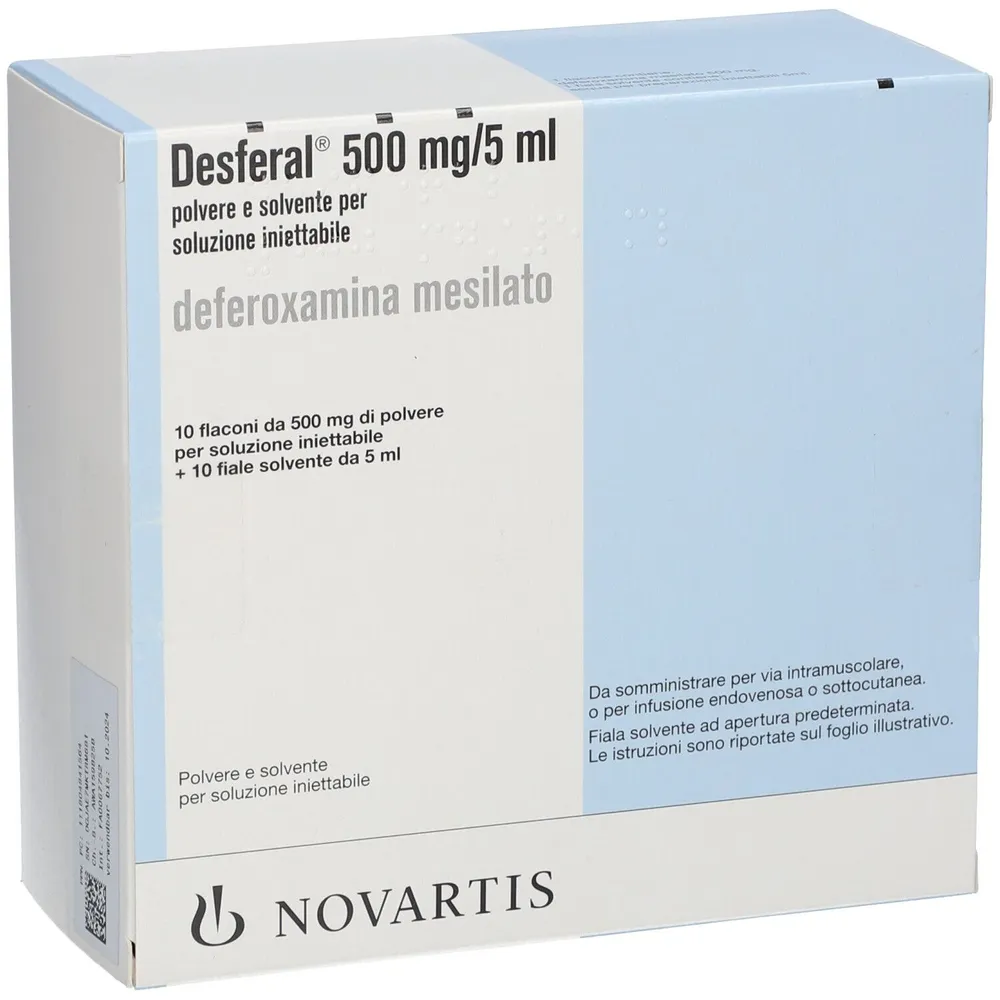
Table of Contents
Package leaflet: Information for the patient
Desferal 500 mg/5 ml powder and solvent for injectable solution
deferoxamine mesylate
Please read all of this leaflet carefully before using this medicine because it contains important information for you.
- Keep this leaflet. You may need to read it again.
- If you have any questions, ask your doctor, pharmacist or nurse.
- This medicine has been prescribed for you only. Do not give it to other people, even if their symptoms are the same as yours, because it could be harmful.
- If you experience any side effects, including any not listed in this leaflet, tell your doctor, pharmacist or nurse. See section 4.
Contents of this leaflet:
- What Desferal is and what it is used for
- What you need to know before using Desferal
- How to use Desferal
- Possible side effects
- How to store Desferal
- Contents of the pack and other information
1. What Desferal is and what it is used for
What Desferal is
Desferal contains the active substance deferoxamine mesylate, which belongs to a class of medicines known as "chelating agents". Deferoxamine is used to remove excess iron and aluminium from the body.
What Desferal is used for
In patients with certain types of anaemia, such as thalassaemia, repeated blood transfusions may be required, which can however lead to an excess of iron in the body. This occurs because blood contains iron, and the body has no natural way of eliminating the excess iron introduced through blood transfusions. Over time, excess iron can damage important organs such as the liver and heart. Desferal removes this excess iron. Desferal can be used to treat adults, adolescents, and children.
Desferal is used alone
- to remove excess iron in chronic iron overload, in cases of:
o iron overload due to transfusions (transfusional haemosiderosis), particularly in the following anaemias: beta-thalassaemia major, anaemias present from birth (congenital), sideroblastic anaemia, autoimmune haemolytic anaemia; or
o iron overload above a certain threshold value or associated with tissue damage (primary haemochromatosis) in patients who have other concomitant diseases (e.g. severe anaemia, heart disease, low blood protein levels) that prevent phlebotomy (venesection); or
o iron overload associated with a blood disorder (porphyria cutanea tarda) in patients who are unable to tolerate phlebotomy - to treat acute iron poisoning
- to remove excess aluminium in chronic aluminium overload in patients with severe end-stage renal failure on maintenance dialysis with:
o aluminium-related bone disease and/or
o dialysis-related brain disorders (dialysis encephalopathy) and/or
o aluminium-related anaemia - for the diagnosis of iron or aluminium overload.
How Desferal works
Desferal binds excess iron and aluminium and removes them from the body, primarily through urine and faeces.
2. What you need to know before using Desferal
Do not use Desferal
- if you are allergic to deferoxamine mesylate or to any of the other ingredients of this medicine (listed in section 6), except when desensitization is feasible and allows treatment to proceed.
If this applies to you, inform your doctor before taking Desferal. If you think you might be allergic to
Desferal, consult your doctor.
Warnings and precautions
Talk to your doctor, pharmacist, or nurse before using Desferal.
Carefully follow all instructions given by your doctor. These may differ from the general information
provided in this leaflet.
Inform your doctor before taking Desferal:
- if you have heart problems and you also need to take vitamin C. Your doctor will monitor you and will decide whether to prescribe vitamin C, which may only be taken after one month of regular Desferal therapy and at a total daily dose not exceeding 200 mg, administered in divided doses. Treatment with Desferal and high doses of vitamin C (over 500 mg per day) may worsen heart function, which returns to normal after discontinuation of vitamin C. Your doctor will monitor you during treatment.
- if you have vision or hearing problems. Your doctor will perform vision and hearing tests before starting Desferal treatment and periodically thereafter (every 3 months), especially if ferritin levels are low.
- if you have renal insufficiency. Your doctor will monitor you, as Desferal causes elimination of iron and aluminium through the kidneys, and dialysis may be needed to enhance their removal.
Inform your doctor if, during treatment with Desferal:
- you experience low blood pressure and shock, manifested for example by flushing, rapid heartbeat, circulatory collapse, or skin rashes, as these may be due to too rapid intravenous injection of Desferal.
- you develop high fever, sore throat (pharyngitis), shortness of breath, abdominal pain, acute diarrhoea, or general malaise, as these may indicate a bacterial or fungal infection. Your doctor will instruct you to stop Desferal treatment, perform appropriate tests, and provide suitable treatment.
- you have changes in kidney function confirmed by blood tests (e.g. increased blood creatinine), as your doctor will need to monitor you.
- you experience vision or hearing disturbances, as it may be necessary to discontinue Desferal treatment.
- you have severe respiratory insufficiency, particularly if you have acute iron intoxication or thalassaemia. This may be caused by excessive doses of Desferal.
Other important information:
- Desferal treatment may cause brain-related changes such as seizures and may accelerate the onset of dialysis dementia. This occurs particularly in patients with aluminium-related brain disorders treated with high doses of Desferal. To prevent these effects, your doctor may prescribe a medicine containing the active substance clonazepam.
- treatment with Desferal to reduce aluminium accumulation may lead to decreased blood calcium levels and worsening of hyperparathyroidism (excessive parathyroid hormone production).
- your urine may become reddish in colour due to the presence of the iron complex.
Monitoring of Desferal treatment
During treatment, you will undergo regular blood and urine tests. These will monitor the amount of iron in your body (serum ferritin level) to assess how well Desferal is working.
Your doctor will evaluate these test results to determine the most appropriate Desferal dose for you.
Children and adolescents
Desferal may be used in adolescents and children. Treatment with Desferal may cause delayed growth, particularly in children under 3 years of age at the start of therapy. If your child is receiving Desferal, your doctor will monitor body weight and height every 3 months.
Other medicines and Desferal
Inform your doctor if you are currently using, have recently used, or might use any other medicines.
In particular, inform your doctor if you are taking:
- prochlorperazine (a medicine used to treat neurological disorders)
- vitamin C at doses exceeding 500 mg/day (see “Warnings and precautions”).
Diagnostic tests
Inform your doctor if you are scheduled for a scintigraphy, a diagnostic test using gallium-67, as you may need to discontinue Desferal treatment 48 hours before the scintigraphy.
Pregnancy and breastfeeding
If you are pregnant, suspect you may be pregnant, plan to become pregnant, or are breastfeeding, consult your doctor before using this medicine.
Pregnancy
If you are pregnant, inform your doctor, who will assess whether the benefits to you clearly outweigh the risks to the foetus before prescribing Desferal. Data on the use of deferoxamine in pregnant women are limited, and the risk to the foetus and mother is unknown.
Breastfeeding
It is not known whether deferoxamine passes into breast milk. If you are breastfeeding, inform your doctor, who will assess whether the benefits to you clearly outweigh the risks to the infant before prescribing Desferal.
Driving and using machines
Desferal may impair your ability to drive or operate machinery. If you experience dizziness, neurological disturbances, or vision or hearing problems, do not drive or operate machinery.
3. How to use Desferal
Use this medicine exactly as instructed by your doctor, pharmacist, or nurse. If you have any doubts, consult your doctor.
The medicine can be administered by subcutaneous, intravenous, or intramuscular routes.
Desferal must not be administered as a single bolus injection under the skin.
Your doctor will determine the most appropriate route of administration.
Treatment of chronic iron overload
The recommended average dose is 20–60 mg/kg per day.
Your doctor will:
- prescribe Desferal after the first 10–20 blood transfusions or when iron accumulation is detected through tests.
- prescribe the lowest effective dose to control the disease, especially if you are elderly.
- determine the most suitable dose and may decide to modify the route of administration and dosage according to the extent of iron accumulation.
- arrange for tests to monitor iron excretion in urine over 24 hours, initially daily and then at intervals of several weeks.
- consider prescribing up to 200 mg of vitamin C per day in divided doses, starting after one month of regular treatment with Desferal, since patients with iron overload generally develop vitamin C deficiency. Usually, 50 mg of vitamin C is sufficient for children under 10 years of age and 100 mg of vitamin C for patients over 10 years of age.
Administration
For the treatment of chronic iron overload, Desferal is usually administered:
- by slow subcutaneous infusion (subcutaneous administration)
- using a lightweight portable pump for 8–12 hours, which may also be used for up to 24 hours.
- Desferal is generally administered with the pump 5–7 times per week. For instructions on how to reconstitute Desferal and use the portable pump, see the section “Instructions for use”.
Treatment of acute iron intoxication
Desferal is used as an adjunctive therapy alongside other treatments. The most commonly used route of administration is continuous intravenous infusion. The recommended dose is 15 mg/kg per hour.
Your doctor will reduce the dose after 4–6 hours, or as soon as possible, to ensure that the recommended maximum daily dose of 80 mg/kg is not exceeded.
For instructions on how to reconstitute Desferal, see the section “Instructions for use”.
Treatment of chronic aluminium overload in patients with severe end-stage renal failure
The recommended dose is 5 mg/kg of Desferal administered by slow intravenous infusion once weekly. Your doctor will arrange for a blood test to assess aluminium levels and determine when and how much Desferal to administer. Desferal may be given by slow infusion during the last 60 minutes of dialysis or 5 hours before the start of dialysis.
Desferal may also be added to the dialysis solution and administered intraperitoneally to patients undergoing continuous ambulatory peritoneal dialysis (CAPD) or continuous cycling peritoneal dialysis (CCPD).
In these patients, the intraperitoneal route should be used to administer Desferal; if this is not possible, it may be administered intramuscularly, subcutaneously, or by slow intravenous infusion.
For instructions on how to reconstitute Desferal, see the section “Instructions for use”.
Diagnosis of iron or aluminium overload
- Assessment of iron overload: You will be given a 500 mg dose of Desferal injected into a muscle (intramuscular administration), and you will be asked to collect your urine over the next 6 hours to determine iron content.
- Assessment of aluminium overload: Your blood aluminium level will be measured just before dialysis and at the beginning of the next dialysis session. Desferal will be administered at a dose of 5 mg/kg by slow intravenous infusion during the last 60 minutes of dialysis.
Instructions for use
Reconstitution of Desferal with Water for Injections
Desferal must be reconstituted with Water for Injections before administration.
When administered subcutaneously or intravenously, Desferal must be used as a 95 mg/ml solution in Water for Injections. When administered intramuscularly, Desferal may be used either as a 95 mg/ml solution in Water for Injections or at a higher concentration.
Instructions for preparing Desferal solution:
- Draw into a syringe the required volume of Water for Injections (see tables below).
- Clean the rubber stopper of the Desferal vial with alcohol. Inject the contents of the syringe into the Desferal vial.
- Shake the vial well to dissolve the powder.
- Draw up the resulting solution into the syringe.
| Bottle size | Amount of sterile water for injection required for reconstitution | Total drug content after reconstitution | Final concentration per ml after reconstitution |
Reconstitution of Desferal for subcutaneous, intravenous, and intramuscular administration
| 500 mg | 5 ml | 500 mg/5.3 ml | 95 mg/ml |
Reconstitution of Desferal for intramuscular administration when a higher concentration is required
| 500 mg | 2 ml | 500 mg/2.35 ml | 213 mg/ml |
After reconstitution, the solution may be further diluted with standard infusion fluids.
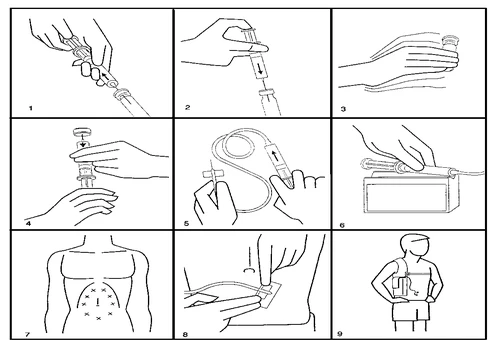
How to use the portable pump
The illustrations provide instructions for preparing the Desferal solution and administering it
subcutaneously. See the table above for the amount of sterile water for injection required for
reconstitution.
- Draw up the water for injection using a syringe.
- Clean the rubber stopper of the Desferal vial with alcohol. Inject the contents of the syringe into the Desferal vial.
- Shake the vial well to dissolve the powder completely.
- Draw up the resulting solution into the syringe.
- Attach the extension tubing to the syringe, connecting it to the butterfly needle. Fill the dead space in the tubing with the solution from the syringe.
- Insert the syringe into the infusion pump.
- Clean the skin thoroughly at the chosen site (abdomen, arm, upper leg, or thigh) with alcohol before inserting the needle. With your free hand, pinch a skin fold. Insert the butterfly needle under the skin. It is important to insert the needle firmly until the wings. Check by gently moving the needle whether its tip moves freely. If it does not move freely, the needle tip may be too close to the skin surface. Repeat the procedure at a different skin site after cleaning both the needle and the skin with alcohol.
- Secure the needle with adhesive tape.
- You may use a belt or shoulder holster to carry the pump. The pump may also be used during the night.
How to open the ampoules
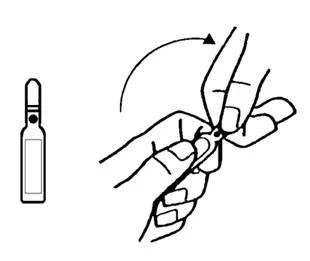
Hold the ampoule as shown in the drawing and
break it off with a quick snap.
How long to use Desferal
Use the medicine regularly and exactly as prescribed by your doctor. This will help you achieve the best results and reduce the risk of side effects. If you have any doubts about your treatment, consult your doctor.
If you have questions about how long to use Desferal, speak with your doctor.
If you use more Desferal than you should
If you accidentally take too much Desferal, inform your doctor immediately or go to the nearest hospital.
An overdose of Desferal may cause adverse effects such as:
- low blood pressure
- rapid heartbeat
- stomach or intestinal disturbances
- temporary loss of vision
- loss of ability to understand or produce speech (aphasia)
- agitation
- headache
- nausea
- slow heartbeat
- severe kidney failure. In patients with acute iron intoxication and in thalassemic patients, severe respiratory failure has been reported following treatment with very high intravenous doses of Desferal. The doctor will treat an overdose of Desferal according to your condition.
Elderly patients (aged 65 years or older)
Desferal may be used in patients aged 65 years or older at the same doses as in adults. Elderly patients should be closely monitored by the doctor for adverse effects, which may require dose adjustment.
If you forget to use Desferal
If you have missed a dose of Desferal, inform your doctor immediately.
If you stop using Desferal
Do not stop using Desferal unless instructed by your doctor. If you stop treatment, excess iron will no longer be removed from the body (see also above the section “How long to use Desferal”).
If you have any doubts about using this medicine, consult your doctor, pharmacist, or nurse.
4. Possible side effects
Like all medicines, this medicine can cause side effects, although not everybody gets them.
Some of the signs and symptoms reported as side effects may also be manifestations of the underlying disease (iron and/or aluminium overload).
Very common side effects (may affect more than 1 in 10 people)
- joint and muscle pain
- injection site reactions such as pain, bruising, mild swelling, redness, itching, death of a small area of skin (eschar), crust formation
Common side effects (may affect up to 1 in 10 people)
- headache
- nausea
- urticaria
- growth retardation and bone abnormalities (e.g. metaphyseal dysplasia, a rare bone disease) at high doses and in young children
- fever
Uncommon side effects (may affect up to 1 in 100 people)
- hearing impairment
- ringing or buzzing in the ears
- asthma
- vomiting
- abdominal pain
- injection site reactions such as blisters, swelling due to fluid accumulation, burning sensation
Rare side effects (may affect up to 1 in 1,000 people)
- fungal infection
- vision problems, including decreased visual acuity, night blindness, and vision loss
- low blood pressure
- rapid heartbeat
- shock
Very rare side effects (may affect up to 1 in 10,000 people)
- inflammation of the stomach and/or intestine caused by bacterial infection
- blood disorders (including reduced platelets and white blood cells)
- severe allergic reaction which may also result in death (anaphylactic reaction, anaphylactic shock)
- fluid accumulation causing swelling due to blood vessel problems (angioneurotic edema)
- neurological disorders including dizziness
- onset or worsening of brain diseases caused by aluminium-related dialysis dementia, peripheral nerve disease, tingling sensations
- severe respiratory failure
- lung inflammation (pulmonary infiltration)
- diarrhoea
- skin rash affecting the entire body
Side effects with unknown frequency (frequency cannot be estimated from the available data)
- seizures
- muscle spasms
- kidney problems, even severe (acute renal failure, renal tubulopathy)
- increased creatinine in the blood
Reporting of side effects
If you experience any side effect, including those not listed in this leaflet, talk to your doctor, pharmacist, or nurse. You can also report side effects directly via the national reporting system at https://www.aifa.gov.it/content/segnalazioni-reazioni-avverse.
By reporting side effects, you can help provide more information on the safety of this medicine.
5. How to store Desferal
Keep this medicine out of the sight and reach of children.
Do not use this medicine after the expiry date stated on the carton after "Exp.". The expiry date refers to the last day of that month.
Do not store above 25°C.
Use one vial for a single administration only. Use the medicine immediately after reconstitution or, at the latest, within 3 hours. At the recommended concentration of 95 mg/ml, the reconstituted solution is clear, colourless or slightly yellowish.
Do not use the solution if it is not clear, or if it appears cloudy or turbid. If reconstitution is carried out under aseptic conditions, the medicine may be stored at room temperature ( 23°C) for up to 24 hours prior to administration.
Do not dispose of any medicine via wastewater or household waste. Ask your pharmacist how to dispose of medicines you no longer use. This will help protect the environment.
6. Package contents and other information
What Desferal contains
- The active substance is deferoxamine mesilate. Each vial contains 500 mg of deferoxamine mesilate.
- The other component is water for injections.
Description of the appearance of Desferal and contents of the pack
Each pack of Desferal 500 mg/5 mL powder and solvent for injectable solution contains 10 vials of
500 mg medicine and 10 ampoules of 5 mL water for injections.
Marketing Authorization Holder
MITEM PHARMA
2-12, RUE DU CHEMIN DES FEMMES
91300 MASSY
FRANCE
Manufacturer
Novartis Farma S.p.A
Via Provinciale Schito 131
80058 Torre Annunziata NA
Italy
Novartis Farma S.p.A.
Viale Luigi Sturzo 43
20154 Milano MI
Italy
Novartis Pharma GmbH
Roonstrasse 25
90429 Nuremberg
Germany
Novartis Farmacéutica SA
Gran Via de les Corts Catalanes, 764
08013 Barcelona
Spain