Somavert 30 mg powder and solvent for solution for injection
Spain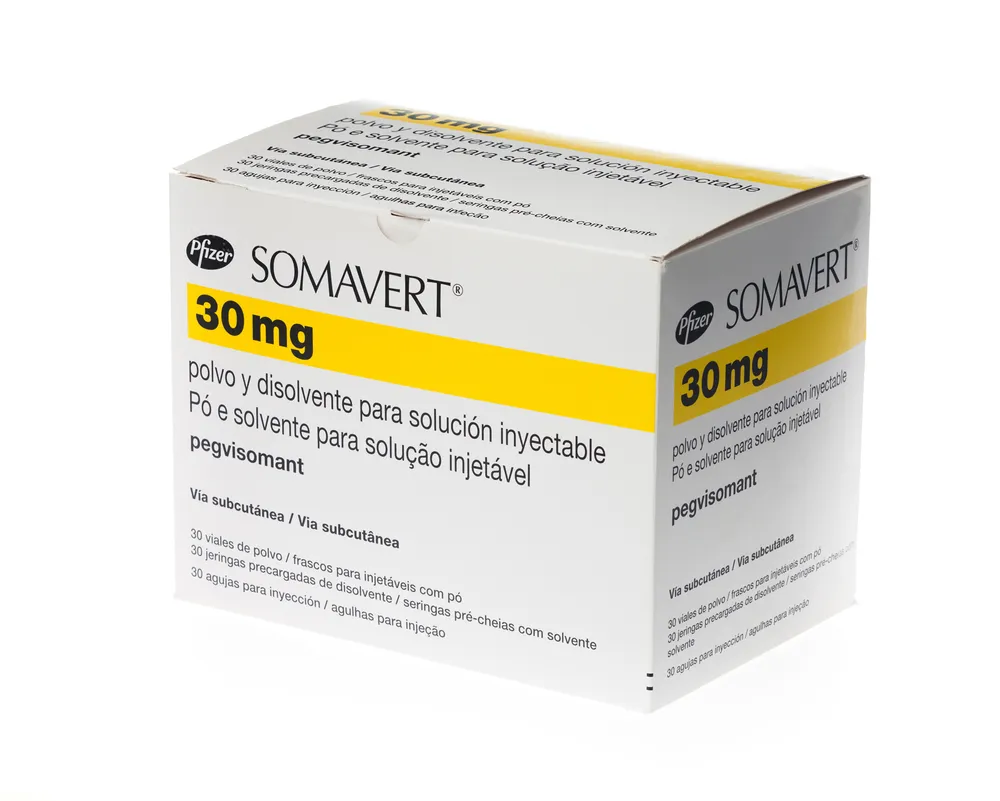
Table of Contents
Package leaflet: Information for the user
Introduction
Package leaflet: information for the user
SOMAVERT 10 mg powder and solvent for solution for injection
SOMAVERT 15 mg powder and solvent for solution for injection
SOMAVERT 20 mg powder and solvent for solution for injection
SOMAVERT 25 mg powder and solvent for solution for injection
SOMAVERT 30 mg powder and solvent for solution for injection
pegvisomant
Read all of this leaflet carefully before you start using this medicine, because it contains important information for you.
- Keep this leaflet. You may need to read it again.
- If you have any questions, ask your doctor, pharmacist, or nurse.
- This medicine has been prescribed for you only. Do not pass it on to other people, even if they have the same symptoms as you, because it may harm them.
- If you experience any side effects, talk to your doctor, pharmacist, or nurse, even if it is a side effect not listed in this leaflet. See section 4.
Contents of the leaflet
- What SOMAVERT is and what it is used for
- What you need to know before you use SOMAVERT
- How to use SOMAVERT
- Possible side effects
- How to store SOMAVERT
- Contents of the pack and other information
1. What SOMAVERT is and what it is used for
SOMAVERT is used for the treatment of acromegaly, a hormonal disorder resulting from increased secretion of growth hormone (GH) and insulin-like growth factor-I (IGF-I), characterized by excessive growth of bones, thickening of soft tissues, heart disease, and related disorders.
The active substance in SOMAVERT, pegvisomant, is known as a growth hormone receptor antagonist. These substances reduce the effects of GH and lower circulating levels of IGF-I in the blood.
2. What you need to know before using SOMAVERT
Do not use SOMAVERT
- If you are allergic to pegvisomant or to any of the other ingredients of this medicine (listed in section 6).
Warnings and precautions
Talk to your doctor, pharmacist, or nurse before starting treatment with SOMAVERT.
-
If you experience visual disturbances or headaches, you must inform your doctor immediately.
-
Your doctor or nurse will monitor your circulating blood levels of IGF‑I (insulin-like growth factors) and, if necessary, adjust your dose of SOMAVERT.
-
Your doctor should also monitor your adenoma (benign tumor).
-
Your doctor will perform liver function tests before starting and during treatment with SOMAVERT. If the results of these tests are abnormal, your doctor will discuss treatment options with you. Once treatment has started, your doctor or nurse will monitor your liver enzyme levels in the blood every 4–6 weeks during the first 6 months of treatment with SOMAVERT. Administration of SOMAVERT should be discontinued if symptoms of liver disease persist.
-
If you are diabetic, your doctor may need to adjust your dose of insulin or other antidiabetic medications.
-
Fertility in patients may increase as the disease improves. This medicine is not recommended for use in pregnant women, and women of childbearing potential should be advised to use contraception. See also the section on Pregnancy below.
Other medicines and SOMAVERT
Tell your doctor if you have previously used another medicine for the treatment of acromegaly or any medicine for the treatment of diabetes.
Inform your doctor or pharmacist if you are currently using or have recently used any other medicines. As part of your treatment, you may be receiving other medications. It is important that you continue to take all your medicines, including SOMAVERT, unless otherwise instructed by your doctor, pharmacist, or nurse.
Pregnancy, breastfeeding and fertility
SOMAVERT is not recommended for use in pregnant women. If you are a woman of childbearing potential, you should use contraception during treatment.
It is unknown whether pegvisomant passes into breast milk. You should not breastfeed while taking SOMAVERT unless you have discussed this with your doctor.
If you are pregnant or breastfeeding, think you may be pregnant, or are planning to become pregnant, consult your doctor or pharmacist before using this medicine.
Driving and using machines
No studies on the effects on the ability to drive and use machines have been conducted.
SOMAVERT contains sodium
This medicine contains less than 1 mmol of sodium (23 mg) per dose; this is, essentially “sodium-free”.
3. How to use SOMAVERT
Follow exactly the administration instructions for this medicine given by your doctor or pharmacist. If in doubt, consult your doctor or pharmacist again.
Your doctor will administer an initial dose of 80 mg of pegvisomant by subcutaneous injection (under the skin). Afterwards, the usual daily dose is 10 mg of pegvisomant administered by subcutaneous injection (under the skin).
Every 4–6 weeks, your doctor will make the necessary dose adjustments by increasing the dose by 5 mg of pegvisomant per day, according to your blood levels of IGF‑I mentioned above, in order to achieve an optimal therapeutic response.
Method and route of administration
SOMAVERT is injected under the skin. The injection may be given by yourself or by another person, such as your doctor or assistant. You must follow the detailed instructions on the injection process included at the end of this leaflet. You should continue injecting this medicine for as long as your doctor instructs you to do so.
This medicine must be dissolved before use. The injection must not be mixed in the same syringe or vial with another medicine.
Fatty tissue under the skin may increase at the injection site. To avoid this, use slightly different injection sites each time, as described in step 2 of the section of this leaflet entitled “Instructions for preparing and administering a SOMAVERT injection”. This will allow time for the skin and underlying tissue to recover between injections before injecting again in the same location.
If you feel that the effect of this medicine is too strong or too weak, speak to your doctor, pharmacist, or nurse.
If you inject more SOMAVERT than you should
If you have accidentally injected more SOMAVERT than your doctor told you to, this is unlikely to be serious, but you must inform your doctor, pharmacist, or nurse immediately.
If you forget to use SOMAVERT
If you forget to give yourself an injection, you should inject the missed dose as soon as you remember, and then continue injecting SOMAVERT as prescribed by your doctor. Do not inject a double dose to make up for a missed dose.
If you have any further questions about the use of this medicine, ask your doctor, pharmacist, or nurse.
4. Possible adverse effects
Like all medicines, this medicine can cause adverse effects, although not everyone will experience them.
Mild to severe allergic (anaphylactic) reactions have been reported in some patients using SOMAVERT. Symptoms of a severe allergic reaction may include one or more of the following: swelling of the face, tongue, lips, or throat; wheezing or difficulty breathing (laryngeal spasm); widespread skin rash, hives, or itching; or dizziness. Contact your doctor immediately if you experience any of these symptoms.
Very common: may affect more than 1 in 10 people:
- Headache.
- Diarrhea.
- Joint pain.
Common: may affect up to 1 in 10 people:
- Difficulty breathing.
- Increases in substances indicating liver function. These may be seen in blood test results.
- Blood in the urine.
- Increased blood pressure.
- Constipation, discomfort, feeling unwell, feeling bloated, indigestion, flatulence.
- Dizziness, drowsiness, uncontrollable tremor, decreased sense of touch.
- Bruising or bleeding at the injection site, pain or swelling at the injection site, increase in fatty tissue under the skin at the injection site, swelling of the limbs, weakness, fever.
- Sweating, itching, rash, tendency to bruise.
- Muscle pain, arthritis.
- Increased blood cholesterol, weight gain, increased blood glucose, decreased blood glucose.
- Flu-like symptoms, fatigue.
- Abnormal dreams.
- Eye pain.
Uncommon: may affect up to 1 in 100 people:
- Allergic reaction after administration (fever, rash, itching, and in severe cases, difficulty breathing, rapid swelling of the skin, requiring urgent medical attention). These may occur immediately or several days after administration.
- Protein in the urine, increased urine volume, kidney problems.
- Loss of interest, feeling confused, increased libido, panic attacks, memory loss, difficulty sleeping.
- Reduced platelets in blood, increased or decreased white blood cells in blood, tendency to bleed.
- Abnormal sensation, impaired healing.
- Heaviness in eyes, inner ear problems.
- Facial swelling, dry skin, night sweats, skin redness (erythema), itching and raised itchy skin rash (urticaria).
- Increased blood lipid levels, increased appetite.
- Dry mouth, increased salivation, dental problems, haemorrhoids.
- Abnormal taste sensation, migraine.
Not known: cannot be estimated from available data:
- Irritability.
- Severe difficulty breathing (laryngospasm).
- Rapid swelling of the skin, underlying tissue, and internal lining (mucosa) of organs (angioedema).
Approximately 17% of patients will develop antibodies against growth hormone during treatment. It appears that these antibodies do not affect the action of this medicine.
Reporting of adverse effects
If you experience any type of adverse effect, consult your doctor, pharmacist, or nurse, even if it is a possible adverse effect not listed in this leaflet. You can also report them directly through the national reporting system listed in Appendix V. By reporting adverse effects, you can help provide more information on the safety of this medicine.
5. Storage of SOMAVERT
Keep this medicine out of sight and reach of children.
Do not use this medicine after the expiry date stated on the vials and on the outer packaging following EXP. The expiry date refers to the last day of the month indicated.
Store the vial(s) of powder in the refrigerator (between 2°C and 8°C) in their packaging to protect them from light. Do not freeze.
The packaging containing the SOMAVERT powder vial(s) may be stored at room temperature, not exceeding 25°C, for a single period of up to 30 days. Write the new expiry date on the packaging, including day/month/year (up to 30 days from the date the product was removed from refrigeration). The vial(s) must be protected from light. Do not return this medicine to the refrigerator.
Dispose of this medicine if it is not used before the new expiry date or the printed expiry date, whichever comes first.
Store the pre-filled syringe(s) at a temperature below 30°C or in the refrigerator (between 2°C and 8°C). Do not freeze.
After preparing the SOMAVERT solution, it should be used immediately.
Do not use this medicine if the solution appears cloudy or contains particles.
Medicines must not be disposed of via wastewater or household waste. Ask your pharmacist how to dispose of medicines and packaging you no longer need. This will help protect the environment.
6. Package contents and other information
Composition of SOMAVERT
- The active substance is pegvisomant.
- SOMAVERT 10 mg: one vial of powder contains 10 mg of pegvisomant. After reconstitution with 1 ml of solvent, 1 ml of solution contains 10 mg of pegvisomant.
- SOMAVERT 15 mg: one vial of powder contains 15 mg of pegvisomant. After reconstitution with 1 ml of solvent, 1 ml of solution contains 15 mg of pegvisomant.
- SOMAVERT 20 mg: one vial of powder contains 20 mg of pegvisomant. After reconstitution with 1 ml of solvent, 1 ml of solution contains 20 mg of pegvisomant.
- SOMAVERT 25 mg: one vial of powder contains 25 mg of pegvisomant. After reconstitution with 1 ml of solvent, 1 ml of solution contains 25 mg of pegvisomant.
- SOMAVERT 30 mg: one vial of powder contains 30 mg of pegvisomant. After reconstitution with 1 ml of solvent, 1 ml of solution contains 30 mg of pegvisomant.
- The other components are glycine, mannitol (E-421), sodium hydrogen phosphate anhydrous, sodium dihydrogen phosphate monohydrate (see section 2 “SOMAVERT contains sodium”).
- The solvent is water for injections.
Presentation of the product and contents of the pack
SOMAVERT is supplied as a powder and solvent for injection (in a vial containing 10 mg, 15 mg, 20 mg, 25 mg or 30 mg of pegvisomant and 1 ml of solvent in a pre-filled syringe). Pack sizes of 1 and/or 30. Only certain pack sizes may be marketed. The powder is white and the solvent is clear and colourless.
Marketing Authorisation Holder and Manufacturer:
Marketing Authorisation Holder
Pfizer Europe MA EEIG
Boulevard de la Plaine 17
1050 Bruxelles
Belgium
Manufacturer
Pfizer Manufacturing Belgium NV
Rijksweg 12
2870 Puurs-Sint-Amands
Belgium
For further information on this medicinal product, please contact the local representative of the Marketing Authorisation Holder:
Belgium/Belgium/Belgium Luxembourg/Luxembourg Pfizer NV/SA Tel/Tel: +32 (0)2 554 62 11 | Lithuania Pfizer Luxembourg SARL branch in Lithuania Tel: +370 5 251 4000 |
Bulgaria Pfizer Bulgaria EOOD, Sofia Tel: +359 2 970 4333 | Hungary Pfizer Kft. Tel.: +36 1 488 37 00 |
Czech Republic Pfizer, spol. s r.o. Tel: +420 283 004 111 | Malta Vivian Corporation Ltd. Tel: +356 21344610 |
Denmark Pfizer ApS Tlf.: +45 44 20 11 00 | Netherlands Pfizer bv Tel: +31 (0)800 63 34 636 |
Germany PFIZER PHARMA GmbH Tel: +49 (0)30 550055-51000 | Norway Pfizer AS Tlf: +47 67 52 61 00 |
Estonia Pfizer Luxembourg SARL Estonia branch Tel: +372 666 7500 | Austria Pfizer Corporation Austria Ges.m.b.H. Tel: +43 (0)1 521 15-0 |
Greece Pfizer Hellas S.A. Tel: +30 210 6785800 | Poland Pfizer Polska Sp. z o.o. Tel.: +48 22 335 61 00 |
Spain Pfizer, S.L. Tel: +34 91 490 99 00 | Portugal Laboratórios Pfizer, Lda. Tel: +351 21 423 5500 |
France Pfizer Tél: +33 (0)1 58 07 34 40 | Romania Pfizer Romania S.R.L. Tel: +40 (0) 21 207 28 00 |
Croatia Pfizer Croatia d.o.o. Tel: +385 1 3908 777 | Slovenia Pfizer Luxembourg SARL Pfizer, branch for consulting in pharmaceutical activities, Ljubljana Tel: +386 (0)1 52 11 400 |
Ireland Pfizer Healthcare Ireland Unlimited Company Tel: 1800 633 363 (toll free) Tel: +44 (0)1304 616161 | Slovakia Pfizer Luxembourg SARL, organizational unit Tel: +421 2 3355 5500 |
Iceland Icepharma hf. Sími: +354 540 8000 | Finland Pfizer Oy Puh/Tel: +358 (0)9 430 040 |
Italy Pfizer S.r.l. Tel: +39 06 33 18 21 | Sweden Pfizer AB Tel: +46 (0)8 550 520 00 |
Cyprus Pfizer Hellas S.A. (Cyprus Branch) Tel: +357 22817690 | |
Latvia Pfizer Luxembourg SARL branch in Latvia Tel: +371 670 35 775 | |
Date of last review of this leaflet: 02/2025.
Other sources of information
Detailed information on this medicine is available on the website of the European Medicines Agency: https://www.ema.europa.eu. Links to other websites on rare diseases and orphan medicines are also available.
INSTRUCTIONS FOR USE
SOMAVERT powder in vial with solvent in a pre-filled syringe
pegvisomant for injectable solution
For subcutaneous injection only
Single-dose vial
SOMAVERT is supplied in a vial as a white powder block. You must mix SOMAVERT with a liquid (solvent) before it can be used.
The liquid is supplied in a pre-filled syringe labelled “Solvent for SOMAVERT”.
Do not mix SOMAVERT with any other liquid.
It is important that you do not attempt to administer an injection to yourself or another person without prior training from your healthcare professional.
Store the vial(s) of powder in the refrigerator at 2°C to 8°C and protect from direct sunlight.
The packaging containing the SOMAVERT powder vial(s) may be stored at room temperature not exceeding 25°C for a single period of up to 30 days. Write the expiry date on the packaging, including day/month/year (up to 30 days from the date removed from the refrigerator). The vial(s) must be protected from light. Do not return this medicine to the refrigerator.
Dispose of this medicine if not used before the new expiry date or the printed expiry date on the packaging, whichever comes first.
The pre-filled syringe of solvent may be stored at room temperature. Keep out of the reach of children.
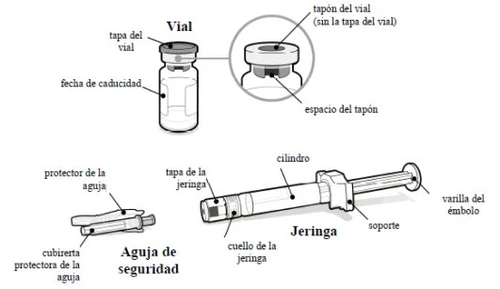
- What you need
One pack of SOMAVERT containing:
- One vial of SOMAVERT powder
- One pre-filled syringe with solvent
- One safety needle
You will also need:
- A cotton ball
- An alcohol swab
- A proper sharps container
- Preparation
Before starting:
-
Mix SOMAVERT with the solvent only when you are ready to inject your dose.
-
Remove one pack of SOMAVERT from the refrigerator and allow it to reach room temperature naturally in a safe place.
-
Wash your hands thoroughly with soap and water, and dry them well.
-
Open the syringe and safety needle packaging to make them easier to handle during injection preparation.
-
Do not use the syringe or vial if:
- they are damaged or defective;
- the expiry date has passed;
- the syringe has been frozen, even if subsequently thawed (applies to syringe only).
- Choose an injection site
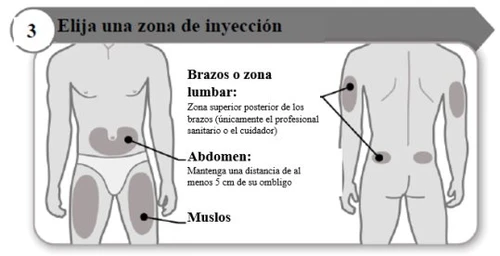
- Select a different site within each area for each injection.
- Avoid bony, red, painful, or hard areas, or those with bruises, scars, or skin conditions.
- Clean the injection site with an alcohol swab as instructed by your healthcare professional.
- Allow the injection site to dry completely.
- Remove the vial cap
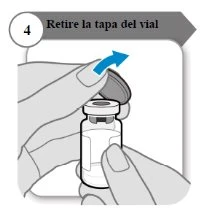
- Remove the cap from the vial.
- Discard the cap; it is not needed again.
Caution: Do not let anything touch the vial stopper.
- Remove the syringe cap
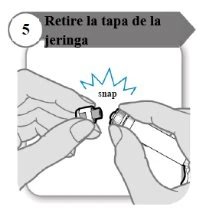
- Remove the syringe cap. You may need to apply more force than expected.
- Discard the syringe cap; it is not needed again.
- Keep the syringe upright to prevent leakage.
Caution: Do not let the tip of the syringe touch anything once the cap has been removed.
- Attach the safety needle
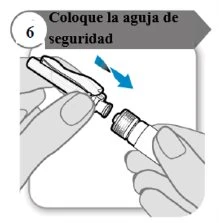
- Attach the safety needle to the syringe by firmly twisting it on as far as possible.
- Remove the needle protective cover
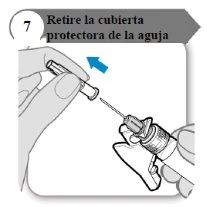
- Bend the needle protector outward, away from the needle protective cover.
- Carefully pull the needle protective cover straight off.
- Discard the needle protective cover; it is not needed again.
Caution: Do not let the needle touch anything.
- Insert the needle
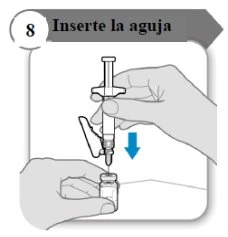
- Push the needle through the center of the vial stopper as shown.
- Hold the syringe while the needle is inserted into the vial stopper to prevent the needle from bending.
- Add the liquid
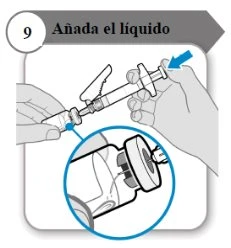
- Tilt the vial and syringe at an angle as shown.
- Push the plunger rod slowly until all the liquid is inside the vial.
- Caution: Avoid letting the liquid drip directly onto the powder, as this may cause foaming. Foam can render the medicine unusable.
- Do not remove the needle yet.
- Swirl the vial
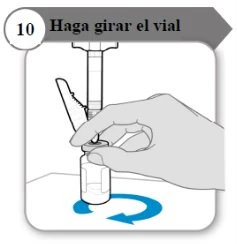
- Hold the syringe and vial in one hand as shown.
- Gently swirl the liquid by moving the vial in a circular motion on a flat surface.
- Continue swirling until all the powder is completely dissolved.
Note: This may take up to 5 minutes.
- Inspect the medicine
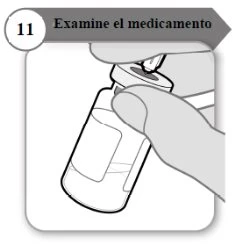
- With the needle still inserted in the vial, carefully inspect the solution. It should be clear and free of particles.
- Do not use if:
- the solution is cloudy or dark;
- the solution has any colour;
- it contains particles or foam in the vial.
- Reposition the needle
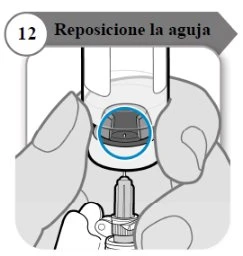
- Rotate the vial so you can see the space in the stopper, as shown.
- Pull the needle down so the tip is at the lowest point in the liquid. This helps you withdraw as much liquid as possible.
- Check that the plunger rod has not moved. If it has, push it back fully into the syringe. This ensures all air has been expelled from the syringe before withdrawing the dose.
- Withdraw the dose
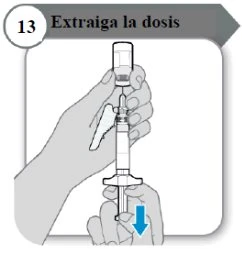
- Slowly pull back the plunger rod to withdraw as much medicine from the vial as possible.
Note: If you see air in the syringe, gently tap the barrel to move bubbles upward, then slowly push the bubbles back into the vial.
- Remove the needle from the vial.
- Insert the needle
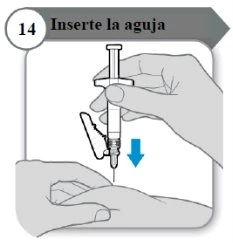
- Gently pinch the skin at the injection site.
- Insert the needle fully into the pinched skin.
- Inject the medicine
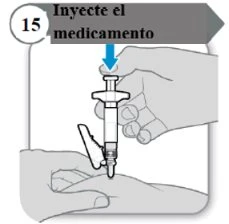
- Slowly push down the plunger rod until the syringe is empty.
Note: Make sure the needle is fully inserted.
- Release the pinched skin and remove the needle straight out.
- Secure the needle
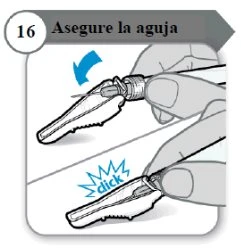
- Fold the needle protector over the needle.
- Carefully, press against a hard surface to lock the needle protector in place.
Note: You will hear a click when the needle protector is closed.
- Dispose
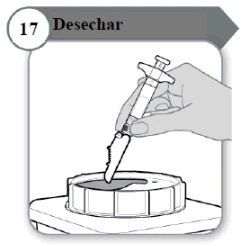
- The syringe and needle must never be reused. Dispose of the syringe and needle as instructed by your doctor, nurse, or pharmacist, and in accordance with local health guidelines and safety regulations.
- After the injection
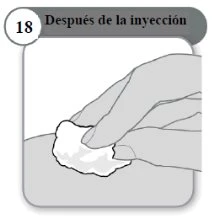
- If needed, apply gentle pressure with a clean cotton ball at the injection site.
- Do not rub the area.
QUESTIONS AND ANSWERS
What should I do if something accidentally touches the vial stopper?
- Clean the vial stopper with a new alcohol wipe and allow it to dry completely. If you are unable to clean the stopper, do not use the vial.
What should I do if the syringe has been dropped?
- Do not use it, even if it appears undamaged. Dispose of the syringe in the same way as a used syringe. You will need a new syringe.
How many times can I safely insert the needle into the vial stopper?
- Only once. Withdrawing and reinserting the needle significantly increases the risk of needle damage and blunting, which may cause discomfort and increase the risk of skin injury and infection. There is also a risk of losing some of the medicine.
Is it okay to shake the vial if the powder does not dissolve?
- No, never shake the vial. Shaking may inactivate the medicine and cause foaming. The powder may take a few minutes to dissolve completely, so continue gently swirling the vial in circular motions until the solution is completely clear.
How can I tell if there is foam in the vial?
- Foam appears as a layer of small bubbles floating on top of the liquid. Do not inject SOMAVERT if foam has formed.
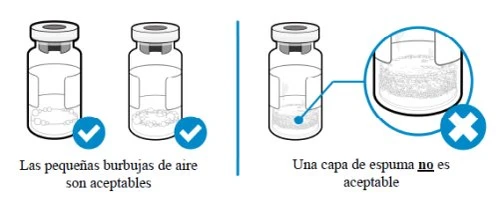
How can I avoid foaming of the medicine?
- Push the plunger very slowly so the liquid flows gently into the vial. Do not let the liquid drip directly onto the powder, as this causes foaming. This technique also reduces the time needed to mix the medicine and allows you to withdraw more medicine.
I can see some air in the syringe. Is this okay?
- Small air bubbles in the liquid are normal and the injection is safe. However, air may accidentally be drawn into the syringe and should be removed before injection. Air bubbles or air spaces floating above the liquid should be expelled back into the vial.
Why can't I withdraw all the medicine from the vial?
- The shape of the vial means a small amount of medicine will remain in the vial. This is normal. To ensure only a minimal amount remains, make sure the needle tip is inserted as far into the vial as possible when withdrawing the dose.
What should I do if I have any questions about the medicine?
- All questions should be directed to a doctor, nurse, or pharmacist experienced with SOMAVERT.