Rivastigmine Sandoz 4.5 mg hard capsules EFG
Spain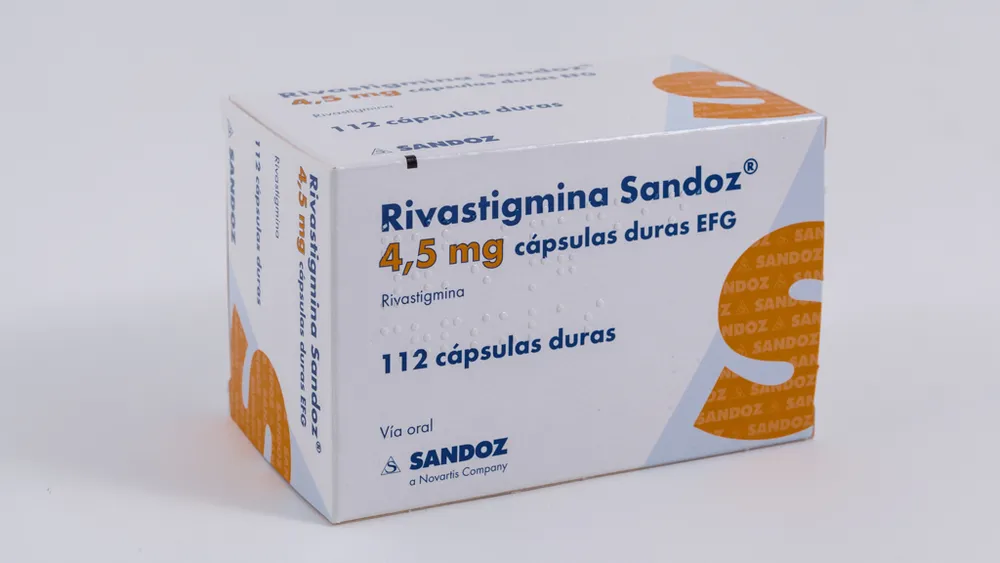
Instructions for Use
Package leaflet: Information for the user
Introduction
Package leaflet: Information for the patient
Rivastigmine Sandoz 1.5 mg hard capsules EFG
Rivastigmine Sandoz 3 mg hard capsules EFG
Rivastigmine Sandoz 4.5 mg hard capsules EFG
Rivastigmine Sandoz 6 mg hard capsules EFG
rivastigmine
Read all of this leaflet carefully before you start taking this medicine, because it contains important information for you.
-
Keep this leaflet, as you may need to read it again.
-
If you have any questions, ask your doctor or pharmacist.
-
This medicine has been prescribed for you only and must not be given to other people, even if they have the same symptoms, as it may harm them.
-
If you experience any adverse effects, consult your doctor or pharmacist, even if they are adverse effects not listed in this leaflet. See section 4.
Leaflet contents:
- What Rivastigmine Sandoz is and what it is used for
- What you need to know before taking Rivastigmine Sandoz
- How to take Rivastigmine Sandoz
- Possible adverse effects
- How to store Rivastigmine Sandoz
- Contents of the pack and other information
1. What Rivastigmina Sandoz is and what it is used for
The active substance in Rivastigmina Sandoz is rivastigmine.
Rivastigmine belongs to a group of substances known as cholinesterase inhibitors. In patients with Alzheimer's dementia or dementia due to Parkinson's disease, certain nerve cells in the brain die, resulting in reduced levels of the neurotransmitter acetylcholine (a substance that enables communication between nerve cells). Rivastigmine blocks the enzymes that break down acetylcholine: acetylcholinesterase and butyrylcholinesterase. By inhibiting these enzymes, Rivastigmina Sandoz helps increase acetylcholine levels in the brain, thereby helping to reduce the symptoms of Alzheimer's disease and dementia associated with Parkinson's disease.
Rivastigmina Sandoz is used to treat adult patients with mild to moderately severe Alzheimer's disease, a progressive brain disorder that gradually affects memory, intellectual ability, and behavior. The capsules and oral solution can also be used for the treatment of dementia in adult patients with Parkinson's disease.
2. What you need to know before starting Rivastigmine Sandoz
Do not take Rivastigmine Sandoz
- if you are allergic to rivastigmine (the active substance in Rivastigmine Sandoz) or to any of the other ingredients of this medicine (listed in section 6).
- if you have previously experienced a skin reaction suggestive of allergic contact dermatitis to rivastigmine.
If you are in any of these situations, inform your doctor and do not take Rivastigmine Sandoz.
Warnings and precautions
Talk to your doctor or pharmacist before starting Rivastigmine Sandoz
- if you have or have ever had a heart condition, such as irregular or slow heart rate (pulse), QTc interval prolongation, family history of QTc interval prolongation, torsades de pointes, or low levels of potassium or magnesium in the blood.
- if you have or have ever had an active stomach ulcer
- if you have or have ever had difficulty urinating
- if you have or have ever had seizures
- if you have or have ever had asthma or a severe respiratory disease
- if you have or have ever had impaired kidney function
- if you have or have ever had impaired liver function
- if you have tremors
- if you have low body weight
- if you experience gastrointestinal reactions such as feeling dizzy (nausea), vomiting, and diarrhea. You could become dehydrated (loss of large amounts of fluid) if vomiting or diarrhea is prolonged
- if you experience skin reactions affecting the whole body.
If you are in any of these situations, your doctor may consider it necessary to monitor you more closely during treatment.
If you have not taken Rivastigmine Sandoz for more than three days, do not take the next dose until you have spoken with your doctor.
Rivastigmine Sandoz is not recommended for use in children or adolescents (under 18 years of age).
Children and adolescents
There is no specific recommendation for the use of Rivastigmine Sandoz in the paediatric population for the treatment of Alzheimer's dementia.
Taking other medicines and Rivastigmine Sandoz
Tell your doctor or pharmacist if you are using, have recently used, or might need to use any other medicines.
Rivastigmine Sandoz should not be administered at the same time as other medicines with effects similar to those of rivastigmine. Rivastigmine Sandoz may interfere with anticholinergic medicines (medicines used to relieve stomach cramps or spasms, for the treatment of Parkinson's disease, or to prevent travel sickness).
Rivastigmine Sandoz should not be taken together with metoclopramide (a medicine used to relieve or prevent nausea and vomiting). Taking both medicines together could cause problems such as stiffness of the limbs and hand tremors.
If you need to undergo surgery while taking Rivastigmine Sandoz, inform your doctor before receiving any anaesthetic, as Rivastigmine Sandoz may enhance the effects of certain muscle relaxants used during anaesthesia.
Use caution when taking Rivastigmine Sandoz together with beta-blockers (medicines such as atenolol used to treat high blood pressure, angina, and other heart conditions). Taking both medicines together could cause problems such as a slowed heart rate (bradycardia), leading to fainting or loss of consciousness.
Use caution when taking Rivastigmine Sandoz together with other medicines that may affect heart rhythm or the heart's electrical system (QT interval prolongation).
Pregnancy, breast-feeding, and fertility
If you are pregnant or breast-feeding, think you may be pregnant, or are planning to become pregnant, consult your doctor or pharmacist before using this medicine.
If you are pregnant, the benefits of using Rivastigmine Sandoz should be weighed against the potential risks to the fetus. Rivastigmine Sandoz should not be used during pregnancy unless clearly necessary.
You should not breast-feed while being treated with Rivastigmine Sandoz.
Driving and using machines
Your doctor will advise you whether your condition allows you to drive or use machinery safely. Rivastigmine Sandoz may cause dizziness and drowsiness, especially at the beginning of treatment or when the dose is increased. If you feel dizzy or sleepy, do not drive, operate machinery, or perform any other tasks requiring your attention.
3. How to take Rivastigmina Sandoz
Follow exactly the instructions given by your doctor for taking this medicine. If you are unsure, please consult your doctor or pharmacist again.
Starting treatment:
Your doctor will tell you what dose of Rivastigmina Sandoz you should take.
-
Treatment is usually started at a low dose.
-
Your doctor will slowly increase your dose depending on how you respond to treatment.
-
The highest dose you will take is 6 mg twice daily.
Your doctor will regularly monitor whether the medicine is working for you. Your doctor will also monitor your weight while you are taking this medicine.
If you have not taken Rivastigmina Sandoz for more than three days, do not take the next dose until you have consulted your doctor.
Taking this medicine:
- Inform your caregiver that you are taking Rivastigmina Sandoz.
- To benefit from your medicine, take it every day.
- Take Rivastigmina Sandoz twice daily (in the morning and in the evening), with meals.
- Swallow the capsule whole with liquid.
- Do not open or crush the capsule.
If you take more Rivastigmina Sandoz than you should
If you accidentally take more Rivastigmina Sandoz than you should, inform your doctor. You may require medical attention. Some people who have accidentally taken higher doses have experienced nausea, vomiting, diarrhoea, high blood pressure, and hallucinations. A slowing of heart rate and fainting may also occur.
If you forget to take Rivastigmina Sandoz
If you forget a dose of Rivastigmina Sandoz, wait and take the next dose at your usual time. Do not take a double dose to make up for forgotten doses.
If you have any questions about the use of this medicine, consult your doctor or pharmacist.
4. Possible adverse effects
Like all medicines, this medicine can cause adverse effects, although not everyone experiences them.
You may experience adverse effects more frequently when you first start taking this medicine or when your dose is increased. Generally, adverse effects gradually disappear as your body gets used to the medicine.
Very common (may affect more than 1 in 10 people)
- Dizziness
- Loss of appetite
- Stomach problems such as nausea, vomiting, diarrhoea
Common (may affect up to 1 in 10 people)
- Anxiety
- Sweating
- Headache
- Burning sensation
- Weight loss
- Stomach pain
- Feeling restless
- Feeling tired or weak
- Feeling generally unwell
- Tremor or confusion
- Decreased appetite
- Nightmares
Uncommon (may affect up to 1 in 100 people)
- Depression
- Difficulty sleeping
- Fainting or accidental falls
- Changes in liver function
Rare (may affect up to 1 in 1,000 people)
- Chest pain
- Skin rash, itching
- Epileptic seizures (convulsions)
- Ulcers in the stomach or intestine
Very rare (may affect up to 1 in 10,000 people)
- High blood pressure
- Urinary tract infection
- Seeing things that are not there (hallucinations)
- Heart rhythm problems such as fast or slow heartbeat
- Gastrointestinal bleeding – shown as blood in stools or vomiting blood
- Inflammation of the pancreas – signs include severe upper stomach pain, often with nausea or vomiting
- Worsening of Parkinson's disease symptoms or development of similar symptoms – such as muscle stiffness, difficulty moving
Not known (frequency cannot be estimated from available data)
- Severe vomiting that may cause a tear in the part of the digestive tract connecting the mouth to the stomach (oesophagus)
- Dehydration (loss of large amounts of fluid)
- Liver disorders (yellowing of the skin, yellowing of the whites of the eyes, abnormally dark urine, or unexplained nausea, vomiting, tiredness, and loss of appetite)
- Aggression, feeling restless
- Irregular heartbeat
Patients with dementia or Parkinson's disease
These patients experience some adverse effects more frequently and may also have additional adverse effects:
Very common (may affect more than 1 in 10 patients)
- Tremor
- Fainting
- Accidental falls
Common (may affect up to 1 in 10 patients)
- Anxiety
- Feeling restless
- Slow and fast heartbeat
- Difficulty sleeping
- Excessive saliva and dehydration
- Abnormally slow movements or uncontrollable movements
- Worsening of Parkinson's disease symptoms or development of similar symptoms – such as muscle stiffness, difficulty moving, and muscle weakness
Uncommon (may affect up to 1 in 100 patients)
- Irregular heartbeat and impaired movement control
Other adverse effects observed with transdermal patches and which may also occur with hard capsules:
Common (may affect up to 1 in 10 patients)
- Fever
- Severe confusion
- Urinary incontinence (inability to control urination)
Uncommon (may affect up to 1 in 100 patients)
- Hyperactivity (high level of activity, agitation)
Not known (frequency cannot be estimated from available data)
- Allergic reaction at the patch application site, such as blisters or skin inflammation
If you experience any of these adverse effects, contact your doctor, as you may require medical attention.
Reporting of adverse effects
If you experience any adverse effects, talk to your doctor or pharmacist, even if they are possible adverse effects not listed in this leaflet. You can also report them directly via the Spanish Pharmacovigilance System for Human Medicines: https://www.notificaram.es. By reporting adverse effects, you can help provide more information on the safety of this medicine.
5. Storage of Rivastigmina Sandoz
Keep this medicine out of the sight and reach of children.
Do not use Rivastigmina Sandoz after the expiry date which is stated on the blister, bottle, and carton after “EXP” or “CAD”. The expiry date refers to the last day of the month indicated.
Medicines should not be disposed of via wastewater or household waste. Ask your pharmacist how to properly dispose of any unused medicine and its packaging. This helps protect the environment.
Do not store above 30°C.
6. Contents of the pack and other information
Composition of Rivastigmina Sandoz
- The active substance is rivastigmine.
- The other components are hypromellose, magnesium stearate, microcrystalline cellulose, colloidal anhydrous silica, gelatin, iron oxide yellow, iron oxide red, titanium dioxide, and shellac.
Each Rivastigmina Sandoz 1.5 mg capsule contains 1.5 mg of rivastigmine.
Each Rivastigmina Sandoz 3 mg capsule contains 3 mg of rivastigmine.
Each Rivastigmina Sandoz 4.5 mg capsule contains 4.5 mg of rivastigmine.
Each Rivastigmina Sandoz 6 mg capsule contains 6 mg of rivastigmine.
Nature of the product and pack contents
-
Rivastigmina Sandoz 1.5 mg hard capsules contain a whitish to slightly yellow powder, with a yellow cap and body, and a red printed mark "RIV 1.5 mg" on the body.
-
Rivastigmina Sandoz 3 mg hard capsules contain a whitish to slightly yellow powder, with an orange cap and body, and a red printed mark "RIV 3 mg" on the body.
-
Rivastigmina Sandoz 4.5 mg hard capsules contain a whitish to slightly yellow powder, with a red cap and body, and a white printed mark "RIV 4.5 mg" on the body.
-
Rivastigmina Sandoz 6 mg hard capsules contain a whitish to slightly yellow powder, with a red cap and an orange body, and a red printed mark "RIV 6 mg" on the body.
The product is packaged in blisters and is available in three different pack sizes (28, 56 or 112 capsules).
Marketing Authorization Holder
Sandoz GmbH
Biochemiestraße 10
A-6250 Kundl
Austria
Manufacturer
Novartis Farmacéutica, S.A.
Gran Via de les Corts Catalanes, 764
08013 Barcelona
Spain
Novartis Pharma GmbH
Roonstrasse 25
90429 Nuremberg
Germany
Salutas Pharma GmbH
Otto-Von-Guericke-Allee 1, Barleben
Saxony-Anhalt, 39179
Germany
Further information on this medicinal product is available upon request by contacting the local representative of the Marketing Authorization Holder:
Belgium/Belgium/Belgium Sandoz N.V. Telecom Gardens, Medialaan 40 B‑1800 Vilvoorde Tél/Tel: + 32 (0)2 722 97 97 | Luxembourg/Luxembourg Sandoz N.V. Telecom Gardens, Medialaan 40 B 1800 Vilvoorde Tél/Tel: + 32 (0)2 722 97 97 |
| Hungary Sandoz Hungária Kft. Bartók Béla út 43-47 H-1114 Budapest Tel.: + 36 1 430 2890 E-mail: [email protected] |
Czech Republic Sandoz s.r.o. Na Pankráci 1724/129 CZ-14000 Praha 4 - Nusle E-mail: [email protected] Tel: +420 225 775 111 | Malta V.J. Salomone Pharma Limited Upper Cross Road Marsa MRS 1542 Malta Tel: 00356 22983143 |
Denmark Sandoz A/S Edvard Thomsens Vej 14 DK‑2300 København S Denmark Tlf: +45 6395 1000 | Netherlands Sandoz BV Hospitaaldreef 29, NL-1315 RC Almere Tel: + 31 36 5241600 E-mail: [email protected] |
Germany Hexal AG Industriestraße 25 D-83607 Holzkirchen Tel: + 49 8024 908 0 E-mail: [email protected] | Norway Sandoz A/S Edvard Thomsens Vej 14 DK‑2300 København S Denmark Tlf: +45 6395 1000 |
Estonia Sandoz d.d. Eesti filiaal Pärnu mnt 105 EE‑11312 Tallinn Tel: +372 6652400 | Austria Sandoz GmbH Biochemiestrasse 10 A‑6250 Kundl Tel: + 43 (0)53382000 |
Greece SANDOZ HELLAS MONOPROSOPI EPE Tel: +30 216 600 5000 | Poland Sandoz Polska Sp.z o.o. ul. Domaniewska 50 C PL‑02‑672 Warszawa Tel: + 48 22 549 15 00 |
Spain Sandoz Farmacéutica, S.A Centro Empresarial Parque Norte, Edificio Roble C/ Serrano Galvache Nº 56, 28033 Madrid Tel: +34 900 456 856 | Portugal Sandoz Farmacêutica, Lda. Quinta da Fonte, Rua dos Malhões nº5, Edifício Q56 D. Pedro I, Piso 0 2770-071 Paço de Arcos Portugal Tel: +351 211 964 000 |
France Sandoz SAS 49, avenue Georges Pompidou F‑92593 Levallois‑Perret Cedex Tél: + 33 1 4964 4800 | Romania SC Sandoz S.R.L. Str Livezeni nr. 7A, Târgu Mureș, 540472 Romania Tel: +40 21 310 44 30 |
Ireland Rowex Ltd. Newtown IE-Bantry Co. Cork P75 V009 Tel: +353 27 50077 | Slovenia Lek Pharmaceuticals d.d. Verovskova 57 SI‑1526 Ljubljana Tel: + 386 1 5802111 E-mail: [email protected] |
Iceland Sandoz A/S Edvard Thomsens Vej 14 DK‑2300 Kaupmannahöfn S Denmark Tlf: +45 6395 1000 | Slovakia Sandoz d.d. - organizational unit Žižkova 22B SK‑811 02 Bratislava Tel: +421 2 48 200 600 |
Italy Sandoz S.p.a Largo Umberto Boccioni 1 I‑21040 Origgio (VA) Tel: + 39 02 96541 | Finland Sandoz A/S Edvard Thomsens Vej 14 DK‑2300 Copenhagen S/Köpenhamn S Denmark Tel: +358 010 6133 400 |
Cyprus P.T. Hatzigeorgiou & Co. Ltd Gildis 31-3042 Limassol Telephone: 00357 25372425 Fax: 00357 25376400 e-mail: [email protected] | Sweden Sandoz A/S Edvard Thomsens Vej 14 DK‑2300 Köpenhamn S E-mail: [email protected] |
Latvia Sandoz d.d. Latvia filiale K. Valdemara Str. 33 – 29 LV-1010 Riga Tel: + 371 67892006 | United Kingdom (Northern Ireland) Sandoz Ltd Frimley Business Park Frimley Camberley Surrey GU16 7SR Tel: +44 1276 69 8020 E-mail: [email protected] |
Lithuania Sandoz Pharmaceuticals d.d., Branch Office Lithuania Seimyniskiu Str. 3A LT-09312 Vilnius Tel: + 370 5 2636037 | Croatia Sandoz d.o.o. Maksimirska 120 10 000 Zagreb Tel: +38512353111 E-mail: [email protected] |
This leaflet has been reviewed in November 2024
Detailed information on this medicine is available on the European Medicines Agency website: http://www.ema.europa.eu
Similar Medications
-
Exelon 1.5 mg hard capsules
Form: capsules, hard
Active substance Dosage RIVASTIGMINE 1,5 mg Manufacturer: Novartis Europharm Limited
-
Exelon 1.5 mg hard capsules
Form: capsules, hard
Active substance Dosage RIVASTIGMINE 1,5 mg Manufacturer: Novartis Europharm Limited
-
Exelon 1.5 mg hard capsules
Form: capsules, hard
Active substance Dosage RIVASTIGMINE 1,5 mg Manufacturer: Novartis Europharm Limited
-
Exelon 3 mg hard capsules
Form: capsules, hard
Active substance Dosage RIVASTIGMINE 3 mg Manufacturer: Novartis Europharm Limited
-
Exelon 3 mg hard capsules
Form: capsules, hard
Active substance Dosage RIVASTIGMINE 3 mg Manufacturer: Novartis Europharm Limited
-
Exelon 4.5 mg hard capsules
Form: capsules, hard
Active substance Dosage RIVASTIGMINE 4,5 mg Manufacturer: Novartis Europharm Limited
-
Exelon 4.5 mg hard capsules
Form: capsules, hard
Active substance Dosage RIVASTIGMINE 4,5 mg Manufacturer: Novartis Europharm Limited
-
Exelon 6 mg hard capsules
Form: capsules, hard
Active substance Dosage RIVASTIGMINE 6 mg Manufacturer: Novartis Europharm Limited
-
Exelon 6 mg hard capsules
Form: capsules, hard
Active substance Dosage RIVASTIGMINE 6 mg Manufacturer: Novartis Europharm Limited
-
Nimvastid 1.5 mg hard capsules EFG
Form: capsules, hard
Active substance Dosage RIVASTIGMINE HYDROGEN TARTRATE 2.40 mg Manufacturer: Krka D.D. Novo Mesto
-
Nimvastid 3 mg hard capsules EFG
Form: capsules, hard
Active substance Dosage RIVASTIGMINE HYDROGEN TARTRATE 4,80 mg Manufacturer: Krka D.D. Novo Mesto
-
Nimvastid 4,5 mg hard capsules EFG
Form: capsules, hard
Active substance Dosage RIVASTIGMINE HYDROGEN TARTRATE 7,20 mg Manufacturer: Krka D.D. Novo Mesto
This page has been machine-translated and may contain inaccuracies. The original data is available in the manufacturing country's language.
Last data check: May 18, 2026 · Data source: CIMA — AEMPS