Praxbind 2.5 g/50 ml solution for injection and infusion
Spain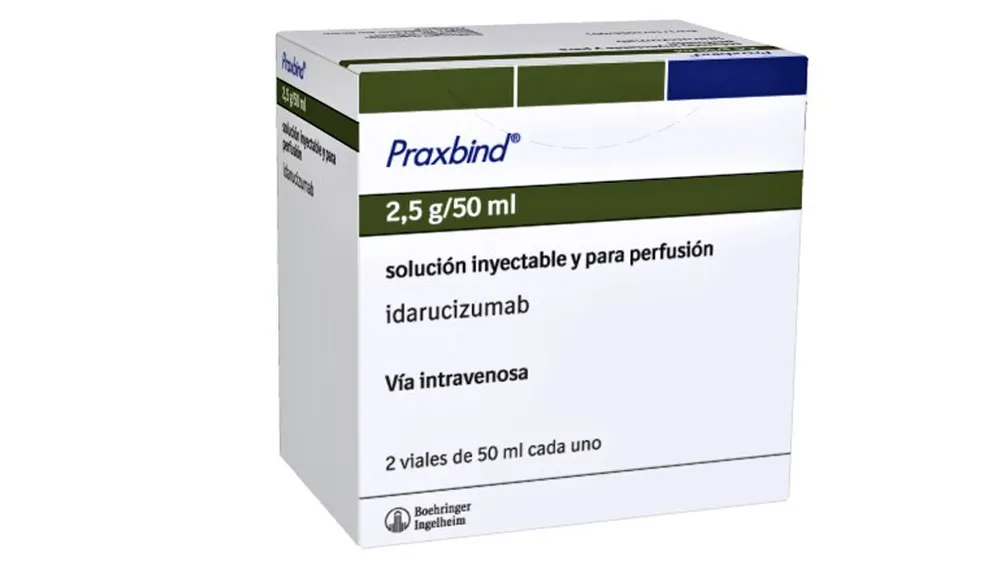
Table of Contents
Package leaflet: Information for the user
Introduction
Package leaflet: information for the patient and user
Praxbind 2.5 g/50 ml solution for injection and infusion
idarucizumab
Read the entire leaflet carefully, as it contains important information for you. Please note that this medicine is mainly used in emergency situations where your doctor has decided that you need it.
- Keep this leaflet, as you may need to read it again.
- If you have any questions, consult your doctor or nurse.
- If you experience any adverse reactions, consult your doctor or nurse, even if they are adverse reactions not listed in this leaflet. See section 4.
Contents of the leaflet
- What Praxbind is and what it is used for
- What you need to know before receiving Praxbind
- How to use Praxbind
- Possible side effects
- How to store Praxbind
- Contents of the pack and other information
1. What Praxbind is and what it is used for
What Praxbind is
Praxbind contains the active substance idarucizumab. Idarucizumab is a specific reversal agent for dabigatran, a medicine that thins the blood and blocks a substance in the body involved in blood clot formation.
Praxbind is used to rapidly bind dabigatran in order to neutralize its effect.
What Praxbind is used for
Praxbind is used in adults in emergency situations when your doctor decides that it is necessary to rapidly reverse the effect of dabigatran:
- For emergency surgery or urgent procedures.
- In the case of potentially life-threatening or uncontrolled bleeding.
2. What you need to know before receiving Praxbind
Warnings and precautions
Inform your doctor or nurse before receiving Praxbind:
- if you are allergic to idarucizumab or to any of the other ingredients listed in section 6.
- if you have a genetic condition called hereditary fructose intolerance. In this case, the sorbitol contained in this medicine may cause serious adverse reactions.
These healthcare professionals will take these factors into account before treating you with Praxbind.
This medicine only removes dabigatran from your body. It does not remove other medications used to prevent blood clots.
After dabigatran has been eliminated from your body, you will no longer be protected against the formation of blood clots. Your doctor will resume treatment with medications used to prevent blood clot formation as soon as your medical condition allows.
Children and adolescents
There is no information available on the use of Praxbind in children.
Other medicines and Praxbind
Inform your doctor if you are taking, have recently taken, or might need to take any other medicines.
This medicine has been developed to bind specifically to dabigatran only. It is unlikely that Praxbind will interfere with the effect of other medicines, or that other medicines will interfere with Praxbind.
Pregnancy and breastfeeding
If you are pregnant or breastfeeding, think you may be pregnant, or are planning to become pregnant, consult your doctor before receiving this medicine.
There is no information available on the effects of this medicine in pregnant or breastfeeding women. Praxbind does not affect any bodily functions per se, so your doctor may decide to administer this medicine if the expected benefits outweigh the potential risks.
Praxbind contains sodium
This medicine contains 50 mg of sodium (main component of table/cooking salt) per dose. This corresponds to 2.5% of the maximum daily recommended sodium intake for an adult.
3. How to use Praxbind
This medicine is for hospital use only.
The recommended dose is 5 g (2 vials of 2.5 g/50 ml).
In rare cases, you may still have too much dabigatran in your blood after the first dose of this medicine, and your doctor may decide to administer a second 5 g dose in specific situations.
Your doctor or nurse will give you this medicine by injection or infusion into a vein.
After receiving this medicine, your doctor will decide whether you need to continue treatment to prevent blood clots from forming. Dabigatran may be given again 24 hours after administration of this medicine.
Detailed instructions for doctors or nurses on how to administer this medicine are included at the end of this leaflet (see “Handling instructions”).
If you have any further questions about the use of this medicine, ask your doctor.
4. Possible adverse effects
Like all medicines, this medicine may cause adverse effects, although not everyone will experience them.
To date, no adverse effects have been identified.
Reporting of adverse effects
If you experience any type of adverse effect, consult your doctor or nurse, even if it is a possible adverse effect not listed in this leaflet. You may also report them directly through the national reporting system included in Appendix V. By reporting adverse effects, you can help provide more information on the safety of this medicine.
5. Storage of Praxbind
Keep this medicine out of the sight and reach of children.
Do not use this medicine after the expiry date stated on the vial and carton after "EXP". The expiry date refers to the last day of the month indicated.
Store in a refrigerator (between 2 °C and 8 °C).
Do not freeze.
Keep in the original packaging to protect from light.
Once opened, this medicine should be used immediately.
6. Contents of the pack and other information
Composition of Praxbind
- The active substance is idarucizumab.
- The other components are: sodium acetate trihydrate (E262), acetic acid (E260, for pH adjustment), sorbitol (E420), polysorbate 20 (E432), and water for injections.
Appearance of the product and contents of the pack
Praxbind is a solution ranging from clear to slightly opalescent and from colourless to slightly yellowish, supplied in a glass vial closed with a butyl rubber stopper and an aluminium cap.
Each pack contains two vials.
Marketing Authorization Holder
Boehringer Ingelheim International GmbH
Binger Str. 173
55216 Ingelheim am Rhein
Germany
Manufacturer
Boehringer Ingelheim Pharma GmbH & Co. KG
Birkendorfer Strasse 65
88397 Biberach an der Riss
Germany
Boehringer Ingelheim France
100-104 Avenue de France
75013 Paris
France
For further information on this medicinal product, please contact the local representative of the Marketing Authorization Holder:
Belgium/Belgium/Belgium Boehringer Ingelheim Scomm Tel/Tel: +32 2 773 33 11 | Lithuania Boehringer Ingelheim RCV GmbH & Co KG Lithuanian branch Tel: +370 5 2595942 |
| Luxembourg/Luxembourg Boehringer Ingelheim Scomm Tel/Tel: +32 2 773 33 11 |
Czech Republic Boehringer Ingelheim spol. s r.o. Tel: +420 234 655 111 | Hungary Boehringer Ingelheim RCV GmbH & Co KG Hungarian Branch Tel: +36 1 299 89 00 |
Denmark Boehringer Ingelheim Danmark A/S Tlf: +45 39 15 88 88 | Malta Boehringer Ingelheim Ireland Ltd. Tel: +353 1 295 9620 |
Germany Boehringer Ingelheim Pharma GmbH & Co. KG Tel: +49 (0) 800 77 90 900 | Netherlands Boehringer Ingelheim B.V. Tel: +31 (0) 800 22 55 889 |
Estonia Boehringer Ingelheim RCV GmbH & Co KG Estonian branch Tel: +372 612 8000 | Norway Boehringer Ingelheim Danmark A/S NUF Tlf: +47 66 76 13 00 |
Greece Boehringer Ingelheim Hellas Mono. E.P.E. Tel: +30 2 10 89 06 300 | Austria Boehringer Ingelheim RCV GmbH & Co KG Tel: +43 1 80 105‑7870 |
Spain Boehringer Ingelheim España, S.A. Tel: +34 93 404 51 00 | Poland Boehringer Ingelheim Sp. z o.o. Tel: +48 22 699 0 699 |
France Boehringer Ingelheim France S.A.S. Tél: +33 3 26 50 45 33 | Portugal Boehringer Ingelheim Portugal, Lda. Tel: +351 21 313 53 00 |
Croatia Boehringer Ingelheim Zagreb d.o.o. Tel: +385 1 2444 600 | Romania Boehringer Ingelheim RCV GmbH & Co KG Vienna – Bucharest Branch Tel: +40 21 302 28 00 |
Ireland Boehringer Ingelheim Ireland Ltd. Tel: +353 1 295 9620 | Slovenia Boehringer Ingelheim RCV GmbH & Co KG Ljubljana Branch Tel: +386 1 586 40 00 |
Iceland Vistor ehf. Tel: +354 535 7000 | Slovakia Boehringer Ingelheim RCV GmbH & Co KG organizational unit Tel: +421 2 5810 1211 |
Italy Boehringer Ingelheim Italia S.p.A. Tel: +39 02 5355 1 | Finland Boehringer Ingelheim Finland Ky Tel: +358 10 3102 800 |
Cyprus Boehringer Ingelheim Hellas Mono. E.P.E. Tel: +30 2 10 89 06 300 | Sweden Boehringer Ingelheim AB Tel: +46 8 721 21 00 |
Latvia Boehringer Ingelheim RCV GmbH & Co KG Latvian branch Tel: +371 67 240 011 |
Date of the most recent review of this leaflet:
Other sources of information
Detailed information on this medicinal product is available on the European Medicines Agency website: https://www.ema.europa.eu/.
This information is intended for healthcare professionals only:
Praxbind specifically binds to dabigatran and reverses its anticoagulant effect. It does not reverse the effects of other anticoagulants.
Treatment with Praxbind may be used in combination with other standard supportive measures, if these are considered medically appropriate.
In order to improve traceability of biological medicinal products, the name and batch number of the administered product should be clearly documented.
The recommended dose of Praxbind contains 4 g of sorbitol as excipient. In patients with hereditary fructose intolerance, there is a risk of serious adverse reactions, which should be weighed against the benefit of emergency treatment with Praxbind. If Praxbind is administered to these patients, intensified medical monitoring is required during exposure to Praxbind and within 24 hours after exposure.
Posology and method of administration:
The recommended dose is 5 g of idarucizumab (2 vials of 2.5 g/50 ml).
Administration of a second 5 g dose of idarucizumab may be considered in the following situations:
- recurrence of clinically relevant bleeding together with prolonged coagulation times, or
- if a potential new bleeding event would be potentially life-threatening and prolonged coagulation times are observed, or
- if patients require a second emergency surgical intervention or urgent procedure and have prolonged coagulation times.
The main coagulation parameters are activated partial thromboplastin time (aPTT), diluted thrombin time (dTT), or ecarin clotting time (ECT).
The maximum daily dose has not been investigated.
Praxbind (2 vials of 2.5 g/50 ml) is administered intravenously as two consecutive infusions, each lasting between 5 and 10 minutes, or as a rapid intravenous injection (bolus).
Patients receiving treatment with dabigatran have underlying conditions that predispose them to thromboembolic events. Reversal of dabigatran treatment exposes patients to the thrombotic risk associated with their underlying condition. To reduce this risk, resumption of anticoagulant therapy should be considered as soon as medically appropriate.
Treatment with dabigatran etexilate may be restarted 24 hours after administration of idarucizumab, provided the patient is clinically stable and adequate haemostasis has been achieved.
After administration of idarucizumab, alternative antithrombotic treatment (e.g. with low molecular weight heparin) may be initiated at any time, provided the patient is clinically stable and adequate haemostasis has been achieved.
Instructions for handling:
Praxbind must not be mixed with other medicinal products. A pre-existing intravenous line may be used for administration of Praxbind. This line must be flushed with 9 mg/ml sodium chloride (0.9%) solution for injection before and after the infusion. No other infusion should be administered simultaneously through the same intravenous access.
Praxbind is for single use only and contains no preservatives.
Before use, the unopened vial may be stored at room temperature (up to 30°C) for up to 48 hours, provided it is kept in the original packaging to protect from light. After vial opening, chemical and physical in-use stability of idarucizumab has been demonstrated for 6 hours at room temperature (up to 30°C). The solution must not be exposed to light for more than 6 hours (in unopened vial and/or during use).
From a microbiological standpoint, unless the method of opening excludes the risk of microbial contamination, the product should be used immediately after opening. If not used immediately, the storage times and conditions prior to use are the responsibility of the user.
No incompatibilities have been observed between Praxbind and infusion equipment made of polyvinyl chloride, polyethylene, or polyurethane, nor with polypropylene syringes.