Paxneury 5 mg prolonged-release tablets
Spain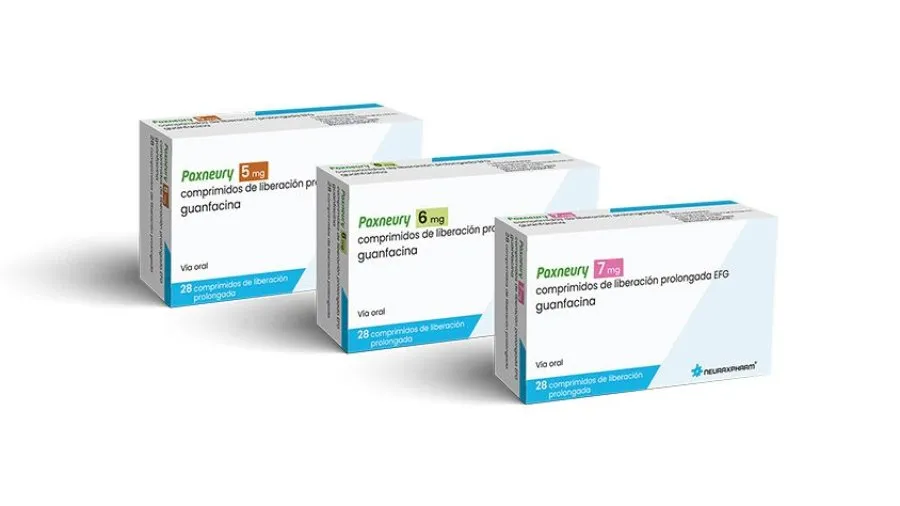
Table of Contents
Patient Information Leaflet
Introduction
Package Leaflet: Information for the patient
Paxneury 1 mg prolonged-release tablets
Paxneury 2 mg prolonged-release tablets
Paxneury 3 mg prolonged-release tablets
Paxneury 4 mg prolonged-release tablets
Paxneury 5 mg prolonged-release tablets
Paxneury 6 mg prolonged-release tablets
Paxneury 7 mg prolonged-release tablets
guanfacine
Read the entire leaflet carefully before you start taking this medicine, because it contains important information for you.
- Keep this leaflet. You may need to read it again.
- If you have any questions, ask your doctor, pharmacist, or nurse.
- This medicine has been prescribed for you only and must not be given to other people, even if they have the same symptoms as you, because it could harm them.
- If you experience any adverse effects, consult your doctor or pharmacist, even if they are effects not listed in this leaflet. See section 4.
- This leaflet has been written as if the reader were the person taking the medicine. If you are administering this medicine to your child, always replace "you" with "your child".
Leaflet Contents
- What Paxneury is and what it is used for
- What you need to know before taking Paxneury
- How to take Paxneury
- Possible side effects
- How to store Paxneury
- Contents of the pack and other information
1. What Paxneury is and what it is used for
What Paxneury is
Paxneury contains the active substance guanfacine. This medicine belongs to a group of medicines that affect brain activity. This medicine may help improve your attention and concentration and make you less impulsive and hyperactive.
What Paxneury is used for
This medicine is used to treat "attention deficit hyperactivity disorder" (ADHD) in children and adolescents aged 6 to 17 years when current stimulant medicines are not suitable and/or current medicines do not adequately control ADHD symptoms.
The medicine is given as part of a treatment programme, which usually includes the following:
- psychological therapy
- educational therapy
- social therapy
About ADHD
People with ADHD have difficulties with:
- staying still and seated;
- concentrating.
ADHD can cause problems in everyday life. Children and adolescents with ADHD may have difficulties with learning and schoolwork. They may find it hard to behave appropriately at home, at school, or in other settings.
2. What you need to know before starting to take Paxneury
Do not take Paxneury:
- if you are allergic to guanfacine or to any of the other components of this medicine (listed in section 6).
Warnings and precautions
Talk to your doctor or pharmacist before starting to take Paxneury:
- if you have low or high blood pressure, heart problems, or a family history of heart problems;
- if you have recently fainted;
- if you have suicidal thoughts or ideation;
- if you suffer from another psychiatric disorder.
Talk to your doctor or pharmacist if you are taking this medicine and:
- experience aggressive feelings or behaviors, or
- have suicidal thoughts or feelings.
Paxneury may affect your weight and height if taken for prolonged periods. Therefore, your doctor will monitor your growth.
Do not stop taking Paxneury without first consulting your doctor. If you stop taking Paxneury suddenly, you may experience withdrawal symptoms such as increased heart rate and elevated blood pressure (see section 4).
If any of the above apply to you (or if you are unsure), consult your doctor or pharmacist before taking this medicine. This is because this medicine may worsen these conditions. Your doctor will monitor you periodically to assess how the medicine affects you.
Children (under 6 years of age) and adults (18 years of age and older)
This medicine should not be used in children under 6 years of age or in adults aged 18 years and older, as it is not known whether it is effective or safe in these populations.
Checks your doctor will carry out when you are taking Paxneury
Before you start taking this medicine, your doctor will ensure that this medicine is safe for you and will be beneficial. While you are taking this medicine, your doctor will repeat these checks weekly at the beginning of treatment, after any dose adjustments, at least every 3 months during the first year, and subsequently at least twice a year. These checks may include:
- blood pressure and heart rate, and other heart tests, if appropriate;
- response to treatment, particularly whether it causes sleepiness or drowsiness;
- height and weight.
You should consult your doctor if you do not improve or if your condition worsens, or if you feel very sleepy or drowsy after taking this medicine for about 6 weeks. Your doctor may wish to review your treatment.
Other medicines and Paxneury
Tell your doctor or pharmacist if you are taking, have recently taken, or might need to take any other medicines. This is because Paxneury and certain medicines may interact.
Specifically, inform your doctor or pharmacist if you are taking any of the following types of medicines:
- medicines that lower blood pressure (antihypertensives);
- medicines for epilepsy such as valproic acid;
- medicines that cause sleepiness (sedatives);
- medicines for mental health conditions (benzodiazepines, barbiturates, and antipsychotics);
- medicines that may affect how the liver eliminates Paxneury (see the following table).
Medications | Treated condition |
Aprepitant | Nausea and dizziness |
Atazanavir, efavirenz, etravirine, | HIV infection |
Ciprofloxacin, chloramphenicol, | Bacterial infections |
Fluconazole, itraconazole, posaconazole, | Fungal infections |
Crizotinib, imatinib | Cancer |
Diltiazem, verapamil | Cardiovascular diseases |
Boceprevir, telaprevir | Viral hepatitis |
Suboxone | Substance dependence |
Bosentan | Cardiovascular diseases (e.g., constriction of |
Carbamazepine, oxcarbazepine, | Used to control epilepsy |
Modafinil | Medication that promotes wakefulness and is |
St. John's Wort | A herbal medication used |
If any of the above points apply to you or if you are unsure, consult your doctor or pharmacist before taking this medicine.
Taking Paxneury with food, drinks and alcohol
- Do not take this medicine with fatty foods (e.g., a high-fat meal), as they may affect how this medicine works.
- Do not drink grapefruit juice with this medicine, as it may affect how this medicine works.
- Do not drink alcohol while taking this medicine, as it may cause drowsiness or somnolence.
Pregnancy and breastfeeding
If you are pregnant or breastfeeding, think you might be pregnant, or are planning to become pregnant, consult your doctor or pharmacist before using this medicine.
- Do not take this medicine if you are pregnant or if you are not using contraception. It is unknown whether Paxneury will affect the fetus.
- Do not breast-feed while taking Paxneury unless instructed otherwise by your doctor.
Driving and using machines
You may feel dizzy or drowsy when taking this medicine, especially at the beginning of treatment, and this may last for 2 to 3 weeks or possibly longer. If this occurs, do not drive, ride a bicycle, operate tools or machinery, or engage in activities that could result in injury until you know how this medicine affects you. Fainting has also been reported, although this is not a common side effect.
Paxneury contains lactose
This medicine contains lactose. If your doctor has informed you that you have an intolerance to certain sugars, consult with him before taking this medicine.
Paxneury contains sodium
This medicine contains less than 1 mmol of sodium (23 mg) per tablet; i.e., essentially sodium-free.
3. How to take Paxneury
Your treatment will begin under the supervision of a specialist in childhood and/or adolescent behavioural disorders.
Follow exactly the instructions for administration of this medicine given by your doctor or pharmacist. If in doubt, consult your doctor or pharmacist again.
As part of your treatment, your doctor will closely monitor how Paxneury affects you at the beginning of treatment and/or during dose adjustments.
How much to take
- Your doctor will start your treatment at 1 mg once daily. Your doctor may increase your dose depending on your body weight and how well Paxneury is working for you, but not by more than 1 mg per week. Depending on your response to treatment, your doctor may increase the dose more slowly. The recommended maintenance dose is between 0.05 and 0.12 mg per kg of body weight per day.
- You may not notice an immediate effect at the beginning of treatment; some patients notice improvement after the first week, although it may take longer.
- The daily dose will range between 1 and 7 mg, depending on your age and response to Paxneury, but will not exceed 7 mg.
How to take Paxneury
- This medicine should be taken once daily, either in the morning or at night.
- It can be taken with or without food, but should not be taken with fatty foods (e.g., a high-fat breakfast).
- Swallow the tablet whole with water or another liquid (not grapefruit juice).
- Do not break, crush, or chew the tablet, as this will affect how the medicine works. Inform your doctor if you are unable to swallow the tablet whole.
Duration of treatment
If you need to take Paxneury for more than one year, your doctor will monitor your response to treatment and may interrupt the medicine for a brief period; this may be done during school holidays. This break will help determine whether you still need to continue taking the medicine.
If you take more Paxneury than you should
If you take more Paxneury than prescribed, consult a doctor or go to a hospital immediately. Take the medicine pack with you and tell them how much you have taken.
The following effects may occur: high or low blood pressure, slow heart rate, slow breathing, tiredness, or exhaustion.
If you forget to take Paxneury
If you miss a dose, wait until the next day and take your usual dose.
- If you miss two or more doses, consult your doctor, as you may need to restart Paxneury at a lower dose.
- Do not take a double dose to make up for missed doses.
If you stop taking Paxneury
Do not stop taking this medicine without first consulting your doctor.
- If you stop taking this medicine, you may experience increased blood pressure and heart rate (see section 4 below).
- To stop taking the medicine, your doctor will gradually reduce your dose of Paxneury to minimize any adverse effects.
If you have any further questions about the use of this medicine, ask your doctor or pharmacist.
4. Possible adverse effects
Like all medicines, this medicine can cause adverse effects, although not everyone experiences them. If you are concerned about anything, consult your doctor.
If you do not feel well while taking this medicine, speak to an adult immediately.
Serious adverse effects
The following adverse effects have been reported: drowsiness (sedation), dizziness (hypotension), and slow heart rate (bradycardia), fainting or loss of consciousness (syncope), a serious withdrawal reaction, high blood pressure after sudden discontinuation of Paxneury; symptoms may include headache, confusion, nervousness, agitation, and tremors (hypertensive encephalopathy).
Some of these adverse effects are more likely to occur at the beginning of treatment and may disappear as treatment continues. If you experience any of these adverse effects, consult your doctor immediately.
Other adverse effects
The following adverse effects have been reported.
Very common (may affect more than 1 in 10 people)
- sleepiness (somnolence);
- tiredness (fatigue);
- headache;
- stomach pain (abdominal pain).
Common (may affect up to 1 in 10 people)
- slow heart rate;
- decrease in blood pressure;
- restlessness or irritability;
- trouble sleeping (insomnia) or interrupted sleep (maintenance insomnia) or nightmares;
- depression, worry (anxiety), or mood changes (affective lability);
- lack of energy (lethargy);
- weight gain;
- loss of appetite;
- dry mouth;
- involuntary loss of urine (enuresis);
- nausea or vomiting;
- diarrhea, abdominal discomfort, or constipation;
- low blood pressure upon standing (orthostatic hypotension);
- skin rash.
Uncommon (may affect up to 1 in 100 people)
- allergic reaction (hypersensitivity);
- chest pain;
- indigestion (dyspepsia);
- breathing problems (asthma);
- weakness (asthenia);
- pale skin (pallor);
- seizures or convulsions;
- need to urinate frequently (polyuria);
- agitation;
- aggression;
- changes in liver blood test results (increase in alanine aminotransferase);
- increase in blood pressure;
- unusual heart rhythm (sinus arrhythmia and first-degree atrioventricular block);
- fast heartbeat (tachycardia);
- reduced heart rate;
- dizziness upon standing (postural dizziness);
- itching of the skin (pruritus);
- seeing or hearing things that are not real (hallucinations).
Rare (may affect up to 1 in 1,000 people)
- sleeping more than usual (hypersomnia);
- high blood pressure (hypertension);
- malaise.
Very rare (may affect up to 1 in 10,000 people)
- a serious withdrawal reaction, high blood pressure after sudden discontinuation of Paxneury; symptoms may include headache, confusion, nervousness, agitation, and tremors (hypertensive encephalopathy).
Frequency not known (cannot be estimated from available data)
- difficulty achieving or maintaining an erection (erectile dysfunction).
Reporting of adverse effects
If you experience any adverse effect, talk to your doctor or pharmacist, even if it is a possible adverse effect not listed in this leaflet. You may also report them directly through the national reporting system included in Appendix V. By reporting adverse effects, you can help provide more information on the safety of this medicine.
5. Storage of Paxneury
Keep this medicine out of the sight and reach of children.
Do not use this medicine after the expiry date stated on the carton and on the blister after EXP.
The expiry date refers to the last day of the month indicated.
This medicine does not require any special storage conditions.
Do not use this medicine if you notice any damage to the tablets or to the blister.
Medicines must not be disposed of via wastewater or household waste. Ask your pharmacist how to dispose of medicines and packaging that you no longer need. This will help protect the environment.
6. Contents of the pack and other information Composition of Paxneury
- Each 1 mg tablet contains guanfacine hydrochloride equivalent to 1 mg of guanfacine
- Each 2 mg tablet contains guanfacine hydrochloride equivalent to 2 mg of guanfacine
- Each 3 mg tablet contains guanfacine hydrochloride equivalent to 3 mg of guanfacine
- Each 4 mg tablet contains guanfacine hydrochloride equivalent to 4 mg of guanfacine
- Each 5 mg tablet contains guanfacine hydrochloride equivalent to 5 mg of guanfacine
- Each 6 mg tablet contains guanfacine hydrochloride equivalent to 6 mg of guanfacine
- Each 7 mg tablet contains guanfacine hydrochloride equivalent to 7 mg of guanfacine
The other components are hypromellose (2208), methacrylic acid-ethyl acrylate copolymer (type A), lactose monohydrate, povidone, crospovidone (type A), microcrystalline cellulose, colloidal anhydrous silica, sodium lauryl sulfate, polysorbate 80, fumaric acid, glycerol dibehenate.
Appearance of the product and pack contents
Paxneury is an extended-release tablet, which means that the active ingredient is released from the tablet over a period of time. The tablets come in packs of:
- 1 mg guanfacine tablets are white, round, 8 mm in diameter, biconvex, with the imprint “I” on one side.
- 2 mg guanfacine tablets are white, biconvex, oblong, 14 x 6 mm, with the imprint “II” on one side.
- 3 mg guanfacine tablets are white, round, 6 mm in diameter, biconvex, with the imprint “3” on one side.
- 4 mg guanfacine tablets are white, round, 7 mm in diameter, biconvex, with the imprint “IV” on one side.
- 5 mg guanfacine tablets are white, round, 8 mm in diameter, biconvex, with the imprint “V” on one side.
- 6 mg guanfacine tablets are white, round, 9 mm in diameter, biconvex, with the imprint “VI” on one side.
- 7 mg guanfacine tablets are white, biconvex, oblong, 12.5 x 6.5 mm, with the imprint “7” on one side.
Marketing Authorization Holder and Manufacturer
Marketing Authorization Holder
Neuraxpharm Pharmaceuticals, S.L.
Avda. Barcelona 69
08970 Sant Joan Despí
Barcelona – Spain
Manufacturer
Neuraxpharm Pharmaceuticals, S.L.
Avda. Barcelona 69
08970 Sant Joan Despí
Barcelona – Spain
or
Neuraxpharm Arzneimittel GmbH
Elisabeth-Selbert-Strasse 23, Richrath
Langenfeld (Rheinland)
40764, Germany
For further information about this medicinal product, please contact the local representative of the Marketing Authorization Holder:
Belgium/Belgium/Belgium Neuraxpharm Belgium Tel/Tel: +32 (0)2 732 56 95 | Lithuania Neuraxpharm Pharmaceuticals, S.L. Tel: +34 93 475 96 00 |
| Luxembourg/Luxembourg Neuraxpharm France Tel/Tel: +32 (0)2 732 56 95 |
Czech Republic Neuraxpharm Bohemia s.r.o. Tel: +420 739 232 258 | Hungary Neuraxpharm Hungary Kft. Tel.: +3630 464 6834 |
Denmark Neuraxpharm Sweden AB Tlf: +46 (0)8 30 91 41 (Sweden) | Malta Neuraxpharm Pharmaceuticals, S.L. Tel: +34 93 475 96 00 |
Germany neuraxpharm Arzneimittel GmbH Tel: +49 2173 1060 0 | Netherlands Neuraxpharm Netherlands B.V Tel: +31 70 208 5211 |
Estonia Neuraxpharm Pharmaceuticals, S.L. Tel: +34 93 475 96 00 | Norway Neuraxpharm Sweden AB Tlf: +46 (0)8 30 91 41 (Sweden) |
Greece Brain Therapeutics PC Tel: +302109931458 | Austria Neuraxpharm Austria GmbH Tel.: +43 (0) 2236 320038 |
Spain Neuraxpharm Spain, S.L.U. Tel: +34 93 475 96 00 | Poland Neuraxpharm Polska Sp. z.o.o. Tel.: +48 783 423 453 |
France Neuraxpharm France Tel: +33 1.53.62.42.90 | Portugal Neuraxpharm Portugal, Unipessoal Lda Tel: +351 910 259 536 |
Croatia Neuraxpharm Pharmaceuticals, S.L. T +34 93 602 24 21 | Romania Neuraxpharm Pharmaceuticals, S.L. Tel: +34 93 602 24 21 |
Ireland Neuraxpharm Ireland Ltd. Tel: +353 (0)1 428 7777 | Slovenia Neuraxpharm Pharmaceuticals, S.L. Tel: +34 93 602 24 21 |
Iceland Neuraxpharm Sweden AB Sími: +46 (0)8 30 91 41 (Sweden) | Slovakia Neuraxpharm Slovakia a.s Tel: +421 255 425 562 |
Italy Neuraxpharm Italy S.p.A. Tel: +39 0736 980619 | Finland/Finland Neuraxpharm Sweden AB Puh/Tel: +46 (0)8 30 91 41 (Sweden/Sverige) |
Cyprus Brain Therapeutics IKE Tel: +302109931458 | Sweden Neuraxpharm Sweden AB Tel: +46 (0)8 30 91 41 |
Latvia Neuraxpharm Pharmaceuticals, S.L. Tel: +34 93 475 96 00 | United Kingdom (Northern Ireland) Neuraxpharm Ireland Ltd. Tel: +353 1 428 7777 |
Date of the most recent revision of this leaflet:
Other sources of information
Detailed information on this medicinal product is available on the European Medicines Agency website: https://www.ema.europa.eu.