Onureg 300 mg film-coated tablets
Spain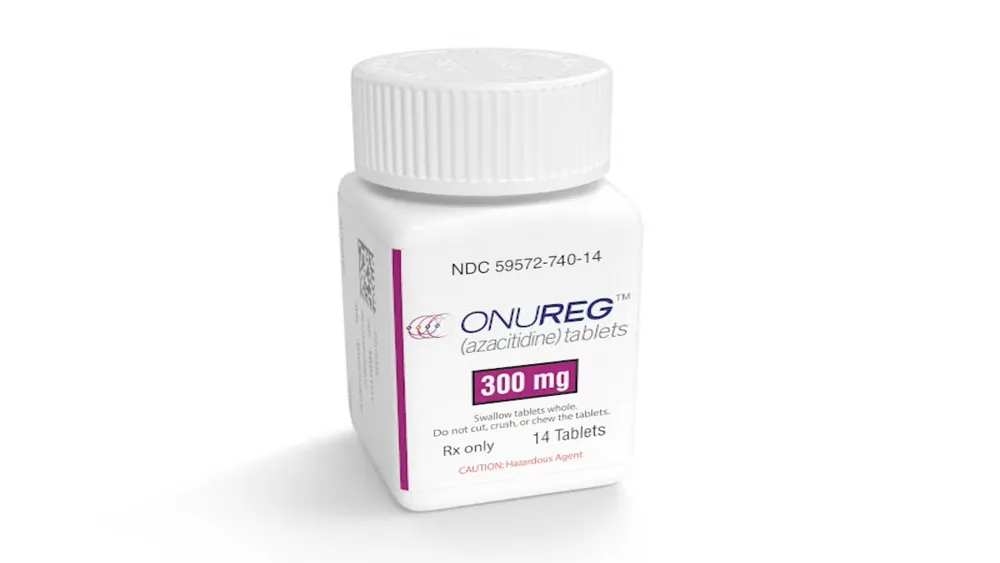
Table of Contents
Package leaflet: Information for the user
Introduction
Package leaflet: information for the user
Onureg 200 mg film-coated tablets
Onureg 300 mg film-coated tablets
azacitidine
Read the entire leaflet carefully before you start taking this medicine, because it contains important information for you.
- Keep this leaflet, as you may need to read it again.
- If you have any questions, ask your doctor, pharmacist, or nurse.
- This medicine has been prescribed for you only, and you should not give it to others, even if they have the same symptoms as you, because it may harm them.
- If you experience any adverse reactions, consult your doctor, pharmacist, or nurse, even if they are possible adverse reactions not listed in this leaflet. See section 4.
Contents of the leaflet
- What Onureg is and what it is used for
- What you need to know before taking Onureg
- How to take Onureg
- Possible side effects
- How to store Onureg
- Contents of the pack and other information
1. What Onureg is and what it is used for
What Onureg is
Onureg is a cancer medicine that belongs to a group of medicines called antimetabolites. Onureg contains the active substance azacitidine.
What Onureg is used for
Onureg is used to treat adults with acute myeloid leukaemia (AML). This is a type of cancer that affects the bone marrow and can cause problems in the production of normal blood cells.
Onureg is used to help maintain disease control (remission, when the disease is less severe or not active).
How Onureg works
Onureg works by preventing the growth of cancer cells. Azacitidine, the active ingredient in Onureg, works by altering the way cells switch genes on or off. It also reduces the production of new genetic material (RNA and DNA). These effects are believed to block the growth of cancer cells in leukaemia.
Talk to your doctor or nurse if you have any questions about how Onureg works or why this medicine has been prescribed for you.
2. What you need to know before starting Onureg
Do not take Onureg
- if you are allergic to azacitidine or to any of the other ingredients of this medicine (listed in section 6);
- if you are breastfeeding.
Warnings and precautions
Blood tests
You will have blood tests before starting treatment with Onureg and during treatment to check that you have enough blood cells and that your liver and kidneys are functioning properly. Your doctor will decide how often blood tests should be performed.
Tell your doctor, pharmacist, or nurse immediately if you experience any of the following symptoms during treatment with Onureg:
- bruising or bleeding: this could be due to a low count of blood cells called platelets;
- fever: this could be due to an infection resulting from low white blood cell levels, which can be potentially life-threatening;
- diarrhoea, vomiting, or nausea (feeling sick).
Azacitidine may cause a serious immune reaction called “differentiation syndrome” (see section 4 “Possible side effects”).
Your doctor may need to adjust your dose or temporarily or permanently stop treatment with Onureg. Your doctor may prescribe other medicines to help manage these symptoms (see section 3 “How to take Onureg”).
Children and adolescents
Onureg is not recommended for use in children and adolescents under 18 years of age.
Other medicines and Onureg
Tell your doctor if you are taking, have recently taken, or might need to take any other medicines. This is because Onureg may affect how other medicines work. Likewise, other medicines may affect how Onureg works.
Pregnancy, contraception, and breastfeeding
If you are pregnant or breastfeeding, think you may be pregnant, or plan to become pregnant, consult your doctor before using this medicine. Men must not father a child while receiving treatment with Onureg.
Pregnancy
Onureg must not be used during pregnancy because it may harm the unborn baby. Inform your doctor immediately if you become pregnant during treatment.
Contraception
If you are a woman who can become pregnant, you must use an effective method of contraception while taking Onureg and for 6 months after stopping treatment with Onureg. Men must use an effective method of contraception while taking Onureg and for 3 months after stopping treatment with Onureg.
Your doctor will advise you on the most appropriate contraceptive method for you.
Breastfeeding
You must not breastfeed while taking Onureg as it may be harmful to your child (see section 2 “Do not take Onureg”).
Fertility
Onureg may affect your ability to have children. Talk to your doctor before using this medicine.
Driving and using machines or tools
You may feel tired or weak or have difficulty concentrating. If this happens to you or if you experience any other side effects, do not drive or operate machines or tools.
Onureg contains lactose
Onureg contains lactose monohydrate. If your doctor has told you that you have an intolerance to certain sugars, consult with them before taking this medicine.
Onureg contains sodium
This medicine contains less than 1 mmol of sodium (23 mg) per tablet; this is essentially “sodium-free”.
3. How to take Onureg
Follow exactly the instructions for using this medicine as given by your doctor. If in doubt, consult your doctor.
How much to take
- The recommended dose is 300 mg orally once daily.
- Your doctor may reduce your dose to 200 mg once daily if you experience adverse reactions.
Onureg is administered in 28-day treatment cycles.
- Onureg is taken daily for the first 14 days of each 28-day cycle.
- This is followed by a 14-day treatment-free period for the remainder of the cycle.
Your doctor will determine the dose of Onureg you should take. Your doctor may decide to:
- extend treatment beyond the 14 days of each treatment cycle;
- reduce your dose or temporarily interrupt treatment;
- reduce treatment to 7 days.
Always take Onureg exactly as prescribed by your doctor.
Your doctor will give you a medicine to help reduce nausea (feeling sick) and vomiting. You will take this medicine 30 minutes before each Onureg tablet during the first and second treatment cycles. If necessary, your doctor may instruct you to take it for a longer period.
Taking this medicine
- Take Onureg once daily – at the same time each day.
- Swallow the tablets whole with a full glass of water.
- To ensure you receive the correct dose, do not split, crush, dissolve, or chew the tablets.
- You may take the medicine with food or between meals.
If you vomit after taking a tablet, do not take another dose on the same day. Instead, wait until the next day to take your next scheduled dose. Do not take two doses on the same day.
If powder from a broken tablet comes into contact with your skin, wash the skin immediately and thoroughly with soap and water. If the powder comes into contact with the eyes, nose, or mouth, rinse the area thoroughly with water.
If you take more Onureg than you should
If you take more tablets than you should, contact your doctor or go to a hospital immediately. If possible, take the medicine container and this leaflet with you.
If you forget to take Onureg
If you forget to take your usual dose of Onureg, take it as soon as you remember on the same day, and take your next dose at the usual time the following day. Do not take a double dose to make up for a forgotten or vomited tablet.
If you stop taking Onureg
Do not stop taking Onureg unless your doctor tells you to.
If you have any further questions about the use of this medicine, ask your doctor.
4. Possible adverse effects
Like all medicines, this medicine may cause adverse effects, although not everyone will experience them.
Serious adverse effects
Immediately inform your doctor, pharmacist, or nurse if you experience any of the following symptoms during treatment with Onureg:
Very common: may affect more than 1 in 10 people
- bruising or bleeding: may be due to a low count of blood cells called platelets;
- fever: may be due to an infection resulting from low levels of white blood cells, which can be potentially life-threatening;
- diarrhoea, vomiting, or nausea (feeling sick).
Other adverse effects include:
Very common: may affect more than 1 in 10 people
- constipation;
- abdominal pain;
- infections of the nose, sinuses, and throat;
- lung infection;
- tiredness or weakness;
- loss of appetite;
- pain affecting different parts of the body, which may range from sharp pain to constant pain;
- joint stiffness;
- back pain.
Common: may affect up to 1 in 10 people
- blood infection caused by bacteria (sepsis): may be due to low levels of white blood cells in your blood;
- influenza (flu);
- urinary tract infection;
- seasonal allergy;
- anxiety;
- weight loss.
Frequency not known (cannot be estimated from available data)
- Severe immune reaction (differentiation syndrome) which may cause fever, cough, difficulty breathing, rash, decreased urine output, low blood pressure (hypotension), swelling of the arms or legs, and rapid weight gain.
Reporting of adverse effects
If you experience any type of adverse effect, consult your doctor, even if it is a possible adverse effect not listed in this leaflet. You may also report them directly through the national reporting system included in Appendix V. By reporting adverse effects, you can help provide more information on the safety of this medicine.
5. Storage of Onureg
Keep this medicine out of the sight and reach of children.
Do not use this medicine after the expiry date stated on the blister and carton after EXP or CAD. The expiry date refers to the last day of the month indicated.
This medicine does not require any special storage conditions.
Medicines must not be disposed of via wastewater or household waste. Ask your pharmacist how to dispose of medicines and packaging you no longer need. This helps protect the environment.
6. Contents of the pack and other information
Composition of Onureg
-
The active substance is azacitidine. Each film-coated tablet contains 200 mg or 300 mg of azacitidine.
-
The other components are croscarmellose sodium (E468), magnesium stearate (E572), mannitol (E421), and silicified microcrystalline cellulose (E460, E551).
-
The 200 mg tablet coating, Opadry II pink, contains: hypromellose (E464), titanium dioxide (E171), lactose monohydrate, polyethylene glycol/macrogols (E1521), triacetin (E1518), and red iron oxide (E172). See section 2 “Onureg contains lactose and sodium”.
-
The 300 mg tablet coating, Opadry II brown, contains: hypromellose (E464), titanium dioxide (E171), lactose monohydrate, polyethylene glycol/macrogols (E1521), triacetin (E1518), red iron oxide (E172), yellow iron oxide (E172), and black iron oxide (E172). See section 2 “Onureg contains lactose and sodium”.
Appearance of the product and contents of the pack
Onureg 200 mg film-coated tablets (tablets) are pink, oblong tablets with “200” printed on one side and “ONU” on the other side.
Onureg 300 mg film-coated tablets (tablets) are brown, oblong tablets with “300” printed on one side and “ONU” on the other side.
The tablets are packed in aluminium blisters.
Each pack contains 7 or 14 film-coated tablets. Only certain pack sizes may be marketed.
Marketing Authorization Holder
Bristol-Myers Squibb Pharma EEIG
Plaza 254
Blanchardstown Corporate Park 2
Dublin 15, D15 T867
Ireland
Manufacturer
Celgene Distribution B.V.
Orteliuslaan 1000
3528 BD Utrecht
The Netherlands
For more information about this medicinal product, please contact the local representative of the Marketing Authorization Holder:
Belgium/Belgium/Belgium N.V. Bristol-Myers Squibb Belgium S.A. Tel/Tel: + 32 2 352 76 11 | Lithuania Swixx Biopharma UAB Tel: + 370 52 369140 |
| Luxembourg/Luxembourg N.V. Bristol-Myers Squibb Belgium S.A. Tel/Tel: + 32 2 352 76 11 |
Czech Republic Bristol-Myers Squibb spol. s r.o. Tel: + 420 221 016 111 | Hungary Bristol-Myers Squibb Kft. Tel.: + 36 1 301 9797 |
Denmark Bristol-Myers Squibb Denmark Tlf: + 45 45 93 05 06 | Malta A.M. Mangion Ltd Tel: + 356 23976333 |
Germany Bristol-Myers Squibb GmbH & Co. KGaA Tel: 0800 0752002 (+ 49 89 121 42 350) | Netherlands Bristol-Myers Squibb B.V. Tel: + 31 (0)30 300 2222 |
Estonia Swixx Biopharma OÜ Tel: + 372 640 1030 | Norway Bristol-Myers Squibb Norway AS Tlf: + 47 67 55 53 50 |
Greece Bristol-Myers Squibb A.E. Tel: + 30 210 6074300 | Austria Bristol-Myers Squibb GesmbH Tel: + 43 1 60 14 30 |
Spain Bristol-Myers Squibb, S.A. Tel: + 34 91 456 53 00 | Poland Bristol-Myers Squibb Polska Sp. z o.o. Tel.: + 48 22 2606400 |
France Bristol-Myers Squibb SAS Tél: + 33 (0)1 58 83 84 96 | Portugal Bristol-Myers Squibb Farmacêutica Portuguesa, S.A. Tel: + 351 21 440 70 00 |
Croatia Swixx Biopharma d.o.o. Tel: + 385 1 2078 500 | Romania Bristol-Myers Squibb Marketing Services S.R.L. Tel: + 40 (0)21 272 16 19 |
Ireland Bristol-Myers Squibb Pharmaceuticals uc Tel: 1 800 749 749 (+ 353 (0)1 483 3625) | Slovenia Swixx Biopharma d.o.o. Tel: + 386 1 2355 100 |
Iceland Vistor hf. Sími: + 354 535 7000 | Slovakia Swixx Biopharma s.r.o. Tel: + 421 2 20833 600 |
Italy Bristol-Myers Squibb S.r.l. Tel: + 39 06 50 39 61 | Finland Oy Bristol-Myers Squibb (Finland) Ab Puh/Tel: + 358 9 251 21 230 |
Cyprus Bristol-Myers Squibb A.E. Tel: 800 92666 (+ 30 210 6074300) | Sweden Bristol-Myers Squibb Aktiebolag Tel: + 46 8 704 71 00 |
Latvia Swixx Biopharma SIA Tel: + 371 66164750 |
Date of the most recent review of this leaflet:
Other sources of information
Detailed information on this medicinal product is available on the website of the European Medicines Agency: https://www.ema.europa.eu/.