Nuwiq 500 IU powder and solvent for solution for injection
Spain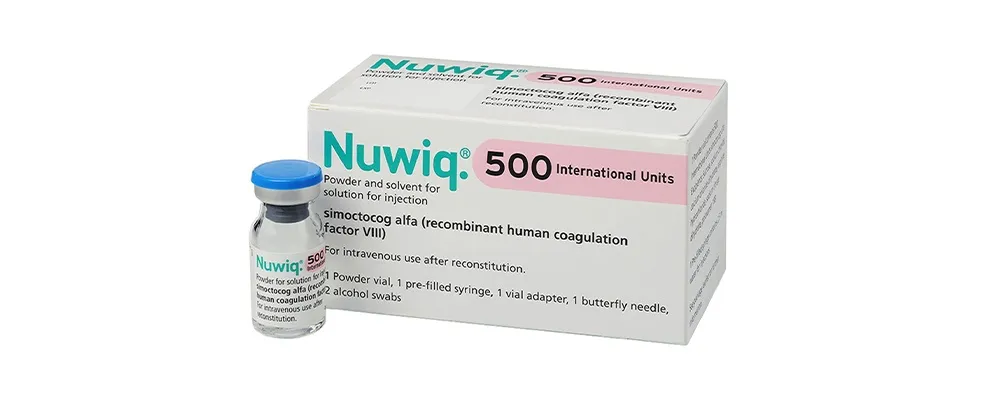
Table of Contents
Package leaflet: Information for the user
Introduction
Package leaflet: information for the user
Nuwiq 250 IU powder and solvent for solution for injection
Nuwiq 500 IU powder and solvent for solution for injection
Nuwiq 1000 IU powder and solvent for solution for injection
Nuwiq 2000 IU powder and solvent for solution for injection
Nuwiq 2500 IU powder and solvent for solution for injection
Nuwiq 3000 IU powder and solvent for solution for injection
Nuwiq 4000 IU powder and solvent for solution for injection
simoctocog alfa (recombinant human coagulation factor VIII)
Read all of this leaflet carefully before you start using this medicine because it contains important information for you.
- Keep this leaflet. You may need to read it again.
- If you have any further questions, ask your doctor.
- This medicine has been prescribed for you only. Do not pass it on to other people, even if they have the same symptoms as you, because it may harm them.
- If you get any side effects, talk to your doctor. This includes any possible side effects not listed in this leaflet. See section 4.
Contents of the leaflet
- What Nuwiq is and what it is used for
- What you need to know before using Nuwiq
- How to use Nuwiq
- Possible side effects
- How to store Nuwiq
- Contents of the pack and other information
1. What Nuwiq is and what it is used for
Nuwiq contains the active substance recombinant human coagulation factor VIII (simoctocog alfa). Factor VIII is required for blood to form clots and stop bleeding. In patients with haemophilia A (congenital factor VIII deficiency), factor VIII is missing or does not work properly.
Nuwiq replaces the missing factor VIII and is used for the treatment and prevention of bleeding in patients with haemophilia A and can be used in all age groups.
2. What you need to know before using Nuwiq
Do not use Nuwiq:
- if you are allergic to the active substance simoctocog alfa or to any of the other components of this medicine (listed in section 6).
If you are unsure, ask your doctor.
Warnings and precautions
Talk to your doctor or nurse before starting to use Nuwiq.
There is a rare possibility that you may experience an anaphylactic reaction (a sudden, severe allergic reaction) to Nuwiq. You must be able to recognize the early symptoms of allergic reactions, which are included in section 4, "Allergic reactions".
If any of these symptoms occur, stop the injection immediately and contact your doctor.
The development of inhibitors (antibodies) is a known complication that may occur during treatment with all factor VIII-containing medicines. These inhibitors, especially when present in high amounts, can prevent the treatment from working properly. Therefore, you and your child will be closely monitored for the development of such inhibitors. If your bleeding or your child's bleeding is not controlled with Nuwiq, contact your doctor immediately.
Cardiovascular events
In patients with existing cardiovascular risk factors, replacement therapy with FVIII may increase the cardiovascular risk.
Catheter-related complications
If you require a central venous access device (CVAD), the risk of CVAD-related complications, including localized infections, presence of bacteria in the blood, and thrombosis at the catheter site, should be considered.
It is strongly recommended that each time Nuwiq is administered, the name and batch number of the product be recorded to maintain a link between you and the batch of medicine used.
Other medicines and Nuwiq
Inform your doctor if you are taking, have recently taken, or might need to take any other medicines.
Pregnancy and breastfeeding
If you are pregnant or breastfeeding, think you may be pregnant, or are planning to become pregnant, consult your doctor before using this medicine.
Driving and using machines
Nuwiq has no influence on the ability to drive and use machines.
Nuwiq contains sodium
This medicine contains less than 1 mmol of sodium (23 mg) per vial, i.e., essentially “sodium-free”.
However, depending on your body weight and dosage, you may be administered more than one vial, which should be taken into account if you are on a low-sodium diet.
3. How to use Nuwiq
Treatment with Nuwiq will be initiated by a doctor experienced in the care of patients with haemophilia A. Follow exactly the instructions for administering this medicine as given by your doctor or nurse. If in doubt, consult your doctor or nurse again.
Nuwiq is usually injected into a vein (intravenously) by your doctor or a nurse experienced in the care of patients with haemophilia A. You or another person may also inject Nuwiq, but only after receiving appropriate training.
Your doctor will calculate your dose of Nuwiq (in International Units = IU) depending on your condition and body weight, and whether it is being used for prevention or for treatment of bleeding episodes. The frequency with which you will need an injection depends on how well Nuwiq works for you. Usually, treatment of haemophilia A is a lifelong treatment.
Prevention of bleeding episodes
The usual dose of Nuwiq is 20 to 40 IU per kg of body weight, administered every 2 to 3 days. However, in some cases, especially in younger patients, more frequent injections or higher doses may be required.
Treatment of bleeding episodes
The dose of Nuwiq is calculated based on your body weight and the factor VIII levels that need to be achieved. The target factor VIII levels will depend on the severity and location of the bleeding.
If you feel that the effect of Nuwiq is insufficient, consult your doctor. Your doctor will perform appropriate laboratory tests to ensure you have adequate factor VIII levels. This is especially important if you are undergoing major surgery.
Patients who develop factor VIII inhibitors
If your plasma factor VIII does not reach the expected levels with Nuwiq, or if bleeding episodes are not adequately controlled, this may be due to the development of factor VIII inhibitors. Your doctor will check for this. You may need a higher dose of Nuwiq or a different product to control bleeding episodes. Do not increase the total dose of Nuwiq to control your bleeding without consulting your doctor.
Use in children and adolescents
The way Nuwiq is used in children and adolescents does not differ from the way it is used in adults. Since factor VIII medicines may need to be administered more frequently in children and adolescents, it may be necessary to use a central venous access device (CVAD). A CVAD is an external connector that allows access to the bloodstream via a catheter without injecting through the skin.
If you use more Nuwiq than you should
There have been no reported symptoms of overdose. If you have injected more Nuwiq than you should, inform your doctor.
If you forget to use Nuwiq
Do not take a double dose to make up for forgotten doses. Administer the next dose immediately and continue following your doctor's recommendations.
If you stop using Nuwiq
Do not stop treatment with Nuwiq without consulting your doctor.
If you have any further questions about the use of this medicine, ask your doctor.
4. Possible adverse effects
Like all medicines, this medicine may cause adverse effects, although not everybody will experience them.
Allergic reactions
You should be able to recognize the early symptoms of allergic reactions. If sudden severe allergic (anaphylactic) reactions (very rare, may affect up to 1 in 10,000 people) occur, the injection must be stopped immediately. Contact your doctor immediately if you notice any of the following symptoms:
- rash, skin eruption, hives, generalized itching,
- swelling of lips and tongue,
- difficulty breathing, wheezing, chest tightness,
- general feeling of discomfort,
- dizziness and loss of consciousness.
These symptoms may be early signs of anaphylactic shock. If any of these symptoms occur, stop the injection immediately and contact your doctor. Severe symptoms require immediate emergency treatment.
Very common adverse effects (may affect more than 1 in 10 people)
Factor VIII inhibitors in previously untreated patients.
In children and adolescents who have not previously received treatment with factor VIII-containing medicines, antibodies (inhibitors) may develop very commonly (in more than 1 in 10 patients).
However, in patients who have previously received factor VIII treatment (more than 150 days of treatment), the risk is uncommon (less than 1 in 100 patients). If this occurs, the medicines you or your child are taking may no longer work properly, and you or your child may experience persistent bleeding. In such a case, contact your doctor immediately.
Common adverse effects (may affect up to 1 in 10 people)
Hypersensitivity, fever.
Uncommon adverse effects (may affect up to 1 in 100 patients)
Tingling or numbness (paresthesia), headache, swelling and/or pain at the injection site, back pain, dizziness, dry mouth, dizziness, a vague feeling of general bodily discomfort, shortness of breath, hemorrhagic anemia, positive results for formation of non-neutralizing antibodies (in PTP).
Reporting of adverse effects
If you experience any type of adverse effects, consult your doctor, even if they are possible adverse effects not listed in this leaflet. You may also report them directly through the national reporting system included in Appendix V. By reporting adverse effects, you can help provide more information on the safety of this medicine.
5. Storage of Nuwiq
Keep this medicine out of the sight and reach of children.
Do not use this medicine after the expiry date which is stated on the label of the carton and on the label of the vial after EXP. The expiry date refers to the last day of the month indicated.
Store in a refrigerator (between 2°C and 8°C). Do not freeze. Keep the vial in its original packaging to protect it from light.
Before reconstituting Nuwiq powder, it may be stored at room temperature (up to 25°C) for a single period not exceeding 1 month. Record the date when storage at room temperature is started on the medicine carton. Do not return Nuwiq to the refrigerator after it has been stored at room temperature.
Use the reconstituted solution immediately after reconstitution.
Warnings regarding certain visible signs of deterioration
Do not use this medicine if you observe visible signs of tampering with the container closure, especially the syringe and/or the vial.
Medicines must not be disposed of via wastewater or household waste. Ask your pharmacist how to dispose of medicines and packaging that you no longer need. This will help protect the environment.
6. Contents of the pack and other information
Composition of Nuwiq
Powder:
- The active substance is recombinant human coagulation Factor VIII (simoctocog alfa). Each vial of powder contains 250, 500, 1000, 2000, 2500, 3000 or 4000 IU of simoctocog alfa.
Each reconstituted solution contains approximately 100, 200, 400, 800, 1000, 1200 or 1600 IU/mL of simoctocog alfa.
- The other components are sucrose, sodium chloride, calcium chloride dihydrate, arginine hydrochloride, sodium citrate dihydrate and poloxamer 188. See section 2, "Nuwiq contains sodium".
Solvent:
Water for injections
Appearance of the product and contents of the pack
Nuwiq is supplied as a powder and solvent for injectable solution. The powder is white to off-white in an amber glass vial. The solvent is water for injections in a pre-filled glass syringe.
After reconstitution, the solution is clear, colourless and free from foreign particles.
Each pack of Nuwiq contains:
- 1 vial of powder containing 250, 500, 1000, 2000, 2500, 3000 or 4000 IU of simoctocog alfa
- 1 pre-filled syringe with 2.5 mL of water for injections
- 1 vial adapter
- 1 butterfly needle
- 2 alcohol wipes
Marketing Authorisation Holder and Manufacturer
Octapharma AB, Lars Forssells gata 23, 112 75 Stockholm, Sweden
More information on this medicine can be requested from the local representative of the Marketing Authorisation Holder:
Belgium/Belgium/Belgium Octapharma Benelux (Belgium) Tel/Tel: +32 2 3730890 | Lithuania Octapharma Nordic AB (Sweden) Tel: +46 8 56643000 |
Greece Octapharma Hellas SA Tel: +30 210 8986500 | Luxembourg/Luxembourg Octapharma Benelux (Belgium) Tel/Tel: +32 2 3730890 |
Czech Republic Octapharma CZ s.r.o. Tel: +420 266 793 510 | Hungary Octapharma Nordic AB (Sweden) Tel: +46 8 56643000 |
Denmark Octapharma Nordic AB (Sweden) Tlf: +46 8 56643000 | Malta Octapharma Nordic AB (Sweden) Tel: +46 8 56643000 |
Germany Octapharma GmbH Tel: +49 2173 9170 | Netherlands Octapharma Benelux (Belgium) Tel: +32 2 3730890 |
Estonia Octapharma Nordic AB (Sweden) Tel: +46 8 56643000 | Norway Octapharma AS Tlf: +47 63988860 |
Greece Octapharma Hellas SA Tel: +30 210 8986500 | Austria Octapharma Handelsgesellschaft m.b.H. Tel: +43 1 610321222 |
Spain Octapharma S.A. Tel: +34 91 6487298 | Poland Octapharma Poland Sp. z o.o. Tel: +48 22 2082734 |
France Octapharma France Tél: +33 1 41318000 | Portugal Octapharma Produtos Farmacêuticos Lda. Tel: +351 21 8160820 |
Croatia Octapharma Nordic AB (Sweden) Tel: +46 8 56643000 | Romania Octapharma Nordic AB (Sweden) Tel: +46 8 56643000 |
Ireland Octapharma AB (Sweden) Tel: +46 8 56643000 | Slovenia Octapharma Nordic AB (Sweden) Tel: +46 8 56643000 |
Iceland Octapharma AS (Norway) Sími: +47 63988860 | Slovakia Octapharma AG, o.z.z.o. Tel: +421 2 54646701 |
Italy Kedrion S.p.A. Tel: +39 0583 767507 | Finland Octapharma Nordic AB Puh/Tel: +358 9 85202710 |
Cyprus Octapharma Nordic AB (Sweden) Tel: +46 8 56643000 | Sweden Octapharma Nordic AB Tel: +46 8 56643000 |
Latvia Octapharma Nordic AB (Sweden) Tel: +46 8 56643000 | United Kingdom Octapharma Limited Tel: +44 161 8373770 |
Date of the most recent review of this leaflet
Detailed information on this medicine is available on the website of the European Medicines Agency: http://www.ema.europa.eu.
This information is intended for healthcare professionals only:
On-demand treatment
The dose to be administered and the frequency of administration should always be guided by the clinical efficacy in each individual case.
In the following bleeding episodes, factor VIII activity should not be lower than the plasma activity level indicated (in % of normal or IU/dL) during the corresponding period. The following table can be used as a guide for dosing in surgery and bleeding episodes.
Degree of bleeding / type of surgical procedure | Required Factor VIII level (%) (IU/dL) | Dosing frequency (hours) / duration of treatment (days) |
Bleeding | ||
Early hemarthrosis, muscle or oral bleeding | 20–40 | Repeat every 12 to 24 hours. At least 1 day until the bleeding episode resolves or healing is achieved, as indicated by relief of pain. |
More extensive hemarthrosis, muscle bleeding, or hematoma | 30–60 | Repeat infusion every 12 to 24 hours for 3 to 4 days or more, until acute pain and disability have resolved. |
Potentially life-threatening bleeding | 60–100 | Repeat infusion every 8 to 24 hours until the risk is resolved. |
Surgery | ||
Minor surgery, including tooth extraction | 30–60 | Every 24 hours, for at least 1 day until healing is achieved. |
Major surgery | 80–100 (pre- and postoperative) | Repeat infusion every 8–24 hours until adequate wound healing is achieved, followed by at least another 7 days of treatment to maintain Factor VIII activity between 30% and 60% (IU/dL). |
INSTRUCTIONS FOR PREPARATION AND ADMINISTRATION
- Allow the syringe of solvent (water for injection) and the powder vial to reach room temperature while still in their closed packaging. You may do this by holding them in your hands until they reach hand temperature. Do not heat the vial or the pre-filled syringe by any other method. This temperature must be maintained during reconstitution.
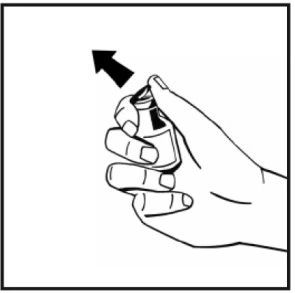
- Remove the plastic flip-off cap from the powder vial to expose the central portion of the rubber stopper. Do not remove the gray stopper or the surrounding metal ring from the top of the vial.
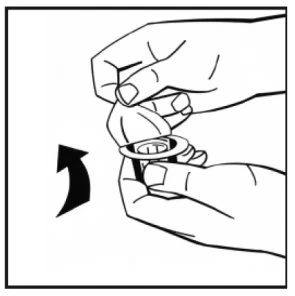
- Clean the top of the vial with an alcohol wipe. Allow the alcohol to dry completely.
- Remove the paper cover from the vial adapter package. Do not remove the adapter from its packaging.
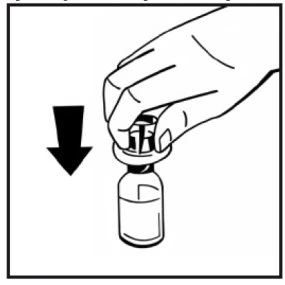
- Place the powder vial on a flat surface and hold it steady. Take the adapter package and place the vial adapter onto the center of the rubber stopper of the powder vial. Press the adapter package firmly downward until the tip of the adapter pierces the rubber stopper. The adapter will be secured to the vial when properly attached.
- Remove the paper cover from the pre-filled syringe packaging. Hold the syringe plunger rod by the end and do not touch the shaft. Attach the threaded end of the plunger rod to the solvent syringe plunger. Rotate the plunger rod clockwise until you feel slight resistance.
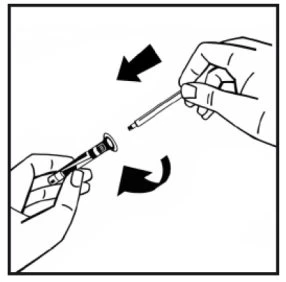
- Break the seal on the plastic protective tip of the solvent syringe by snapping off the break-off portion of the closure cap. Do not touch the inside of the closure cap or the syringe tip. If the solution is not used immediately, cover the filled syringe with the plastic protective tip for storage.
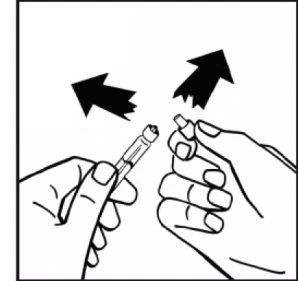
- Remove the adapter packaging and discard it.
- Firmly attach the solvent syringe to the vial adapter by turning clockwise until slight resistance is felt.
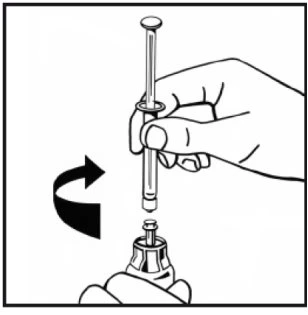
- Slowly inject all of the solvent into the powder vial by pressing the plunger rod downward.
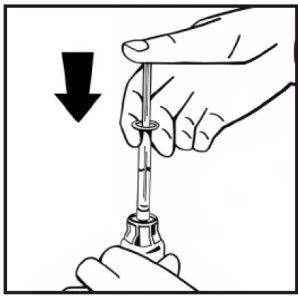
- Without removing the syringe, gently swirl or rotate the vial several times to dissolve the powder. Do not shake. Wait until all the powder is completely dissolved.
- Check the final solution for particles before administration. The solution should be clear and colorless, practically free of visible particles. Do not use cloudy solutions or those containing sediment.
- Turn the vial, which is still attached to the syringe, upside down and slowly withdraw the solution into the syringe. Ensure that all the contents of the vial are transferred into the syringe.
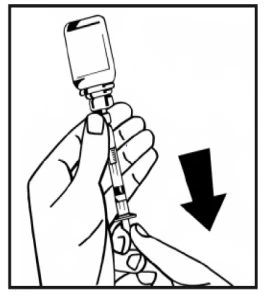
- Detach the filled syringe from the vial adapter by turning counterclockwise and discard the empty vial.
- The solution is now ready for immediate use. Do not refrigerate.
- Clean the selected injection site with one of the provided alcohol wipes.
- Attach the provided injection kit to the syringe.
Insert the needle of the injection kit into the selected vein. If a tourniquet was used to make the vein more visible, it must be loosened before beginning the injection.
Blood should not enter the syringe due to the risk of fibrin clot formation.
- Inject the solution into the vein slowly, at a rate no faster than 4 mL per minute.
If more than one powder vial is used for a treatment, the same needle may be reused. The vial adapter and syringe are for single use only.