Niuliva 250 U.I./ml solution for infusion
Spain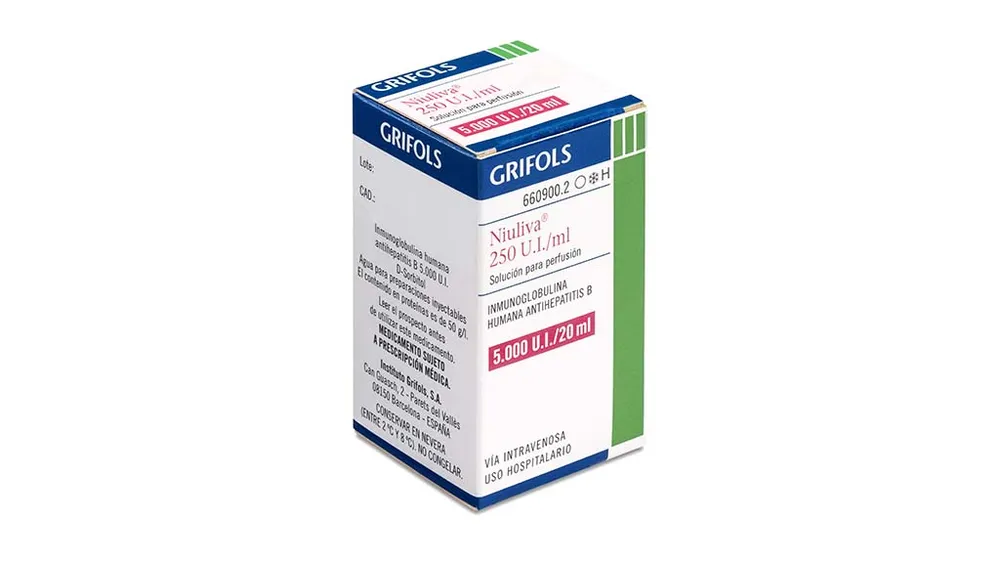
Table of Contents
Package leaflet: Information for the user
Introduction
PACKAGE LEAFLET: INFORMATION FOR THE USER
Niuliva 250 IU/ml solution for infusion
Human hepatitis B immunoglobulin
Read the entire leaflet carefully before you start using this medicine.
- Keep this leaflet, as you may need to read it again.
- If you have any questions, consult your doctor or pharmacist.
- This medicine has been prescribed for you and must not be given to others, even if they have the same symptoms, as it could harm them.
- If you experience any adverse effects, consult your doctor, pharmacist, or nurse, even if the effects are not listed in this leaflet. See section 4.
Leaflet contents:
-
What Niuliva is and what it is used for
-
Before you use Niuliva
- How to use Niuliva
- Possible side effects
- How to store Niuliva
-
Further information
1. What Niuliva is and what it is used for
Niuliva is presented as an intravenous infusion solution containing 250 IU/ml of human anti-hepatitis B immunoglobulin.
This medicine belongs to the pharmacotherapeutic group of immune sera and immunoglobulins.
Niuliva is used for:
Prevention of hepatitis B virus (HBV) reinfection after liver transplantation due to liver failure caused by hepatitis B in patients without active viral replication prior to transplantation.
Hepatitis B immunoprophylaxis
-
In case of accidental exposure in non-immunized individuals (including those with incomplete or unknown vaccination status).
-
In patients undergoing hemodialysis, until vaccination becomes effective.
-
In newborns of mothers who are carriers of hepatitis B virus.
-
In individuals who have not developed an immune response (non-detectable anti-hepatitis B antibodies) after vaccination and who require ongoing prevention due to continued risk of hepatitis B infection.
If you have any doubts about the use of Niuliva, consult your doctor.
2. Before using Niuliva
Do not use Niuliva
-
if you are allergic (hypersensitive) to human immunoglobulins or to any of the other components of Niuliva.
-
if you have fructose intolerance, a rare genetic disorder in which the enzyme needed to break down fructose is not produced.
(See special warnings about excipients at the end of this section).
Take special care with Niuliva
Adverse reactions may occur more frequently:
? in the case of high infusion rate.
? if you have hypo- or agammaglobulinemia (a condition involving low levels of immunoglobulin in your blood), with or without IgA deficiency.
Pulmonary adverse reactions (transfusion-related acute lung injury, TRALI) may occur if you receive intravenous immunoglobulin.
True hypersensitivity reactions are uncommon. Symptoms of hypersensitivity reactions include: skin rash, generalized hives, chest tightness, difficulty breathing, decreased blood pressure (hypotension), and severe allergic reaction (anaphylaxis).
Niuliva contains a small amount of IgA. If you have IgA deficiency, you may develop anti-IgA antibodies and experience allergic reactions after administration of blood-derived products containing IgA. Your doctor should weigh the benefits of treatment with Niuliva against the potential risks of hypersensitivity reactions.
Rarely, human anti-hepatitis B immunoglobulin may cause a drop in blood pressure with an allergic reaction, even if you have previously tolerated immunoglobulin treatment.
Patients with pre-existing risk factors
Please inform your doctor if you suffer from any other pathological condition or disease, as this may require increased caution. In particular, inform your doctor if you have thrombotic risk factors (risk of developing blood clots or thrombi in your circulation).
Consult your doctor, even if any of the above-mentioned circumstances have occurred to you in the past.
Special safety precautions
When medicines derived from human plasma or blood are administered, certain measures must be taken to prevent transmission of infections to patients. Such measures include careful donor selection to exclude those at risk of being carriers of infectious diseases, testing for specific markers of infection in individual donations and plasma pools, and inclusion of manufacturing steps to inactivate or remove viruses. Nevertheless, when medicines derived from human blood or plasma are administered, the possibility of transmission of infectious agents cannot be completely ruled out. This also applies to emerging or unknown viruses and other types of infections.
The measures taken are considered effective against enveloped viruses such as human immunodeficiency virus (HIV), hepatitis B virus, and hepatitis C virus, and against the non-enveloped hepatitis A virus. The measures may have limited effectiveness against non-enveloped viruses such as parvovirus B19.
Immunoglobulins have not been associated with hepatitis A or parvovirus B19 infections, possibly because the antibodies against these infections contained in the product are protective.
It is highly recommended that each time a dose of Niuliva is administered, the name of the medicine and the batch number be recorded, in order to maintain a record of batches used.
Use of other medicines
? Inform your doctor or pharmacist if you are using or have recently used any other medicines, including those obtained without a prescription.
? Effects on vaccines: Niuliva may reduce the effectiveness of certain types of vaccines, such as those for measles, rubella, mumps, and varicella.
Effects on blood tests
If a blood test is performed after receiving Niuliva, please inform the laboratory staff or your doctor that you have received this medicine. The levels of certain antibodies may be increased.
Pregnancy and breastfeeding
Consult your doctor or pharmacist before using any medicine.
Inform your doctor if you are pregnant or breastfeeding. Your doctor will decide whether Niuliva can be used during pregnancy and breastfeeding.
Driving and use of machines
No effects on the ability to drive vehicles or operate machinery have been observed.
Important information about some of the components of Niuliva
This medicine contains 50 mg of sorbitol per ml. If your doctor has informed you that you have an intolerance to certain sugars, contact him before using this medicine.
In newborns and children up to weaning age, hereditary fructose intolerance may not yet have been diagnosed, and administration of Niuliva may trigger serious effects. When treatment of newborns and children (especially up to weaning age) is considered appropriate, extreme caution should be exercised before and during administration of Niuliva due to the amount of sorbitol contained in the product. This is particularly important when more than one dose is required to achieve protective antibody titers.
No interference is expected in the determination of blood glucose levels.
3. How to use Niuliva
Follow these instructions unless your doctor has given you different advice.
Prevention of hepatitis B virus (HBV) reinfection after liver transplantation due to liver failure caused by hepatitis B in patients without active viral replication before transplantation:
In adults:
10,000 IU on the day of transplantation, during surgery. Then 2,000–10,000 IU/day for 7 days, and as needed to maintain antibody levels above 100–150 IU/L in HBV DNA-negative patients.
In children:
Dosage should be adjusted according to body surface area, based on 10,000 IU/1.73 m².
Immunoprophylaxis of hepatitis B:
- Prevention of hepatitis B following accidental exposure in non-immunized individuals:
At least 500 IU, depending on the intensity of exposure, as soon as possible after exposure, and preferably within 24–72 hours.
- Hepatitis B immunoprophylaxis in patients undergoing hemodialysis:
8–12 IU/kg, up to a maximum of 500 IU, every 2 months until seroconversion after vaccination.
- Prevention of hepatitis B in newborns of hepatitis B virus carrier mothers, at birth or as soon as possible after birth:
30–100 IU/kg. Administration of hepatitis B immunoglobulin should be repeated until seroconversion after vaccination.
In all these situations, vaccination against hepatitis B virus is strongly recommended. The first dose of the vaccine may be administered on the same day as hepatitis B immunoglobulin, although at different injection sites.
In individuals who did not develop an immune response (non-detectable hepatitis B antibodies) after vaccination and who require ongoing prevention, administration of 500 IU in adults and 8 IU/kg in children every 2 months may be considered; the minimum protective antibody titer is considered to be 10 mIU/mL.
Niuliva must be administered intravenously at an initial infusion rate not exceeding 0.02 ml/kg/min for the first 10 minutes. If you tolerate this infusion rate well, your doctor may gradually increase the administration rate up to a maximum of 0.04 ml/kg/min. Therefore, administration of 5,000 IU is generally completed in less than 15 minutes.
If no adverse reactions occur, the initial maximum rate for subsequent infusions will also be 0.02 ml/kg/min, and if you tolerate this rate well, your doctor may gradually increase the administration rate up to a maximum of 0.1 ml/kg/min. In general, administration of 5,000 IU will take less than 10 minutes.
Niuliva must not be mixed with other medicines or intravenous solutions and must be administered using a dedicated infusion set.
If you use more Niuliva than you should
If you have been given more Niuliva than you should have, consult your doctor or pharmacist immediately.
The consequences of overdose are not known.
If you forget to use Niuliva
Consult your doctor or pharmacist immediately and follow their instructions.
Do not administer a double dose to make up for missed doses.
4. Possible adverse effects
Like all medicines, Niuliva can cause adverse effects, although not everyone will experience them.
Inform your doctor if you experience any of the following adverse reactions during or after the infusion:
? Chills
? Headache
? Fever
? Nausea
? Vomiting
? Allergic reaction
? Joint pain
? Decrease in blood pressure (hypotension)
? Mild back pain
Rare adverse effects:
? Sudden drop in blood pressure and, in isolated cases, anaphylactic shock, even if you have not previously experienced allergic reactions (hypersensitivity) during prior administrations.
? Cases of temporary inflammation of the meninges (reversible aseptic meningitis).
? Cases of temporary reduction in the number of certain blood cells (red blood cells) (hemolytic anemia/reversible hemolysis).
? Cases of transient skin reactions.
? Increases in serum creatinine levels and/or acute kidney failure.
Very rare adverse effects:
? Formation of blood clots in the veins (thromboembolic reactions), which may result in sudden failure of blood supply to the heart muscle (myocardial infarction), stroke (cerebrovascular accident), lung complications (pulmonary embolism), or severe blockage of the veins (deep vein thrombosis).
In two clinical studies conducted with Niuliva, the following adverse effects were observed:
Uncommon (may affect up to 1 in 100 people):
- Decrease in white blood cells
- Transplant rejection
- Hypokinesia
- Hypotension, hypertension
- Dry mouth
- Joint pain
- Kidney failure, acute kidney injury
- Increased liver enzyme, positive throat culture
Reporting of adverse effects
If you experience any type of adverse effect, consult your doctor, pharmacist, or nurse, even if it is a possible adverse effect not listed in this leaflet. You may also report them directly through the Spanish Pharmacovigilance System for Human Medicinal Products: www.notificaRAM.es. By reporting adverse effects, you can help provide more information on the safety of this medicine.
5. Storage of Niuliva
Keep out of the reach and sight of children.
Do not use Niuliva after the expiry date stated on the packaging after EXP. The expiry date refers to the last day of the month indicated.
Store in a refrigerator (between 2 °C and 8 °C). Do not freeze.
Must be brought to room temperature or body temperature before use.
The solution should be clear or slightly opalescent. Do not use Niuliva if the solution appears cloudy or contains particles.
Any unused medicine and materials that have come into contact with it must be disposed of in accordance with local regulations. Medicines must not be disposed of via wastewater or household waste. Ask your pharmacist how to dispose of containers and medicines you no longer need. This will help protect the environment.
6. Additional information
Composition of Niuliva
The active substance is:
Human anti-hepatitis B immunoglobulin. One millilitre of Niuliva contains 50 mg of protein, of which at least 97% are IgG.
The content of human anti-hepatitis B immunoglobulin is 250 IU/ml (600 IU/2.4 ml, 1.000 IU/4 ml, 5.000 IU/20 ml and 10.000 IU/40 ml).
The percentage of IgG subclasses, determined by immunonephelometry, is approximately 74.3% IgG1, 22.1% IgG2, 1.99% IgG3 and 1.61% IgG4.
Contains traces of IgA (less than 0.05 mg/ml).
The other components are sorbitol and water for injectable preparations.
(See section 2. "Before using Niuliva" for more information on the components).
Appearance of the product and contents of the container
Niuliva is a solution for infusion. The solution is transparent or slightly opalescent, colourless or pale yellow.
Presentations:
Niuliva
Syringes of 600 IU/2.4 ml and 1.000 IU/4 ml.
Vials of 5.000 IU/20 ml and 10.000 IU/40 ml.
Pack size: 1 syringe or 1 vial.
Marketing Authorization Holder and Manufacturer
Instituto Grifols, S.A.
Can Guasch, 2 - Parets del Vallès
08150 Barcelona - SPAIN
Date of the most recent review of this leaflet: January 2018.
Detailed and up-to-date information on this medicine is available on the website of the Spanish Agency of Medicines and Health Products (AEMPS) http://www.aemps.es/