Minipres 5 mg tablets
Spain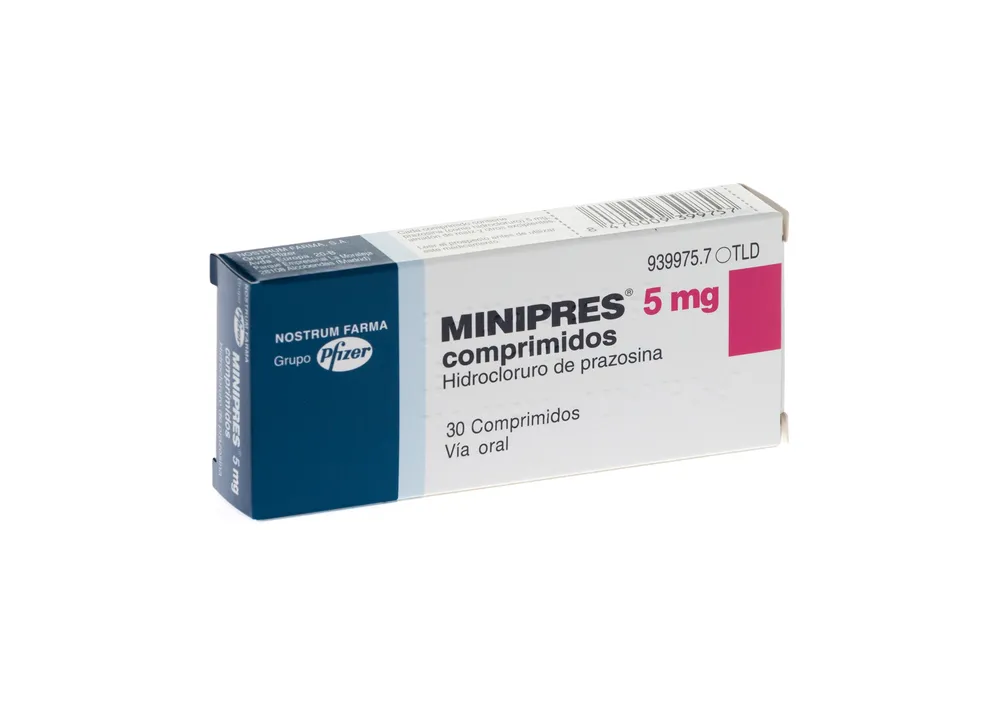
Table of Contents
Package leaflet: Information for the user
Introduction
Package leaflet: information for the user
MINIPRES 1 mg tablets
MINIPRES 2 mg tablets
MINIPRES 5 mg tablets
Prazosin hydrochloride
Read this entire leaflet carefully before you start taking this medicine, because it contains important information for you.
- Keep this leaflet; you may need to read it again.
- If you have any questions, ask your doctor or pharmacist.
- This medicine has been prescribed for you; do not give it to others, even if they have the same symptoms as you, because it could harm them.
- If you experience any adverse effects, consult your doctor or pharmacist, even if they are effects not listed in this leaflet. See section 4.
Contents of the leaflet
- What Minipres is and what it is used for
- What you need to know before taking Minipres
- How to take Minipres
- Possible adverse effects
- How to store Minipres
- Contents of the pack and other information
1. What Minipres is and what it is used for
Minipres is indicated for the treatment of high blood pressure in the arteries (arterial hypertension), Raynaud's disease (narrowing of the capillaries in the hands and feet), and for the treatment of symptoms associated with urinary flow obstruction in benign prostatic hyperplasia (BPH).
2. What you need to know before taking Minipres
Do not take Minipres:
- if you are allergic to the active substance (prazosin) or to other quinazolines (for example, doxazosin, terazosin) or to any of the other ingredients of this medicine (listed in section 6).
Warnings and precautions
Talk to your doctor or pharmacist before starting to take Minipres.
- As with other antihypertensive medicines, administration of Minipres may cause postural hypotension characterized by dizziness, weakness, or rarely loss of consciousness (syncope). Your doctor will inform you about how to avoid symptoms resulting from hypotension and what steps to take if these symptoms occur.
- If you are elderly or are being treated for Raynaud's disease, your doctor will monitor your blood pressure at the beginning of treatment.
- If you are scheduled for cataract eye surgery, please inform your doctor before the procedure if you are currently taking or have previously taken Minipres. This is because Minipres may cause complications during surgery, which can be anticipated and managed by your ophthalmologist if they are informed in advance.
- If you experience prolonged and sometimes painful erections. This is rare. If you have an erection lasting more than 4 hours, contact your doctor immediately.
Children and adolescents
The safety and efficacy of Minipres in patients under 18 years of age have not been established.
The use of Minipres is not recommended in patients under 18 years of age.
Taking Minipres with other medicines
Tell your doctor or pharmacist if you are using, have recently used, or might need to use any other medicines.
Some medicines may interact with Minipres:
- Medicines for the heart: digitalis, digoxin, procainamide, propranolol, and quinidine
- Medicines to regulate your blood sugar levels: insulin, chlorpropamide, phenformin, tolazamide, and tolbutamide
- Tranquilizers and sleeping medicines: chlordiazepoxide, diazepam, and phenobarbital
- Medicines to treat gout: allopurinol, colchicine, and probenecid
- Medicines to treat pain, fever, and inflammation: propoxyphene, aspirin, indomethacin, and phenylbutazone
- Medicines to reduce blood clotting (coumarin-type)
- Certain medicines to reduce blood pressure (thiazide diuretics)
- Medicines to treat erectile dysfunction
Minipres may affect the results of diagnostic tests for pheochromocytoma.
Taking Minipres with food and drinks
Minipres can be taken at any time of day, preferably with food.
Pregnancy, breastfeeding, and fertility
If you are pregnant or breastfeeding, think you might be pregnant, or plan to become pregnant, consult your doctor or pharmacist before using this medicine.
Driving and using machines
Do not drive or operate machinery if you feel dizzy after taking this medicine.
Minipres contains sodium
This medicine contains less than 23 mg of sodium (1 mmol) per tablet; therefore, it is essentially “sodium-free”.
3. How to take Minipres
Follow exactly the instructions for the use of this medicine as given by your doctor. If in doubt, consult your doctor or pharmacist again.
Adults
The usual initial dose of Minipres is one 1 mg tablet daily, divided into two daily doses. If necessary, your doctor may gradually increase the dose at intervals of 4 days, up to the appropriate maintenance dose, with a maximum of 20 mg in the treatment of hypertension. The maintenance dose in the treatment of Raynaud's disease is 4–6 mg and in benign prostatic hyperplasia is 4 mg. It is recommended that on the first day of treatment the medicine be administered with the evening meal.
Minipres should be swallowed whole, with a little water. The tablets may be taken orally at any time of day, preferably with food.
If you think that the effect of Minipres tablets is too strong or too weak, inform your doctor or pharmacist.
Elderly people and patients with hepatic impairment
Your doctor will monitor dose adjustment.
If you take more Minipres than you should
If for any reason you have taken more Minipres than you should, contact your doctor or pharmacist immediately or call the Toxicology Information Service. Telephone 91 562 04 20, indicating the medicine and the amount taken.
Take any remaining tablets, the carton, and the complete packaging so that hospital staff can easily identify the medicine you have taken.
If you forget to take Minipres
If you forget to take a dose, take the next scheduled dose at the correct time.
Do not take a double dose to make up for forgotten doses.
If you stop taking Minipres
Do not stop taking Minipres unless your doctor tells you to. If you have any further questions about the use of this medicine, ask your doctor or pharmacist.
4. Possible adverse effects
Like all medicines, this medicine can cause adverse effects, although not everyone will experience them.
Frequent adverse effects (affect fewer than 1 in 10 people):
- depression, nervousness
- dizziness, drowsiness, headache, temporary loss of consciousness, loss of consciousness
- blurred vision
- vertigo
- palpitations
- shortness of breath, nasal congestion
- constipation, diarrhoea, nausea, vomiting, dry mouth
- rash
- increased frequency of urination
- fluid retention, tiredness, weakness, lack of energy
Uncommon adverse effects (affect fewer than 1 in 100 people):
- difficulty sleeping (insomnia)
- reduced skin sensitivity to touch or pain, numbness or tingling in fingers of hands and feet
- eye pain, eye redness
- ringing in the ears
- chest pain, heart rate faster than normal
- nosebleeds
- abdominal discomfort
- excessive sweating, itching, rash
- joint pain
- impotence
- malaise
Rare adverse effects (affect fewer than 1 in 1,000 people):
- allergic reaction
- hallucinations
- worsening of daytime drowsiness
- heart rate slower than normal, flushing, hypotension, postural hypotension, inflammation of veins or arteries
- inflammation of the pancreas
- liver function abnormalities, hair loss, chronic skin disease with scaly patches
- urinary incontinence
- abnormal breast enlargement in males, persistent and painful erection
- fever, pain
- false positive immune system test results
- priapism (prolonged and painful erections)
If any of these adverse effects become severe, or if you notice any adverse effects not listed in this leaflet, please inform your doctor.
Reporting of adverse effects:
If you experience any type of adverse effect, consult your doctor, pharmacist, or nurse, even if it is an adverse effect not listed in this leaflet. You may also report them directly via the Spanish Pharmacovigilance System for Human Medicinal Products: www.notificaram.es. By reporting adverse effects, you can help provide more information on the safety of this medicine.
5. Storage of Minipres
Keep out of the sight and reach of children.
Do not store above 30°C.
Do not use this medicine after the expiry date stated on the packaging and outer carton, after EXP. The expiry date refers to the last day of the month indicated.
Medicines should not be disposed of via wastewater drains or household waste. Dispose of packaging and unused medicines at the SIGRE collection point at your pharmacy. If in doubt, ask your pharmacist how to dispose of unused packaging and medicines. This way, you will help protect the environment.
6. Contents of the pack and other information
Composition of Minipres
The active substance is prazosin.
The other components (excipients) are: microcrystalline cellulose, calcium hydrogen phosphate, corn starch, and a mixture of magnesium stearate and sodium lauryl sulphate.
Minipres 1 mg tablets contain 1 mg of prazosin as prazosin hydrochloride.
Minipres 2 mg tablets contain 2 mg of prazosin as prazosin hydrochloride.
Minipres 5 mg tablets contain 5 mg of prazosin as prazosin hydrochloride.
Appearance of the product and contents of the pack
Minipres 1 mg tablets are white, oblong, with a score line on one side and engraved with "M6" on the same side.
Minipres 2 mg tablets are white, round, with a score line on one side and engraved with "M7" on the opposite side.
Minipres 5 mg tablets are white, rhomboidal, with a score line on one side and engraved with "M8" on the opposite side.
Minipres 1 mg and 2 mg tablets are available in boxes containing 60 tablets in blisters.
Minipres 5 mg tablets are available in boxes containing 30 tablets in blisters.
Marketing Authorisation Holder
Pfizer, S.L.
Avda. de Europa, 20B – Parque Empresarial La Moraleja
28108 Alcobendas (Madrid)
Manufacturer
FARMASIERRA MANUFACTURING, S.L.
Ctra. N-I, Km 26,200
28709 San Sebastián de los Reyes (Madrid).
Date of the most recent revision of this summary: October 2023
Detailed and up-to-date information on this medicine is available on the website of the Spanish Agency for Medicines and Health Products (AEMPS) http://www.aemps.gob.es/