Magnesia seid 2,4 g powder for oral suspension
Spain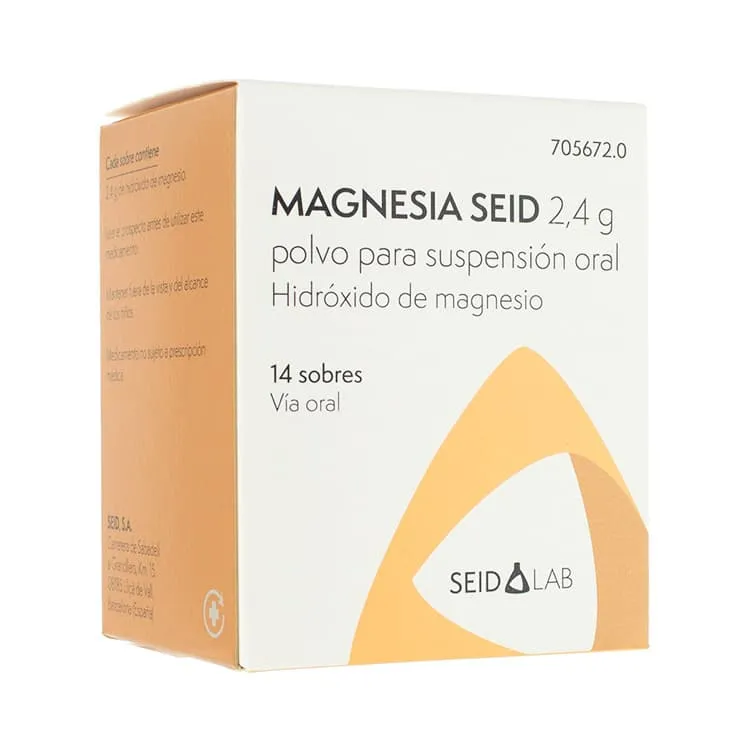
Table of Contents
Patient Information Leaflet
Introduction
Patient Information Leaflet
MAGNESIA SEID 2.4 g POWDER FOR ORAL SUSPENSION
Magnesium hydroxide
Read the entire leaflet carefully before you start taking this medicine, because it contains important information for you. Follow exactly the instructions for administration of the medicine contained in this leaflet or those indicated by your doctor or pharmacist.
|
Package leaflet:
- What Magnesia Seid 2.4 g is and what it is used for
- What you need to know before taking Magnesia Seid 2.4 g
- How to take Magnesia Seid 2.4 g
- Possible side effects
- How to store Magnesia Seid 2.4 g
- Contents of the pack and other information
1. What Magnesia Seid 2.4 g is and what it is used for
This medicine belongs to a group of medicines called laxatives.
It is indicated for the symptomatic and short-term treatment of occasional constipation in adults and adolescents over 12 years of age.
You should consult a doctor if symptoms worsen or do not improve after 5 days.
2. What you need to know before taking Magnesia Seid 2.4 g
Do not take Magnesia Seid:
- If you are allergic to magnesium hydroxide or to any of the other ingredients of this medicine (listed in section 6).
- During the 24 hours prior to undergoing a gastric acid secretion test.
If you have:
- Severe kidney disease.
- Any condition causing a hydroelectrolytic imbalance (salts and water in the body).
- Appendicitis, intestinal obstruction, undiagnosed gastrointestinal or rectal bleeding, ulcerative colitis (an inflammatory disease of the colon), colostomy (a surgical procedure in which the end of the large intestine is brought through the abdominal wall), diverticulitis (inflammation of the intestinal wall forming abnormal pouches), ileostomy (a surgical procedure in which the end of the small intestine is brought through the abdominal wall).
Warnings and precautions
Consult your doctor or pharmacist before starting to take Magnesia Seid.
Exercise particular caution if you have any kidney disease, even if not severe, or diseases of the liver or heart. Special monitoring should also be carried out in cases of dehydration, in elderly patients, or if you experience swelling of the feet or lower legs.
You should consult your doctor if you have any symptoms suggesting bleeding, such as black stools or coffee-ground-like vomit. Consult your doctor as soon as possible if you experience any symptoms such as abdominal pain of unknown origin, cramps, bloated or painful abdomen, nausea, vomiting, or diarrhea.
Children and adolescents
Do not administer to children under 12 years of age.
In young children, the use of magnesium hydroxide may cause hypermagnesemia, especially in the presence of renal insufficiency or dehydration.
Use of Magnesia Seid with other medicines
Inform your doctor or pharmacist if you are taking, have recently taken, or might need to take any other medicines.
Some medicines may be affected by magnesium hydroxide or may affect the efficacy of magnesium hydroxide. Concomitant administration of Magnesia Seid with other medicines may alter the absorption or action of other medicines used to treat:
- Diabetes: chlorpropamide, glyburide, glipizide, tolbutamide.
- Infections: sulfonamides, quinolones (ciprofloxacin, ofloxacin, pefloxacin, enoxacin), tetracyclines (chlortetracycline, doxycycline, tetracycline), ketoconazole, methenamine.
- Blood coagulation disorders: dicoumarol.
- Anemia: iron salts, folic acid.
- Parkinson's disease: levodopa.
- Stomach, intestinal, and bladder spasms or contractions (anticholinergic medicines).
- Cardiovascular diseases: atenolol, digoxin, captopril, quinidine.
- Psychiatric disorders: phenothiazines (especially oral chlorpromazine), chlordiazepoxide, amphetamines.
- Epilepsy: phenytoin.
- Digestive disorders: medicines used for acidity (cimetidine, etc.), misoprostol, pancreolipase, sucralfate.
- Inflammation: indomethacin, penicillamine, salicylates, ibuprofen, flurbiprofen, mefenamic acid or flufenamic acid.
- Metabolic disorders: oral phosphates, alendronate acid and tiludronate acid, polystyrene resin, sodium sulfonate, vitamin D, including calcifediol and calcitriol.
- Smoking cessation: mecamylamine.
- Others: enteric-coated medicines, urinary acidifying agents such as ammonium chloride, ascorbic acid, or potassium or sodium phosphates.
Separate the administration of Magnesia Seid from other medicines by 2 to 3 hours.
Interference with diagnostic tests
If you are scheduled to undergo any diagnostic tests (blood, urine, etc.), inform your doctor or pharmacist that you are being treated with Magnesia Seid, as it may alter test results.
Do not take this medicine during the 24 hours prior to undergoing a gastric acid secretion test, serum gastrin levels (a hormone that regulates acid secretion in the stomach), serum potassium levels, or serum and urinary pH determinations.
Taking Magnesia Seid with food and drink
Take in the morning, on an empty stomach.
Pregnancy and breastfeeding
If you are pregnant or breastfeeding, think you may be pregnant, or are planning to become pregnant, consult your doctor or pharmacist before using this medicine.
Driving and using machines
It has not been reported that this medicine affects the ability to drive or operate machinery.
3. How to take Magnesia Seid 2.4 g
Follow exactly the administration instructions for this medicine provided in this leaflet or as indicated by your doctor or pharmacist. If in doubt, consult your doctor or pharmacist again.
Oral use
The recommended dose for adults and children over 12 years of age is one sachet every 24 hours, taken in the morning on an empty stomach.
Pour the powder from one sachet into half a glass of water and stir before taking.
Always take the lowest effective dose.
If your symptoms do not improve or persist after 5 days of continuous treatment, you must consult a doctor.
If you take more Magnesia Seid than you should
Contact your doctor or pharmacist immediately or call the Toxicology Information Service at telephone number: 91 5620420, indicating the medicine and the amount ingested.
Symptoms of overdose may include diarrhea; more rarely, hypermagnesemia may occur, causing disturbances in vision, heart rhythm, and neurological disorders.
If you forget to take Magnesia Seid
Do not take a double dose to make up for missed doses.
If you have any further questions about the use of this medicine, ask your doctor or pharmacist.
4. Possible adverse effects
Like all medicines, this medicine can cause adverse effects, although not everyone experiences them.
Adverse effects of magnesium hydroxide are generally mild and transient.
Gastrointestinal disorders
- Common (may affect up to 1 in 10 people): diarrhoea
- Frequency not known: abdominal pain
Metabolism and nutrition disorders
- Very rare (may affect up to 1 in 10,000 people): hypermagnesaemia (elevated blood magnesium levels) after prolonged administration in patients with renal insufficiency. Initial symptoms include flushing, thirst, hypotension, nausea, vomiting, general fatigue, confusion, dizziness, blurred vision, lack of coordination, and muscle weakness.
Reporting of adverse effects
If you experience any type of adverse effect, consult your doctor or pharmacist, even if it is a possible adverse effect not listed in this leaflet. You may also report them directly through the Spanish Pharmacovigilance System for Human Medicines: www.notificaRAM. By reporting adverse effects, you can help provide more information on the safety of this medicine.
5. Storage of Magnesia Seid 2.4 g
Keep this medicine out of the sight and reach of children.
No special storage conditions are required.
Do not use this medicine after the expiry date stated on the packaging after EXP. The expiry date refers to the last day of the month indicated.
Medicines must not be disposed of via wastewater or household waste. Dispose of unused medicines and their containers at the SIGRE collection point  at your pharmacy. If you are in doubt, ask your pharmacist how to dispose of medicines and containers you no longer need. This will help protect the environment.
6. Contents of the pack and other information
Composition of Magnesia Seid 2.4 g
-
The active substance is magnesium hydroxide. Each sachet contains 2.4 g of magnesium hydroxide.
-
The other components are: microcrystalline cellulose, sodium carmellose, sodium cyclamate and lemon flavour (containing maltodextrin, modified tapioca starch and butylated hydroxyanisole (E 320)).
Appearance of the medicine and contents of the pack
Magnesia Seid is presented as a powder for oral suspension in single-dose sachets.
Each carton contains 14 or 200 sachets, each containing 2.6 g.
Marketing Authorisation Holder and Manufacturer
SEID, S.A.
Carretera de Sabadell a Granollers, Km. 15
08185 - Lliçà de Vall (Barcelona)
Date of the most recent revision of this leaflet: October 2017
Detailed and up-to-date information on this medicine is available on the website of the Spanish Agency of Medicines and Medical Devices (AEMPS):
http://www.aemps.gob.es/