Linitul cicatrizing ointment
Spain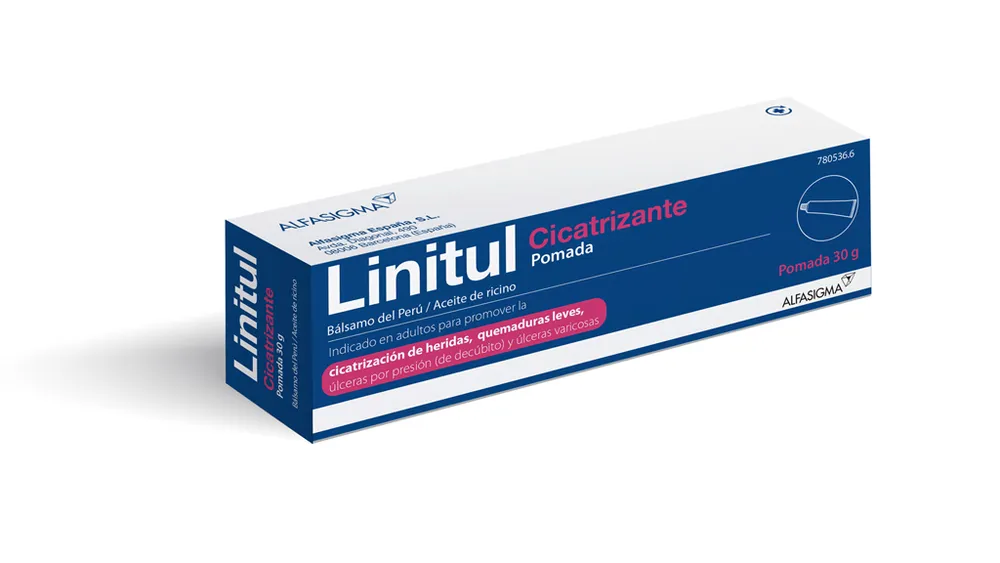
Table of Contents
- Package leaflet: Information for the user
- Introduction
- 1. What Linitul Cicatrizante is and what it is used for
- 2. What you need to know before using Linitul Cicatrizante
- 3. How to use Linitul Cicatrizante
- 4. Possible adverse effects
- 5. Storage of Linitul Cicatrizante
- 6. Contents of the pack and other information
Package leaflet: Information for the user
Introduction
Package leaflet: information for the user
Linitul Cicatrizante Ointment
Peruvian balsam / castor oil
Read the entire leaflet carefully before you start using this medicine, because it contains important information for you.
Follow exactly the instructions for use provided in this leaflet or as directed by your doctor or pharmacist.
- Keep this leaflet, as you may need to read it again.
- If you need advice or more information, consult your pharmacist.
- If you experience any adverse reactions, consult your doctor or pharmacist, even if they are adverse reactions not listed in this leaflet. See section 4.
- You should consult a doctor if you worsen or do not improve after 15 days.
Contents of the leaflet
- What Linitul Cicatrizante is and what it is used for
- What you need to know before using Linitul Cicatrizante
- How to use Linitul Cicatrizante
- Possible adverse effects
- How to store Linitul Cicatrizante
- Contents of the pack and other information
1. What Linitul Cicatrizante is and what it is used for
It belongs to a group of medicines used as wound healing agents, and works by stimulating blood flow and reducing drying in the affected area.
Linitul Cicatrizante is indicated in adults to promote the healing of wounds, minor burns, pressure ulcers (decubitus ulcers), and varicose ulcers.
2. What you need to know before using Linitul Cicatrizante
Do not use Linitul Cicatrizante
- If you are allergic to Peru balsam, castor oil, or any of the other components of this medicine (listed in section 6).
- If you have inflammatory dermatosis (superficial skin inflammation with redness, moisture, fluid retention, scaling, itching, etc.).
- On recent arterial blood clots (occurring in an artery).
Warnings and precautions
Consult your doctor or pharmacist before starting to use Linitul Cicatrizante Ointment.
- This medicine must not be used on acne-affected or oily skin.
- Do not apply in the eyes.
- You should consult your doctor if you have any disease involving hemoglobin deficiency (such as certain anemias) or zinc deficiency, or if your wound shows delayed healing.
Children and adolescents
Linitul Cicatrizante Ointment should not be applied to children, as there are no data available regarding its use in this population.
Other medicines and Linitul Cicatrizante
Inform your doctor or pharmacist if you are using, have recently used, or might need to use any other medicines.
No interaction studies have been conducted.
Peru balsam may cause cross-reactions in sensitive individuals with Tolu balsam and certain essential oils used as flavorings.
Pregnancy and breastfeeding
If you are pregnant or breastfeeding, think you may be pregnant, or plan to become pregnant, consult your doctor or pharmacist before using this medicine.
Before using Linitul Cicatrizante Ointment during pregnancy or breastfeeding, the potential benefits should be weighed against the possible risks.
Driving and operating machinery
Linitul Cicatrizante Ointment does not affect your ability to drive or operate machinery.
3. How to use Linitul Cicatrizante
Follow exactly the instructions for use provided in this leaflet or those indicated by your doctor or pharmacist. If in doubt, ask your doctor or pharmacist.
The recommended dose is:
- Adults:
Apply a thin layer of ointment to the affected area at least twice a day, which may be repeated when necessary.
For cutaneous use (on the skin).
After applying the ointment, the area may be covered with a protective dressing. The area should be gently washed with a cleansing solution (such as saline) when renewing the ointment application. Repeat the procedure when necessary.
Use in children and adolescents
There are no data available on use in children.
If you use more Linitul Cicatrizante than you should
Overdose is unlikely with normal use.
However, in case of accidental ingestion, nausea, vomiting, colic, and severe diarrhea may occur.
In case of accidental ingestion, consult your doctor or pharmacist immediately, go to a medical center, or call the Toxicology Information Service at telephone number 91 562 04 20, indicating the product and the amount ingested.
If you forget to use Linitul Cicatrizante
Do not use a double dose to make up for missed doses.
If you have any further questions about the use of this medicine, ask your doctor or pharmacist.
4. Possible adverse effects
Like all medicines, this medicine may cause adverse effects, although not everyone will experience them.
Very rare side effects (frequency not known exactly) may include: allergic reactions such as contact dermatitis and stinging sensation at the application site.
Reporting of adverse effects
If you experience any type of adverse effect, consult your doctor, pharmacist, or nurse, even if it is a possible adverse effect not listed in this leaflet. You may also report them directly through the Spanish Pharmacovigilance System for human medicinal products, https://www.notificaRAM.es. By reporting adverse effects, you can help provide more information on the safety of this medicine.
5. Storage of Linitul Cicatrizante
Keep this medicine out of the sight and reach of children.
Do not store above 30°C.
Do not use this medicine after the expiry date stated on the packaging after EXP. The expiry date refers to the last day of the month indicated.
Medicines must not be disposed of via wastewater drains or household waste. Dispose of unused medicines and their containers at the SIGRE collection point located at your pharmacy. Ask your pharmacist how to properly dispose of medicines and containers you no longer need. This way, you will help protect the environment.
6. Contents of the pack and other information
Composition of Linitul Cicatrizante
- Active substances: Peru balsam and castor oil. Each gram of ointment contains the soluble fraction of 20 mg of Peru balsam and 150 mg of castor oil.
- Other components (excipients): soft paraffin, liquid paraffin, dimethicone, beeswax, and solid paraffin.
Appearance of the product and contents of the pack
Linitul Cicatrizante Ointment is a translucent white ointment.
It is presented in an aluminum tube containing 30 g or 60 g of ointment.
- Other presentations of Linitul:
Linitul Cicatrizante Impregnated Dressing, 10 single-dose sachets with dressings of 5.5x8 cm
Linitul Cicatrizante Impregnated Dressing, 20 dressings of 8.5 x 10 cm
Linitul Cicatrizante Impregnated Dressing, 20 single-dose sachets with dressings of 9x15 cm
Linitul Cicatrizante Impregnated Dressing, 20 single-dose sachets with dressings of 15x25 cm.
Marketing Authorization Holder and Manufacturer
Holder
Alfasigma España, S.L.
C/ Aribau 195, 4º 08021 Barcelona. Spain
Manufacturer
Alfasigma España, S.L.
Naus 301-304 Polig. Ind. Baix Ebre.
Campredo, Tortosa (Tarragona) Spain
Date of latest review of this leaflet:
18 August 2025
Other sources of information
Detailed and up-to-date information on this medicinal product is available on the website of the Spanish Agency for Medicines and Health Products (AEMPS) http://www.aemps.gob.es/.