Evrenzo 50 mg film-coated tablets
Spain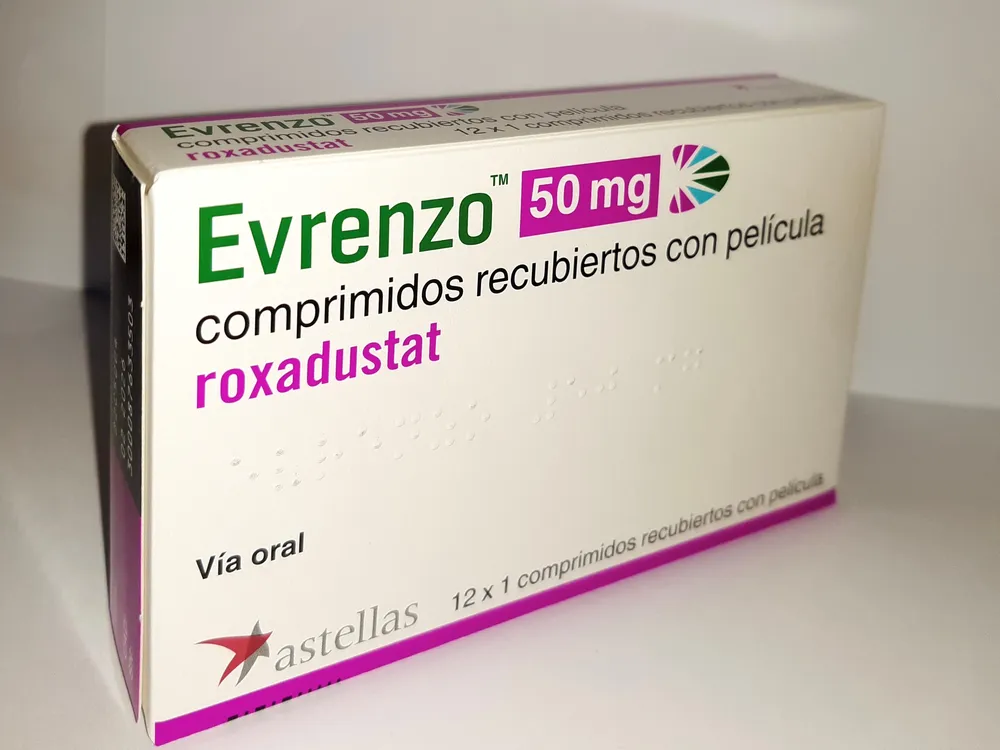
Table of Contents
Package leaflet: Information for the user
Introduction
Package leaflet: information for the patient
Evrenzo 20 mg film-coated tablets
Evrenzo 50 mg film-coated tablets
Evrenzo 70 mg film-coated tablets
Evrenzo 100 mg film-coated tablets
Evrenzo 150 mg film-coated tablets
roxadustat
This medicinal product is subject to additional monitoring, which will allow quicker identification of new safety information. You can help by reporting any adverse reactions you may experience. Information on how to report adverse reactions is included at the end of section 4.
Read the entire leaflet carefully before starting to take this medicine, because it contains important information for you.
- Keep this leaflet, as you may need to read it again.
- If you have any questions, consult your doctor or pharmacist.
- This medicine has been prescribed for you only and must not be given to other people, even if they have the same symptoms as you, because it may harm them.
- If you experience any adverse reactions, consult your doctor or pharmacist, even if they are adverse reactions not listed in this leaflet. See section 4.
Leaflet contents
- What Evrenzo is and what it is used for
- What you need to know before taking Evrenzo
- How to take Evrenzo
- Possible side effects
- How to store Evrenzo
- Contents of the pack and other information
1. What Evrenzo is and what it is used for
What Evrenzo is
Evrenzo is a medicine that increases the number of red blood cells and the level of haemoglobin in the blood. The active substance it contains is roxadustat.
What Evrenzo is used for
Evrenzo is used to treat symptomatic anaemia occurring in adult patients with chronic kidney disease. Anaemia occurs when you have too few red blood cells and your haemoglobin level is too low. As a result, your body may not receive enough oxygen. Anaemia can cause symptoms such as tiredness, weakness, or shortness of breath.
How Evrenzo works
Roxadustat, the active substance in Evrenzo, increases the level of HIF, a substance in the body that enhances red blood cell production when oxygen levels are low. By increasing HIF levels, this medicine boosts red blood cell production and haemoglobin levels (the protein that carries oxygen in red blood cells). This improves oxygen delivery to all parts of the body and may reduce the symptoms of anaemia.
2. What you need to know before starting to take Evrenzo
Do not take Evrenzo
- If you are allergic to peanuts or soy, do not use this medicine. Evrenzo contains soy lecithin.
- If you are allergic to roxadustat or any of the other ingredients of this medicine (listed in section 6).
- If you are more than 6 months pregnant (it is also advisable to avoid this medicine during the early stages of pregnancy; see the section on pregnancy).
- If you are breastfeeding.
Warnings and precautions
Talk to your doctor or pharmacist before starting to take Evrenzo:
- If you have epilepsy or have ever experienced seizures or fits.
- If you have signs or symptoms of an infection, such as fever, sweating or chills, sore throat, runny nose, shortness of breath, feeling weak, confusion, cough, vomiting, diarrhoea or stomach pain, burning sensation when urinating, redness or pain of the skin, or body sores.
- If you have a liver disorder.
Chronic kidney disease and anaemia may increase the risk of cardiovascular events and death. It is important to treat your anaemia. Your doctor will monitor your haemoglobin and determine your treatment regimen, as anaemia treatment and switching between anaemia treatments may also negatively impact your cardiovascular health.
Contact your doctor or pharmacist immediately:
- If you develop blood clots:
- In the veins of the legs (deep vein thrombosis or DVT), which may include symptoms such as pain or swelling in the legs, cramps, or a feeling of warmth in the affected leg.
- In the lungs (pulmonary embolism or PE), which may include sudden shortness of breath, chest pain (usually worse when breathing), anxiety, dizziness, fainting, rapid heartbeat, or coughing (sometimes with blood).
- In your haemodialysis access (vascular access thrombosis or VAT) that stops the access from working; signs may include swelling, redness, hardening or thickening of the skin around the access site, discharge from the access site, or absence of the vibration sensation ("thrill") over the access area.
- If you experience a seizure (fit) or possible warning signs that a seizure may occur, such as headache, irritability, fear, confusion, or unusual sensations.
- If you develop signs or symptoms of infection, such as fever, sweating or chills, sore throat, runny nose, shortness of breath, feeling weak or faint, confusion, cough, vomiting, diarrhoea or stomach pain, burning sensation when urinating, redness or pain of the skin, or body sores.
- If you experience signs and symptoms of a stroke (cerebrovascular accident), including sudden weakness or numbness of the face, arm, or leg, especially on one side of the body, sudden confusion, trouble speaking or understanding, sudden vision problems in one or both eyes, severe headache, loss of consciousness or fainting, seizures (fits), loss of coordination, or loss of balance.
Misuse of the medicine may cause an increase in blood cells and, as a result, thicken the blood. This can lead to potentially life-threatening problems related to the heart or blood vessels.
Children and adolescents
Do not give Evrenzo to children or adolescents under 18 years of age, as there is insufficient information on its use in this age group.
Other medicines and Evrenzo
Tell your doctor or pharmacist if you are taking, have recently taken, or might need to take any other medicines. Evrenzo may affect how these medicines work, or these medicines may affect how Evrenzo works.
In particular, inform your doctor or pharmacist if you have taken or are taking any of the following medicines:
- Medicines to reduce phosphate levels in the blood (called phosphate binders) or other medicines or supplements containing calcium, iron, magnesium, or aluminium (called multivalent cations), such as sevelamer carbonate or calcium acetate. You must take Evrenzo at least 1 hour after taking these medicines or supplements. Otherwise, roxadustat will not be properly absorbed by your body.
- A medicine used to treat gout called probenecid.
- Medicines used to lower cholesterol, such as simvastatin, atorvastatin, or rosuvastatin (also called "statins") or gemfibrozil.
- Other medicines used to treat anaemia, such as erythropoiesis-stimulating agents (ESAs).
If you regularly take any of these medicines, your doctor may change your treatment and prescribe another medicine for you to take during your treatment with Evrenzo.
Pregnancy, breastfeeding, and fertility
If you are pregnant, think you may be pregnant, or plan to become pregnant, consult your doctor.
Evrenzo may harm your baby. Evrenzo is not recommended during the first 6 months of pregnancy and must not be taken during the last 3 months of pregnancy. Women who take Evrenzo and who could become pregnant must use an effective method of contraception during treatment with Evrenzo and for at least 1 week after the last dose of Evrenzo. If you use a hormonal contraceptive method, you must also use a barrier method, such as a condom or diaphragm.
If you are being treated with Evrenzo, do not breastfeed your baby. It is unknown whether Evrenzo passes into breast milk; if it does, it may harm your baby.
Driving and using machines
This medicine may affect your ability to drive and use machines. You may experience a seizure; this is one of the possible side effects (see section 4).
Evrenzo contains lactose, soy lecithin, and Allura Red AC aluminium lake
Evrenzo contains sugar (lactose), traces of peanut and soy (soy lecithin), and an azo dye (Allura Red AC aluminium lake). If your doctor has told you that you have an intolerance to certain sugars or are allergic to peanuts, soy, or azo dyes, consult your doctor before taking this medicine.
3. How to take Evrenzo
Follow exactly the instructions for use of this medicine given by your doctor or pharmacist. If in doubt, consult your doctor or pharmacist again.
Your doctor will determine the dose of Evrenzo you should take.
Additionally, your doctor will measure your hemoglobin levels periodically and, if necessary, increase or decrease your dose.
Evrenzo is taken orally as tablets.
Taking Evrenzo
- Take your dose of Evrenzo three times a week, unless your doctor has instructed otherwise.
- Never take Evrenzo on consecutive days.
- Take Evrenzo on the same three days each week.
- Evrenzo may be taken with food or between meals.
- Swallow the tablets whole.
- Do not chew, split, or crush the tablets.
Take Evrenzo at least 1 hour after taking medications to reduce phosphate levels in the blood (called phosphate binders) or other medicines or supplements containing calcium, iron, magnesium, or aluminum (called multivalent cations).
Dosage regimen
Dosage regimen of three times a week
Evrenzo is supplied in a blister pack containing 4 weeks' worth of medication (12 tablets) arranged in 4 rows. Each row contains the medication for 1 week (3 tablets). Make sure to take the tablets from the same row each week.
Your dose may range from 20 mg three times a week up to a maximum of 400 mg three times a week.
Different dosing frequencies
In exceptional cases (depending on your hemoglobin levels), your doctor may decide to reduce your Evrenzo dose to 20 mg twice a week or once a week. In this case, your doctor will instruct you on which day or days of the week to take the dose.
If more than 1 tablet per dose is required
In most cases, you will receive 1 blister pack per month. If your dose requires more than 1 blister pack, you must take 1 tablet from each blister pack on each day that a dose is scheduled. Your doctor will inform you how many tablets to take and when to take them.
Your doctor will monitor your hemoglobin level and may temporarily interrupt treatment if your hemoglobin level becomes too high. Do not restart treatment until your doctor tells you to do so. Your doctor will tell you what dose of Evrenzo to take and when to resume treatment.
If you take more Evrenzo than you should
If you take more tablets than you should or a higher dose than prescribed, contact your doctor immediately.
If you forget to take Evrenzo
- Never take a double dose to make up for missed doses.
- If more than 24 hours (1 day) remain before the next scheduled dose, take the missed dose as soon as possible, then take the next dose on the scheduled day.
- If less than 24 hours (1 day) remain before the next scheduled dose: skip the missed dose and take the next dose on the scheduled day.
If you stop taking Evrenzo
Do not stop taking this medicine unless your doctor has instructed you to do so.
If you have any further questions about the use of this medicine, ask your doctor or pharmacist.
4. Possible side effects
Like all medicines, this medicine can cause side effects, although not everyone will experience them.
Some possible side effects can be serious. Contact your doctor immediately if you experience any of the following:
- blood clot in the veins of the legs (deep vein thrombosis or DVT) (may affect up to 1 in 10 people).
- blood clot in the lungs (pulmonary embolism) (may affect up to 1 in 100 people).
- blood clot in the haemodialysis access site (vascular access thrombosis or VAT), causing the vascular access to become blocked or stop working if you are using a fistula or graft for dialysis access (may affect more than 1 in 10 people).
- stroke (cerebrovascular accident) (may affect up to 1 in 100 people).
- low levels of platelets in the blood (thrombocytopenia) (may affect up to 1 in 10 people), which may present as unexplained bruising or a rash of small red spots on the skin (called petechiae), prolonged bleeding from cuts, bleeding from gums or nose, blood in urine or stools, bleeding in the white of the eye.
- seizures and warning signs of seizures (fits or convulsions) (may affect up to 1 in 10 people).
- sepsis, a serious infection and, rarely, potentially fatal (may affect up to 1 in 10 people).
- redness and peeling of the skin over a large area of the body, which may cause itching or pain (exfoliative dermatitis) (frequency cannot be estimated from available data).
Other possible side effects
Very common (may affect more than 1 in 10 people):
- increased potassium levels
- high blood pressure (hypertension)
- feeling unwell (nausea)
- diarrhoea
- swelling due to fluid retention in the limbs (peripheral oedema)
Common (may affect up to 1 in 10 people):
- difficulty sleeping (insomnia)
- headache
- vomiting
- constipation
- low levels of platelets in the blood (thrombocytopenia)
Uncommon (may affect up to 1 in 100 people):
- increased amount of bilirubin in the blood
Frequency not known (cannot be estimated from available data):
- decreased thyroid function
- elevated copper in blood
Reporting of side effects
If you experience any side effects, talk to your doctor or pharmacist, even if they are possible side effects not listed in this leaflet. You can also report them directly through the national reporting system included in Appendix V. By reporting side effects, you can help provide more information on the safety of this medicine.
5. Storage of Evrenzo
Keep this medicine out of the sight and reach of children.
Do not use this medicine after the expiry date stated on the carton and blister after EXP. The expiry date refers to the last day of the month indicated.
This medicine does not require any special storage conditions.
Medicines should not be disposed of via wastewater or household waste. Ask your pharmacist how to dispose of medicines and packaging you no longer need. This will help protect the environment.
6. Contents of the pack and other information
Composition of Evrenzo
Evrenzo 20 mg:
- The active substance is roxadustat. Each tablet contains 20 mg of roxadustat.
Evrenzo 50 mg:
- The active substance is roxadustat. Each tablet contains 50 mg of roxadustat.
Evrenzo 70 mg:
- The active substance is roxadustat. Each tablet contains 70 mg of roxadustat.
Evrenzo 100 mg:
- The active substance is roxadustat. Each tablet contains 100 mg of roxadustat.
Evrenzo 150 mg:
- The active substance is roxadustat. Each tablet contains 150 mg of roxadustat.
The other components are:
-
Tablet core: lactose monohydrate, microcrystalline cellulose (E460), sodium croscarmellose (E468), povidone (E1201), magnesium stearate (E470b).
-
Film coating: polyvinyl alcohol (E1203), talc (E553b), macrogol (E1521), aluminium lake of Allura Red AC (E129), titanium dioxide (E171), lecithin (soy) (E322).
Nature and contents of the container
Evrenzo 20 mg are red, film-coated, oval tablets with the number "20" in relief on one side.
Evrenzo 50 mg are red, film-coated, oval tablets with the number "50" in relief on one side.
Evrenzo 70 mg are red, film-coated, round tablets with the number "70" in relief on one side.
Evrenzo 100 mg are red, film-coated, oval tablets with the number "100" in relief on one side.
Evrenzo 150 mg are red, film-coated, almond-shaped tablets with the number "150" in relief on one side.
Evrenzo is available in packs containing 12 × 1 film-coated tablets and 36 × 1 film-coated tablets in PVC/aluminium blisters with pre-scored doses.
Some pack sizes may not be marketed.
Marketing Authorisation Holder
Astellas Pharma Europe B.V.
Sylviusweg 62
2333 BE Leiden
The Netherlands
Manufacturer
Delpharm Meppel B.V.
Hogemaat 2
7942 JG Meppel
The Netherlands
For further information about this medicinal product, please contact the local representative of the Marketing Authorisation Holder:
Belgium/Belgium/Belgium Astellas Pharma B.V. Branch Tel/Tel: +32 (0)2 5580710 | Lithuania Astellas Pharma d.o.o. Tel.: +370 37 408 681 |
| Luxembourg/Luxembourg Astellas Pharma B.V. Branch Belgium/Belgium Tel/Tel: +32 (0)2 5580710 |
Czech Republic Astellas Pharma s.r.o. Tel: +420 221 401 500 | Hungary Astellas Pharma Kft. Tel.: +36 1 577 8200 |
Denmark Astellas Pharma a/s Tlf: +45 43 430355 | Malta Astellas Pharmaceuticals AEBE Tel: +30 210 8189900 |
Germany Astellas Pharma GmbH Tel.: +49 (0)89 454401 | Netherlands Astellas Pharma B.V. Tel: +31 (0)71 5455745 |
Estonia Astellas Pharma d.o.o. Tel: +372 6 056 014 | Norway Astellas Pharma Tlf: +47 66 76 46 00 |
Greece Astellas Pharmaceuticals AEBE Tel: +30 210 8189900 | Austria Astellas Pharma Ges.m.b.H. Tel.: +43 (0)1 8772668 |
Spain Astellas Pharma S.A. Tel: +34 91 4952700 | Poland Astellas Pharma Sp.z.o.o. Tel.: +48 225451 111 |
France Astellas Pharma S.A.S. Tél: +33 (0)1 55917500 | Portugal Astellas Farma, Lda. Tel: +351 21 4401300 |
Croatia Astellas d.o.o. Tel: +385 1670 0102 | Romania S.C. Astellas Pharma SRL Tel: +40 (0)21 361 04 95 |
Ireland Astellas Pharma Co. Ltd. Tel: +353 (0)1 4671555 | Slovenia Astellas Pharma d.o.o. Tel: +386 14011400 |
Iceland Vistor hf Tel: +354 535 7000 | Slovakia Astellas Pharma s.r.o. Tel: +421 2 4444 2157 |
Italy Astellas Pharma S.p.A. Tel: +39 (0)2 921381 | Finland Astellas Pharma Puh/Tel: +358 (0)9 85606000 |
Cyprus Greece Astellas Pharmaceuticals AEBE Tel: +30 210 8189900 | Sweden Astellas Pharma AB Tel: +46 (0)40‑650 15 00 |
Latvia Astellas Pharma d.o.o. Tel: +371 67 619365 | United Kingdom (Northern Ireland) Astellas Pharma Co., Limited Tel: +353 (0)1 4671555 Free call from Northern Ireland: 0800 783 5018 |
Date of the latest review of this leaflet: MM/YYYY
Other sources of information
Detailed information on this medicine is available on the website of the European Medicines Agency: https://www.ema.euopa.eu.