Etalpha 2 micrograms/ml oral solution
Spain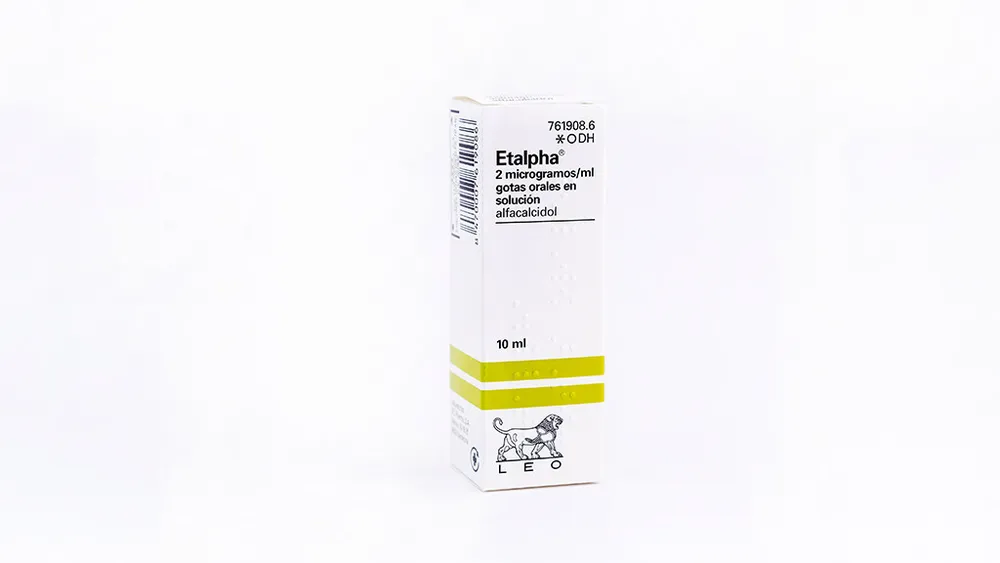
Table of Contents
Package leaflet: Information for the user
Introduction
Package leaflet: information for the user
Etalpha2 micrograms/ml oral drops solution
alfacalcidol
Read the entire leaflet carefully before you start taking this medicine, as it contains important information for you.
- Keep this leaflet, as you may need to read it again.
- If you have any questions, ask your doctor or pharmacist.
- This medicine has been prescribed for you only, and you should not give it to others, even if they have the same symptoms as you, because it may harm them.
- If you experience any adverse effects, consult your doctor or pharmacist, even if they are adverse effects not listed in this leaflet. See section 4.
Leaflet contents
- What Etalpha is and what it is used for
- What you need to know before taking Etalpha
- How to take Etalpha
- Possible side effects
- How to store Etalpha
- Contents of the pack and other information
1. What Etalpha is and what it is used for
Etalpha belongs to a group of medicines called vitamin D analogues that regulate calcium and phosphate levels in your body.
The active substance in Etalpha is alfacalcidol, a form of vitamin D.
Alfacalcidol exerts its effect after being converted into calcitriol (the active form of vitamin D) in the liver.
The medicine is indicated in conditions where there is a disturbance in calcium and phosphate metabolism due to reduced production of 1,25-dihydroxyvitamin D.
2. What you need to know before taking Etalpha
Do not take Etalpha
- if you are allergic to alfacalcidol or to any of the other ingredients of this medicine (listed in section 6).
- if you have high levels of calcium in your blood (hypercalcemia).
Since high levels of calcium in the blood (hypercalcemia) may occur during treatment with Etalpha, you should be aware of the following signs and symptoms of hypercalcemia:
- loss of appetite (anorexia)
- fatigue
- nausea
- vomiting
- constipation or diarrhea
- increased urine production
- sweating
- headache
- thirst
- high blood pressure
- drowsiness
- dizziness
Warnings and precautions
Talk to your doctor or pharmacist before you start taking Etalpha.
Take special care with Etalpha if:
- you have atherosclerosis, calcification of heart valves, or kidney stones (nephrolithiasis). These conditions may worsen if you have high levels of calcium in your blood (hypercalcemia).
- you suffer from calcification of lung tissue.
- you have renal bone disease or any kidney disorder. Phosphate binders may be used to maintain acceptable serum phosphate levels.
- you have inflammatory diseases such as sarcoidosis. These conditions may increase your sensitivity to Etalpha.
- you are being treated with heart medications (cardiac glycosides). If the calcium level in your blood becomes too high (hypercalcemia), using these medicines may cause disturbances in your heart rhythm.
During treatment, your doctor will perform blood tests to monitor your calcium and phosphate levels.
Taking Etalpha with other medicines
Inform your doctor or pharmacist if you are taking, have recently taken, or might need to take any other medicines.
It is important that you inform your doctor if:
-
you are being treated with diuretics, calcium-containing preparations, or other vitamin D-containing preparations, as these may increase the risk of elevated calcium levels in your blood (hypercalcemia).
-
you are being treated with antiepileptic medicines (barbiturates, phenytoin, carbamazepine, or primidone). You may require a higher dose of Etalpha.
-
you are taking antacids containing magnesium, as they may increase the risk of high magnesium levels in your blood (hypermagnesemia).
-
you are being treated with aluminum-containing preparations (such as aluminum hydroxide or sucralfate), as this may increase aluminum absorption.
-
you are taking bile acid sequestrants such as cholestyramine at the same time as Etalpha, as this may interfere with the intestinal absorption of Etalpha. To minimize the possibility of interference, alfacalcidol should be administered at least 1 hour before or 4–6 hours after taking bile acid sequestrants.
Pregnancy and breastfeeding
If you are pregnant, breastfeeding, think you may be pregnant, or plan to become pregnant, consult your doctor or pharmacist before using this medicine.
Etalpha may be used during pregnancy and breastfeeding only if your doctor considers it essential.
Consult your doctor or pharmacist before using any medicine.
Driving and using machines
The effect of Etalpha on the ability to drive and operate machinery is negligible or none.
However, dizziness may occur during treatment, which you should take into account if you drive or operate machinery.
Etalpha contains ethanol, sorbitol, macrogol glycerol hydroxystearate, and methyl parahydroxybenzoate
This medicine contains up to 113 mg of alcohol (ethanol) per dose (corresponding to 2 micrograms of alfacalcidol), equivalent to 14% ethanol (alcohol). The amount in each dose of this medicine is equivalent to less than 3 ml of beer or 1.5 ml of wine.
The small amount of alcohol contained in this medicine does not produce any perceptible effect.
This medicine contains 452 mg of sorbitol per ml, equivalent to 6.5 mg sorbitol/kg/day for an adult (70 kg). Sorbitol is a source of fructose. If your doctor has informed you (or your child) that you have an intolerance to certain sugars, or if you (or your child) have been diagnosed with hereditary fructose intolerance (HFI), a rare genetic disorder in which the patient cannot break down fructose, consult your doctor before taking this medicine.
This medicine may cause stomach discomfort and diarrhea because it contains macrogol glycerol hydroxystearate.
It may cause allergic reactions (possibly delayed) because it contains methyl parahydroxybenzoate.
This medicine contains less than 23 mg of sodium (1 mmol) per ml; therefore, it is essentially “sodium-free”.
3. How to take Etalpha
Follow exactly the instructions given by your doctor for taking this medicine. If in doubt, consult your doctor or pharmacist again.
1 ml or 20 drops of Etalpha oral solution correspond to 2 micrograms of alfacalcidol (1 drop equals 0.1 microgram of alfacalcidol).
Adults and children weighing more than 20 kg:
The initial dose is 1 microgram (0.5 ml) per day, i.e. 10 drops per day.
Children weighing less than 20 kg:
The initial dose is 0.05 micrograms per kg of body weight per day.
The maintenance dose generally ranges between 0.25 and 1 microgram per day.
Your doctor may adjust these doses according to your needs. For this purpose, your doctor may perform blood tests or request other diagnostic tests.
If you take more Etalpha than you should
If you have taken too much Etalpha, you must contact your doctor or pharmacist.
An overdose may lead to high levels of calcium in your blood and urine. Therefore, your doctor may need to carry out appropriate tests.
In case of overdose or accidental ingestion, contact the Toxicology Information Service at telephone number 91 562 04 20, indicating the medicine and the amount taken.
If you forget to take Etalpha
Do not take a double dose to make up for missed doses. Continue as prescribed.
If you stop taking Etalpha
Your doctor will advise you on the duration of your treatment with Etalpha. Do not stop treatment earlier, as this may be harmful to your health.
If you have any further questions about the use of this medicine, ask your doctor or pharmacist.
4. Possible adverse effects
Like all medicines, this medicine may cause adverse effects, although not everyone will experience them.
Frequent adverse effects (may affect up to 1 in 10 patients):
- elevated calcium levels in blood
- excessive levels of phosphate in blood
- abdominal pain and discomfort
- skin rash
- itching
- excess calcium in urine
Uncommon adverse effects (may affect up to 1 in 100 patients):
- confusion
- headache
- diarrhea
- vomiting
- constipation
- nausea
- muscle pain
- worsening of kidney function (including acute renal failure)
- kidney stones
- calcium deposits in the kidneys
- fatigue
- tiredness
- malaise
- calcium deposits in non-bone tissues
Rare adverse effects (may affect up to 1 in 1000 patients):
- dizziness
Reporting of adverse effects
If you experience any type of adverse effect, consult your doctor or pharmacist, even if it is a possible adverse effect not listed in this leaflet. You may also report them directly via the Spanish Pharmacovigilance System for Human Medicines: https://www.notificaram.es. By reporting adverse effects, you can help provide more information on the safety of this medicine.
5. Storage of Etalpha
Keep this medicine out of sight and reach of children.
Store in a refrigerator (between 2°C and 8°C).
Do not use this medicine after the expiry date stated on the packaging after EXP. The expiry date refers to the last day of the month indicated.
Medicines must not be disposed of via wastewater or household waste. Dispose of unused medicines and their containers at the SIGRE collection point at your pharmacy. If you are unsure, ask your pharmacist how to dispose of unused medicines and their packaging. This will help protect the environment.
6. Contents of the pack and other information
Composition of Etalpha
- The active substance is alfacalcidol.
One ml of solution (20 drops) contains 2 micrograms of alfacalcidol.
- The other components are sorbitol (E-420), ethanol, macrogol glycerol hydroxystearate, sodium parahydroxybenzoate (E-218), citric acid monohydrate, all-rac-α-tocopherol and purified water.
Appearance of the medicinal product and contents of the pack
Colorless, transparent or slightly opalescent solution.
Etalpha oral drops solution is supplied in a 10 ml amber glass bottle with a dropper dispenser.
Marketing Authorization Holder
CHEPLAPHARM Arzneimittel GmbH
Ziegelhof 24
17489 Greifswald
Germany
Local representative
Laboratorios Rubió, S.A.
Industria, 29 – Pol. Ind. Comte de Sert
08755 Castellbisbal (Barcelona)
Spain
Manufacturer responsible for batch release
LEO Pharma A/S
Industriparken 55
DK-2750 Ballerup
Denmark
Delpharm Bladel B.V.
Industrieweg 1,
5531AD, Bladel
The Netherlands
Date of the most recent revision of this leaflet: January 2022
Detailed and up-to-date information on this medicinal product is available on the website of the Spanish Agency for Medicines and Health Products (AEMPS) http://www.aemps.gob.es/.