Dzuveo 30 micrograms sublingual tablet
SpainTable of Contents
Patient Information Leaflet
Introduction
Patient Information Leaflet
Dzuveo 30 micrograms sublingual tablet
sufentanil
Read the entire leaflet carefully before you start using this medicine, as it contains important information for you.
- Keep this leaflet, as you may need to read it again.
- If you have any questions, consult your doctor, pharmacist, or nurse.
- If you experience any side effects, consult your doctor, pharmacist, or nurse, even if they are side effects not listed in this leaflet. See section 4.
Leaflet Contents
- What Dzuveo is and what it is used for
- What you need to know before using Dzuveo
- How to use Dzuveo
- Possible side effects
- How to store Dzuveo
- Contents of the pack and other information
1. What Dzuveo is and what it is used for
The active substance in Dzuveo is sufentanil, which belongs to a group of strong pain-relieving medicines called opioids.
Sufentanil is used to treat moderate to severe sudden pain in adults in a medically controlled setting, such as a hospital.
2. What you need to know before using Dzuveo
Do not use Dzuveo
- If you are allergic to sufentanil or to any of the other ingredients of this medicine (listed in section 6).
- If you have severe lung or breathing problems.
Warnings and precautions
Talk to your doctor or nurse before starting to use Dzuveo. Inform your doctor or nurse before treatment if:
- You have any condition affecting your breathing (such as asthma, wheezing, or difficulty breathing). Since Dzuveo may affect your breathing, your doctor or nurse will monitor your respiratory function during treatment.
- You have a head injury or brain tumor.
- You have heart or circulation problems, especially slow heart rate, irregular heartbeat, low blood volume, or low blood pressure.
- You have moderate to severe liver problems or severe kidney problems, as these organs affect how your body breaks down and eliminates the medicine; or if you have abnormally slow intestinal movements.
- You suffer from a disease of the gallbladder or pancreas.
- You or any family member has ever abused or been dependent on alcohol, prescription medicines, or illegal drugs ("addiction").
- You are a smoker.
- You have ever had mood-related problems (depression, anxiety, or a personality disorder) or have been treated by a psychiatrist for other mental illnesses.
This medicine contains sufentanil, which is an opioid. Repeated use of opioid painkillers may cause the medicine to become less effective (your body gets used to them). It may also lead to dependence and abuse, which could result in potentially fatal overdose. It is important that you consult your doctor if you are concerned about becoming dependent on Dzuveo.
Talk to your doctor DURING treatment with Dzuveo if:
- You experience pain or increased sensitivity to pain (hyperalgesia) that does not respond to a higher dose of the medicine as prescribed by your doctor.
What you need to know before using Dzuveo
Sleep-related breathing disorders
- Dzuveo may cause sleep-related breathing disorders such as sleep apnea (pauses in breathing during sleep) and sleep-related hypoxemia (low blood oxygen levels). These symptoms may include pauses in breathing during sleep, waking up at night due to difficulty breathing, difficulty maintaining sleep, or excessive daytime sleepiness. If you or someone else notices these symptoms, contact your doctor. Your doctor may consider reducing your dose.
Children and adolescents
Dzuveo must not be used in children and adolescents under 18 years of age.
Other medicines and Dzuveo
Tell your doctor if you are taking, have recently taken, or might need to take any other medicines. In particular, inform your doctor if you are taking any of the following:
- Ketoconazole, used to treat fungal infections, which may affect how your body breaks down sufentanil.
- Any medicine that may make you drowsy (have a sedative effect), such as sleeping pills, medicines to treat anxiety (e.g., benzodiazepines), tranquilizers, or other opioid medicines, as they could increase the risk of serious breathing problems, coma, and death.
- Medicines used to treat depression known as monoamine oxidase inhibitors (MAOIs). These medicines must not be taken within the previous 2 weeks or concurrently with Dzuveo.
- Medicines used to treat epilepsy, neuropathic pain, or anxiety (gabapentin and pregabalin), as they may increase the risk of opioid overdose and respiratory depression, which could be life-threatening.
- Medicines used to treat depression known as selective serotonin reuptake inhibitors (SSRIs) and serotonin-noradrenaline reuptake inhibitors (SNRIs). Concomitant use of these medicines with Dzuveo is not recommended.
- Other medicines taken sublingually (medicines placed under the tongue where they dissolve) or medicines that act in your mouth (such as nystatin, a liquid or tablets held in the mouth to treat fungal infections), as the effect on Dzuveo has not been studied.
- Opioids commonly prescribed (e.g., morphine, codeine, fentanyl, hydromorphone, oxycodone).
- Medicines used to treat high blood pressure or angina (chest pain), known as calcium channel blockers or beta-blockers, such as diltiazem and nifedipine.
Use of Dzuveo with alcohol
Do not drink alcohol while using Dzuveo. It may increase the risk of serious breathing problems.
Pregnancy and breastfeeding
If you are pregnant or breastfeeding, think you may be pregnant, or plan to become pregnant, consult your doctor before taking this medicine.
Dzuveo must not be used during pregnancy or in women of childbearing potential who are not using effective contraception.
Dzuveo passes into breast milk and may cause adverse effects in the breastfed infant. Breastfeeding is not recommended while taking Dzuveo.
Driving and using machines
Dzuveo affects your ability to drive or operate machinery, as it may cause drowsiness, dizziness, or visual disturbances. You must not drive or operate machinery if you experience any of these symptoms during or after treatment with sufentanil. You should only drive or operate machinery after a sufficient amount of time has passed since your last dose of Dzuveo.
Dzuveo contains sodium
This medicine contains less than 1 mmol of sodium (23 mg) per tablet; essentially "sodium-free".
3. How to use Dzuveo
This medicine must be administered by a doctor or nurse using the single-dose delivery device. You must not administer this medicine to yourself.
Dzuveo should only be used in a medically controlled setting, such as a hospital. It may only be prescribed by physicians experienced in the use of potent analgesics such as sufentanil and who are familiar with its potential effects on you, particularly on your breathing (see "Warnings and precautions" above).
The recommended dose is one 30 microgram sublingual tablet administered no more frequently than every hour. A healthcare professional will administer the sublingual tablet using the disposable single-dose applicator. The applicator will assist the healthcare professional in placing a tablet under your tongue. The tablets dissolve under the tongue and must not be chewed or swallowed, as they will not be effective in relieving pain unless dissolved under the tongue. You must not eat or drink anything and should speak as little as possible for 10 minutes after each dose is administered.
After receiving a dose, you will not be given another dose until at least one hour has passed. The maximum daily dose is 720 micrograms per day (24 tablets per day).
Dzuveo must not be used for longer than 48 hours.
After your treatment, medical staff will dispose of the applicator appropriately.
If you use more Dzuveo than you should
Symptoms of overdose include serious breathing problems, such as slow and shallow breathing, loss of consciousness, extremely low blood pressure, collapse, and muscle rigidity. If these symptoms begin to occur, inform a doctor or nurse immediately.
If you have any further questions about the use of this medicine, ask your doctor or nurse.
4. Possible adverse effects
Like all medicines, this medicine can cause adverse effects, although not everyone experiences them.
Serious adverse effects
The most serious adverse effects are severe breathing problems, such as slow and shallow breathing, which may even cause you to stop breathing.
If you experience any of the adverse effects mentioned above, inform your doctor or nurse immediately.
Very common adverse effects (may affect more than 1 in 10 people):
Nausea, vomiting or feeling sick, and general sensation of warmth.
Common adverse effects (may affect up to 1 in 10 people):
- Inability or difficulty to sleep, anxiety or confusion, dizziness.
- Headache, drowsiness, feeling sleepy.
- Increased heart rate, high blood pressure, low blood pressure.
- Low levels of oxygen in the blood, sensation of pain in the lower part of the throat, slow and shallow breathing.
- Dry mouth, flatulence (gas), constipation, indigestion or reflux.
- Allergic reactions, skin itching.
- Muscle contractions and spasms.
- Inability to urinate.
- This medicine may also cause changes in levels of red blood cells, white blood cells, calcium, albumin, potassium, and sodium in the blood, which can only be detected by a blood test. If you are to have a blood test, make sure your doctor knows you are taking this medicine.
Uncommon adverse effects (may affect up to 1 in 100 people):
-
Inflammation of the lungs, redness and inflammation of the eyes, inflammation of the throat.
-
Accumulation of fat under the skin.
-
Inability to control blood sugar (diabetes), increased cholesterol.
-
Restlessness, lack of interest or emotion, lack of energy, disorientation, euphoria, hallucinations or seeing things that are not there, nervousness.
-
Problems with coordination of muscle movements, muscle contractions, tremors or excessive restlessness, exaggerated reflex responses, burning sensation, feeling faint, abnormal skin sensation (tingling), general numbness, fatigue, forgetfulness, migraine, tension headache.
-
Vision disorders, eye pain.
-
Decreased heart rate, irregular heartbeat, angina or other chest discomfort.
-
High or low blood pressure upon standing, skin flushing.
-
Slow or difficult breathing (even while sleeping), nosebleed, hiccups.
-
Chest pain and difficulty breathing caused by a blood clot in the lung, fluid in the lungs, wheezing.
-
Diarrhea, belching, inflammation of the stomach lining or gastritis, gas, acid reflux, retching, stomach pain or stomach discomfort.
-
Appearance of blisters, excessive sweating, skin rash, dry skin, numbness of the mouth or face.
-
Back, chest or other body pain, pain in the limbs.
-
Difficulty urinating, strong-smelling urine, pain when urinating, kidney failure.
-
Swelling, uncomfortable sensations in the chest, chills, and weakness (lack of energy).
This medicine may also cause changes in levels of platelets (which help blood clotting), magnesium, proteins, sugar, fats, phosphates, and plasma in the blood, which can only be identified by a blood test. If you are to have a blood test, make sure your doctor knows you are taking this medicine.
Frequency not known (cannot be estimated from available data):
- Severe allergic reactions (anaphylactic shock), seizures, coma, small pupil size, skin redness.
- Withdrawal syndrome, which may include symptoms such as restlessness, anxiety, muscle aches, insomnia, sweating, and yawning.
Reporting of adverse effects
If you experience any type of adverse effect, consult your doctor or nurse, even if it is a possible adverse effect not listed in this leaflet. You may also report them directly through the national reporting system included in Appendix V. By reporting adverse effects, you can help provide more information on the safety of this medicine.
5. Storage of Dzuveo
Keep this medicine out of the sight and reach of children. Your doctor or nurse will ensure that:
- this medicine is not used after the expiry date stated on the label and on the packaging after EXP. The expiry date refers to the last day of the month indicated.
- it is stored in the original packaging to protect it from light and oxygen.
- you do not use this medicine if you notice any signs of deterioration.
Medicines must not be disposed of via wastewater or household waste. Your healthcare professional will dispose of unused medicines and their packaging in accordance with hospital regulations. This helps to protect the environment.
6. Contents of the pack and other information
Composition of Dzuveo
- The active substance is sufentanil. Each sublingual tablet contains 30 micrograms of sufentanil (as citrate).
- The other components are mannitol (E421), calcium hydrogen phosphate, hypromellose, sodium croscarmellose, indigo carmine (E132), stearic acid, and magnesium stearate.
Appearance of the product and contents of the pack
Dzuveo is a flat, blue sublingual tablet with rounded edges. It measures 3 mm in diameter and is supplied in a single-dose applicator (labelled with [sublingual tablet]). The applicator, containing the tablet, is enclosed in a pouch.
Each pouch contains one applicator and one 30-microgram sufentanil tablet. Each package contains 5 or 10 pouches.
Only certain pack sizes may be marketed.
Marketing Authorisation Holder and Manufacturer
Laboratoire Aguettant
1, rue Alexander Fleming
69007 Lyon
France
Date of the most recent revision of this leaflet:
<------------------------------------------------------------------------------------------------------------------------>
This information is intended for healthcare professionals only:
Instructions for use of the single-dose applicator (SDA)
Single-use product / Do not reuse
Do not use if the seal of the pouch is broken
Do not use if the single-dose applicator (SDA) is damaged
Patients must be instructed not to chew or swallow the tablet.
Patients must be advised not to eat or drink anything and to speak as little as possible for 10 minutes following administration of the tablet.
- When ready to administer the medication, open the pouch along the cut line at the top. The pouch contains a transparent plastic single-dose applicator (SDA) with a blue tablet housed at its tip, and an oxygen-absorbing sachet. The oxygen-absorbing sachet should be discarded.
The contents of the pouch are shown below:
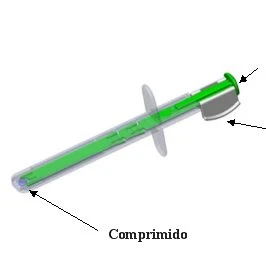
Plunger
Locking system
- Remove the white locking system from the green plunger by pressing both sides simultaneously to detach it from the plunger. Discard the locking system.
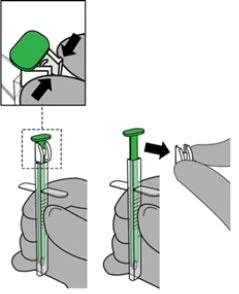
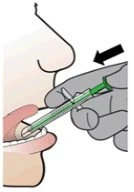
- Instruct the patient to touch the palate with the tongue, if possible.
- Gently rest the SDA against the patient's teeth or lips.
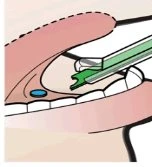
- Place the tip of the SDA under the patient's tongue, orienting it toward the floor of the mouth. NOTE: Avoid direct contact between the mucosa and the tip of the SDA.
- Press the green plunger to release the tablet into the patient's sublingual space and confirm correct placement of the tablet.
The single-dose applicator (SDA) must be disposed of in accordance with local facility policies and regulatory requirements.