Balversa 5 mg film-coated tablets
Spain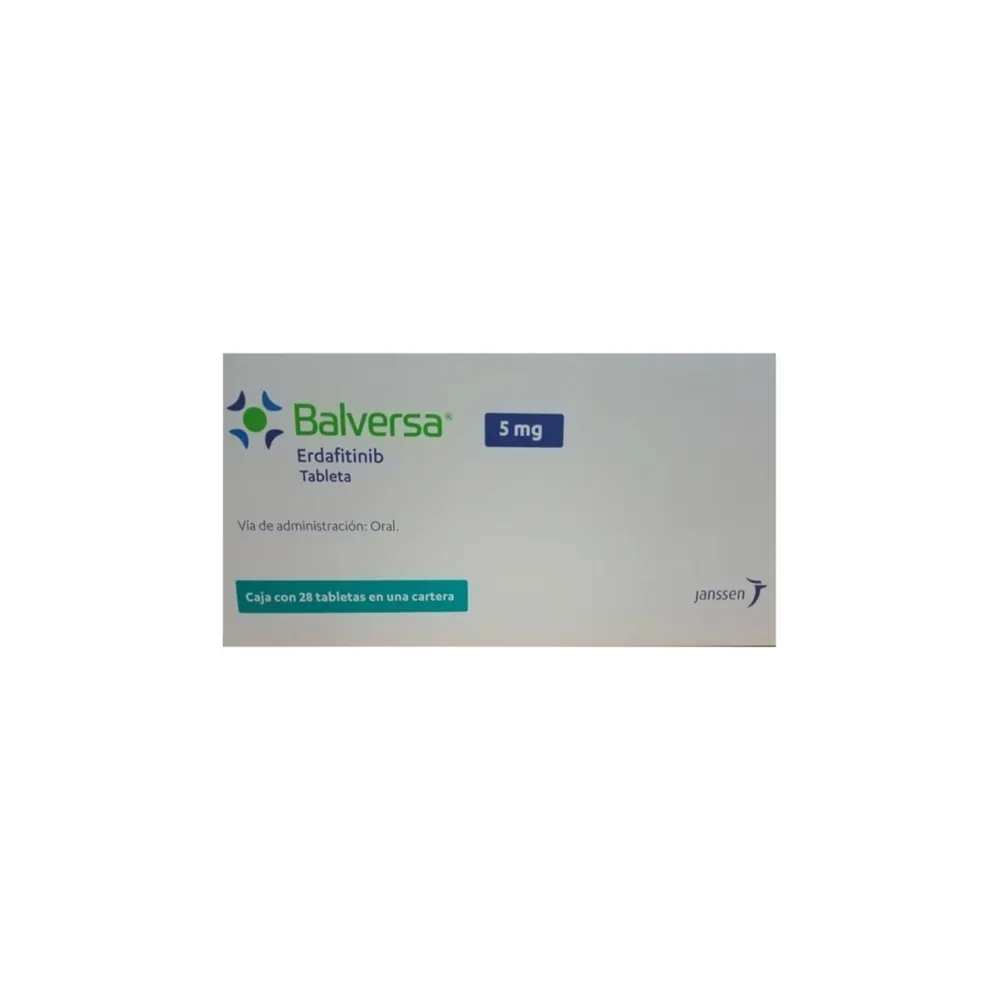
Table of Contents
Patient Information Leaflet
Introduction
Patient Information Leaflet
Balversa 3 mg film-coated tablets
Balversa 4 mg film-coated tablets
Balversa 5 mg film-coated tablets
erdafitinib
This medicinal product is subject to additional monitoring, which will allow quicker detection of new safety information. You can help by reporting any side effects you may experience. Information on how to report side effects is included at the end of section 4.
Read this entire leaflet carefully before you start taking this medicine, as it contains important information for you.
- Keep this leaflet, as you may need to refer to it again.
- If you have any questions, consult your doctor or pharmacist.
- This medicine has been prescribed for you only and must not be given to other people, even if they have the same symptoms as you, since it may harm them.
- If you experience any side effects, consult your doctor or pharmacist, even if they are side effects not listed in this leaflet. See section 4.
Leaflet Contents
- What Balversa is and what it is used for
- What you need to know before taking Balversa
- How to take Balversa
- Possible side effects
- How to store Balversa
- Contents of the pack and other information
1. What Balversa is and what it is used for
Balversa is an anticancer medicine that contains the active substance erdafitinib. It belongs to a group of medicines called tyrosine kinase inhibitors.
Balversa is used in adults for the treatment of locally advanced (spread to nearby tissues) and unresectable (cannot be removed by surgery) or metastatic (has spread to other parts of the body) urothelial carcinoma (bladder and urinary tract cancer).
It is used when the cancer:
- has specific alterations in the fibroblast growth factor receptor 3 gene (FGFR3), and
- has worsened after treatment with immunotherapy.
Balversa should only be used if cancer cells have changes in the FGFR3 gene. Before starting treatment, your doctor will carry out tests to determine whether you have such FGFR3 gene alterations to ensure this medicine is suitable for you.
The active substance in Balversa, erdafitinib, works by blocking proteins called FGFR tyrosine kinases. This helps slow down or stop the growth of cancer cells that have abnormal FGFR3 receptors due to changes in the FGFR3 gene.
2. What you need to know before starting Balversa
Do not take Balversa
- if you are allergic to erdafitinib or to any of the other components of this medicine (listed in section 6).
Warnings and precautions
Talk to your doctor before starting Balversa if:
- you have elevated phosphate levels in your blood
- you have vision or eye problems
- you are pregnant
- you are a woman of childbearing potential
Eye problems (vision)
Balversa increases the risk of developing central serous retinopathy (CSR; a condition in which fluid accumulates and separates the macula—the central part of the retina located at the back of the eye—causing blurred or distorted vision). The risk of CSR is higher in people aged 65 years and older.
- Before starting treatment with Balversa, you will undergo a comprehensive eye examination, including tests to assess your vision, retina, and eye structure.
- Your doctor will closely monitor your eyes with monthly eye exams during the first 4 months of treatment, and then every 3 months thereafter.
- If you experience any abnormal vision symptoms, your doctor will perform an urgent eye examination.
- Inform your doctor immediately if you develop symptoms of CSR, such as blurred vision or reduced peripheral vision (side vision), a dark spot in your central vision, distorted central vision where lines appear wavy or bent, objects appearing smaller or farther away than they actually are, faded colors, floaters or spots moving across your visual field, flashes of light, or a sensation of looking through a curtain. See also section 4, “Most important side effects.”
- If you develop CSR during treatment with Balversa, your doctor may need to temporarily interrupt your treatment. Your treatment will be permanently discontinued if symptoms do not resolve within 4 weeks or if they are severe.
During treatment with Balversa, you should regularly use eye drops or gels to prevent and treat dry eyes.
Elevated phosphate levels in the blood (hyperphosphatemia)
Balversa may cause increased phosphate levels (hyperphosphatemia) in the blood. This is a known side effect of Balversa that usually occurs within the first few weeks of starting treatment. This may lead to mineral accumulation, such as calcium, in soft tissues, cutaneous calcinosis (calcium buildup in the skin causing hard nodules and lumps), and non-uremic calcinosis (a rare skin condition causing painful skin ulcers due to calcium accumulation in blood vessels).
-
Your doctor will monitor your blood phosphate levels during treatment. You may be advised to limit intake of foods high in phosphate and avoid taking other medications that could increase phosphate levels.
-
Vitamin D supplements are not recommended during treatment with Balversa, as they may also contribute to increased phosphate and calcium levels.
-
If your blood phosphate levels become too high, your doctor may recommend taking a medication to help control them.
-
If you have high phosphate levels in your blood, your doctor may need to adjust your dose of Balversa or interrupt treatment with Balversa.
-
Inform your healthcare provider immediately if you experience any of the following symptoms, which may be signs of hyperphosphatemia:
-
painful skin lesions
-
muscle cramps
-
numbness, or
-
tingling around the mouth.
Skin disorders
While taking Balversa, you may experience itching, dryness, or redness of the skin, swelling, peeling, or tenderness to touch, especially on the hands or feet (palmar-plantar erythrodysesthesia). You should monitor your skin and avoid unnecessary exposure to sunlight, excessive use of soap, and prolonged bathing. Use moisturizing products regularly and avoid perfumed products.
Photosensitivity
While taking Balversa, you may become more sensitive to sunlight. This may cause skin damage. You should be cautious and take precautions when outdoors in the sun. Precautions may include wearing protective clothing and using sunscreen to protect against harmful UV rays.
Nail disorders
While taking Balversa, you may experience nails separating from the nail bed, infection of the skin around the nails, or nail discoloration. You should monitor your nails for signs of infection and practice preventive nail care, such as maintaining good hygiene and using over-the-counter nail hardeners.
Mucosal disorders
While taking Balversa, you may experience dryness or sores in the mouth. You should practice good oral hygiene and avoid spicy or acidic foods while taking Balversa.
Children and adolescents
This medicine should not be used in children or adolescents, as there is no experience with the use of Balversa in this age group.
Other medicines and Balversa
Tell your doctor or pharmacist if you are taking, have recently taken, or might need to take any other medicines. Taking Balversa together with other medicines may affect how Balversa works and may cause side effects.
The following medicines may reduce the effectiveness of Balversa by decreasing the amount of Balversa in the blood:
- carbamazepine (used to treat epilepsy)
- rifampicin (used to treat tuberculosis)
- phenytoin (used to treat epilepsy)
- St. John’s wort (used to treat depression)
The following medicines may increase the risk of Balversa side effects by increasing the amount of Balversa in the blood:
- fluconazole (used to treat fungal infections)
- itraconazole (used to treat fungal infections)
- ketoconazole (used to treat fungal infections)
- posaconazole (used to treat fungal infections)
- voriconazole (used to treat fungal infections)
- miconazole (used to treat fungal infections)
- ceritinib (used to treat lung cancer)
- clarithromycin (used to treat infections)
- telithromycin (used to treat infections)
- elvitegravir (used to treat HIV)
- ritonavir (used to treat HIV)
- paritaprevir (used to treat hepatitis)
- saquinavir (used to treat HIV)
- nefazodone (used to treat depression)
- nelfinavir (used to treat HIV)
- tipranavir (used to treat HIV)
- lopinavir (used to treat HIV)
- amiodarone (used to treat arrhythmias)
- piperine (used as a supplement)
Balversa may increase the risk of side effects from other medicines by increasing the amount of these medicines in the blood. These include:
- midazolam (used to treat seizures)
- hormonal contraceptives
- colchicine (used to treat gout)
- digoxin (used to treat certain arrhythmias or heart failure)
- dabigatran (used as an anticoagulant)
- apixaban (used as an anticoagulant)
Taking Balversa with food
Do not take Balversa with grapefruit or bitter orange, including eating them, drinking their juice, or taking a supplement containing them. This is because they may increase the amount of Balversa in your blood.
Pregnancy, contraception, and breastfeeding
If you are pregnant or breastfeeding, think you may be pregnant, or plan to become pregnant, consult your doctor before using this medicine.
Information for women
-
Pregnancy
-
Balversa may harm the unborn baby.
-
Do not use Balversa during pregnancy unless your doctor advises otherwise.
-
You must not become pregnant during treatment with Balversa or for 1 month after the last dose of Balversa.
-
Inform your doctor immediately if you become pregnant.
-
Pregnancy test
-
Your doctor must perform a pregnancy test before starting treatment with Balversa.
-
Contraception
-
Balversa may reduce the effectiveness of certain contraceptive methods. Talk to your doctor about suitable contraceptive methods while taking Balversa. Women who can become pregnant must use highly effective contraception during treatment and for at least 1 month after stopping Balversa.
-
Breastfeeding
-
Breastfeeding must be discontinued during treatment with Balversa and for 1 month after the last dose of this medicine.
Information for men
Men must use an effective method of contraception (e.g., condom) during treatment with Balversa and for 1 month after the last dose. In addition, men must not donate or store semen during treatment or for 1 month after the last dose.
Driving and using machines
Eye problems have been reported in patients treated with Balversa. If you experience vision problems, do not drive or operate tools or machinery until your vision returns to normal.
Balversa contains sodium
This medicine contains less than 1 mmol of sodium (23 mg) per tablet; hence, it is essentially “sodium-free.”
3. How to take Balversa
Follow exactly the instructions for taking this medicine as given by your doctor or pharmacist. If in doubt, consult your doctor or pharmacist.
How much to take
Your doctor will determine the dose and frequency with which you should take this medicine.
-
The recommended starting dose of Balversa is 8 mg taken orally once daily.
-
You may need to take one 5 mg tablet and one 3 mg tablet, or two 4 mg tablets to achieve this dose.
After approximately 2 weeks of treatment with Balversa, your doctor will perform a blood test to check the level of phosphate in your blood.
- Depending on the results of this blood test and whether or not you are experiencing adverse effects, your doctor may increase your dose to 9 mg per day.
Your doctor may also decide to reduce the dose if you experience certain adverse effects, such as mouth sores, redness, swelling, peeling or tenderness, especially in the hands or feet, separation of the nails from their beds, or elevated levels of phosphate in the blood.
How to take this medicine
- Swallow the Balversa tablets whole.
- You may take this medicine with or without food.
- Try to take this medicine at the same time each day. This will help you remember to take it.
- If you vomit, do not take another tablet. Take your next dose at the usual time the following day.
If you take more Balversa than you should
If you take more Balversa than you should, call your doctor or go immediately to the nearest hospital emergency department.
If you forget to take Balversa
- If you forget to take a dose, take it as soon as possible on the same day. Take your next dose of Balversa at the usual time the following day.
- Do not take a double dose to make up for forgotten doses.
If you stop taking Balversa
Do not stop taking this medicine unless instructed by your doctor.
If you have any further questions about the use of this medicine, ask your doctor.
4. Possible adverse effects
Like all medicines, this medicine can cause adverse effects, although not everyone will experience them.
Most important adverse effects
Inform your doctor immediately if you notice any of the following serious adverse effects:
Central serous retinopathy (very common: may affect more than 1 in 10 people)
The following symptoms may be signs of CSR:
- blurred vision or reduced peripheral (side) vision
- a dark spot in the central vision
- distorted central vision, where lines may appear wavy or bent
- objects appear smaller or farther away than they actually are
- colors appear faded
- floaters or spots moving across your field of vision, flashes of light, or a sensation of looking through a curtain
Hyperphosphatemia (very common: may affect more than 1 in 10 people)
The following symptom may be a sign of hyperphosphatemia:
- elevated blood phosphate levels
Nail disorders (very common: may affect more than 1 in 10 people)
The following symptoms may be signs of nail disorders:
- nails separating from the nail bed (onycholysis)
- infected skin around the nail (paronychia)
- nail malformation (nail disorder)
- change in nail color
Skin disorders (very common: may affect more than 1 in 10 people)
The following symptoms may be signs of skin disorders:
- redness, swelling, peeling, or tenderness, especially in the hands or feet (palmar-plantar erythrodysesthesia)
- hair loss (alopecia)
- dry skin
Mucosal disorders (very common: may affect more than 1 in 10 people)
The following symptoms may be signs of mucosal disorders:
- mouth sores (stomatitis)
- dry mouth
Inform your doctor immediately if you notice any of the above signs of central serous retinopathy, hyperphosphatemia, nail disorders, skin disorders, or mucosal disorders.
Your doctor may ask you to stop taking Balversa or refer you to a specialist if you develop eye or vision problems.
Other adverse effects may occur with the following frequencies:
Very common (may affect more than 1 in 10 people):
- diarrhea
- decreased appetite
- altered sense of taste with a metallic, sour, or bitter taste in food (dysgeusia)
- weight loss
- constipation
- feeling dizzy (nausea)
- vomiting
- stomach pain
- dry eyes
- feeling weak and extremely tired
- low sodium levels in the blood (hyponatremia)
- increased levels of creatinine in the blood (elevated creatinine)
- increased levels of the liver enzyme alanine aminotransferase in the blood (elevated ALT)
- increased levels of the liver enzyme aspartate aminotransferase in the blood (elevated AST)
- low red blood cell count (anemia)
- nosebleeds (epistaxis)
Common (may affect up to 1 in 10 people):
- painful nails
- formation of ridges in the nails or nail breakage
- very dry skin
- cracked, thickened, or peeling skin
- itching or itchy skin rash (eczema)
- abnormal skin growth or appearance
- skin rash
- dry or inflamed eyes (conjunctivitis)
- ulcers or inflammation of the front part of the eye (cornea)
- cloudy vision (cataract)
- red and swollen eyelids
- excessive tearing
- high levels of calcium in the blood
- low levels of phosphate in the blood
- dry nose
- indigestion (dyspepsia)
- sudden decrease in kidney function
- elevated levels of parathyroid hormone (PTH) (hyperparathyroidism)
- kidney failure
- kidney problems (renal dysfunction)
- liver damage (hepatic cytolysis)
- abnormal liver function
- elevated bilirubin levels in the blood
Uncommon (may affect up to 1 in 100 people):
- bleeding under the nail
- discomfort or pain in the nails
- skin reaction
- thinning of the skin
- redness of the palms of the hands
- dryness of mucous membranes (including nose, mouth, eyes, vagina)
- calcium deposits in blood vessels which may cause blood clots, skin ulcers, and serious infections
Inform your doctor if you experience any of the adverse effects listed above.
Reporting of adverse effects
If you experience any adverse effect, talk to your doctor, even if it is a possible adverse effect not listed in this leaflet. You can also report them directly through the national reporting system detailed in Appendix V. By reporting adverse effects, you can help provide more information on the safety of this medicine.
5. Storage of Balversa
Keep this medicine out of the sight and reach of children.
Do not use this medicine after the expiry date stated on the carton and on the bottle after “EXP”. The expiry date refers to the last day of the month indicated.
This medicine does not require any special storage conditions.
Do not use this medicine if the packaging is damaged or shows signs of tampering.
Medicines must not be disposed of via wastewater or household waste. Ask your pharmacist how to dispose of medicines and packaging that you no longer need. This will help protect the environment.
6. Contents of the container and other information
Composition of Balversa
-
The active substance is erdafitinib.
-
Each film-coated tablet contains 3 mg, 4 mg or 5 mg of erdafitinib.
-
The other components are:
-
Tablet core: Sodium croscarmellose, magnesium stearate (E572), mannitol (E421), meglumine and microcrystalline cellulose (E460).
-
Film coating (Opadry amb II): Glyceryl monocaprylocaprate type I, partially hydrolysed polyvinyl alcohol, sodium lauryl sulphate, talc, titanium dioxide (E171), yellow iron oxide (E172), red iron oxide (E172) (only for 4 mg and 5 mg tablets), black iron oxide (E172) (only for 5 mg tablets).
Appearance of Balversa and contents of the pack
Balversa 3 mg film-coated tablets are yellow, round, biconvex, engraved with “3” on one side and “EF” on the other.
Balversa 4 mg film-coated tablets are orange, round, biconvex, engraved with “4” on one side and “EF” on the other.
Balversa 5 mg film-coated tablets are brown, round, biconvex, engraved with “5” on one side and “EF” on the other.
Balversa film-coated tablets are supplied in a child-resistant container. Only certain pack sizes may be marketed.
Bottle:
The tablets are supplied in a plastic bottle with a child-resistant closure. Each bottle may contain 28, 56 or 84 film-coated tablets. Each cardboard box contains one bottle.
3 mg tablet:
- Each cardboard box containing 56 film-coated tablets contains one bottle with 56 tablets.
- Each cardboard box containing 84 film-coated tablets contains one bottle with 84 tablets.
4 mg tablet:
- Each cardboard box containing 28 film-coated tablets contains one bottle with 28 tablets.
- Each cardboard box containing 56 film-coated tablets contains one bottle with 56 tablets.
5 mg tablet:
- Each cardboard box containing 28 film-coated tablets contains one bottle with 28 tablets.
Marketing Authorization Holder
Janssen-Cilag International NV
Turnhoutseweg 30
B-2340 Beerse
Belgium
Manufacturer
Janssen Cilag SpA
Via C. Janssen,
Borgo San Michele
Latina 04100
Italy
For more information about this medicinal product, please contact the local representative of the Marketing Authorization Holder:
Belgium/Belgium/Belgium Janssen-Cilag NV Tel/Tel: +32 14 64 94 11 | Lithuania UAB "JOHNSON & JOHNSON" Tel: +370 5 278 68 88 |
| Luxembourg/Luxembourg Janssen-Cilag NV Tel/Tel: +32 14 64 94 11 |
Czech Republic Janssen-Cilag s.r.o. Tel: +420 227 012 227 | Hungary Janssen-Cilag Kft. Tel.: +36 1 884 2858 |
Denmark Janssen-Cilag A/S Tlf.: +45 4594 8282 | Malta AM MANGION LTD Tel: +356 2397 6000 |
Germany Janssen-Cilag GmbH Tel: 0800 086 9247 / +49 2137 955 6955 | Netherlands Janssen-Cilag B.V. Tel: +31 76 711 1111 |
Estonia UAB "JOHNSON & JOHNSON" Estonia branch Tel: +372 617 7410 | Norway Janssen-Cilag AS Tlf: +47 24 12 65 00 |
Greece Janssen-Cilag Pharmaceutical Representative S.A.I.C. Tel: +30 210 80 90 000 | Austria Janssen-Cilag Pharma GmbH Tel: +43 1 610 300 |
Spain Janssen-Cilag, S.A. Tel: +34 91 722 81 00 | Poland Janssen-Cilag Polska Sp. z o.o. Tel.: +48 22 237 60 00 |
France Janssen-Cilag Tel: 0 800 25 50 75 / +33 1 55 00 40 03 | Portugal Janssen-Cilag Farmacêutica, Lda. Tel: +351 214 368 600 |
Croatia Johnson & Johnson S.E. d.o.o. Tel: +385 1 6610 700 | Romania Johnson & Johnson România SRL Tel: +40 21 207 1800 |
Ireland Janssen Sciences Ireland UC Tel: 1 800 709 122 | Slovenia Johnson & Johnson d.o.o. Tel: +386 1 401 18 00 |
Iceland Janssen-Cilag AB c/o Vistor hf. Tel: +354 535 7000 | Slovakia Johnson & Johnson, s.r.o. Tel: +421 232 408 400 |
Italy Janssen-Cilag SpA Tel: 800.688.777 / +39 02 2510 1 | Finland/Finland Janssen-Cilag Oy Tel/Tel: +358 207 531 300 |
Cyprus Barnabas Hadjipanagis Ltd Tel: +357 22 207 700 | Sweden Janssen-Cilag AB Tfn: +46 8 626 50 00 |
Latvia UAB "JOHNSON & JOHNSON" Latvia branch Tel: +371 678 93561 |
Date of the most recent review of this leaflet:
Detailed information on this medicine is available on the European Medicines Agency website: https://www.ema.europa.eu.